Qasr Al Hosn
Coral-stone watchtower of the 1760s, expanded about 1793 or 1795 and enclosed by an outer palace in 1939. Conservation removed a later white render that trapped corrosive moisture against the coral bricks.

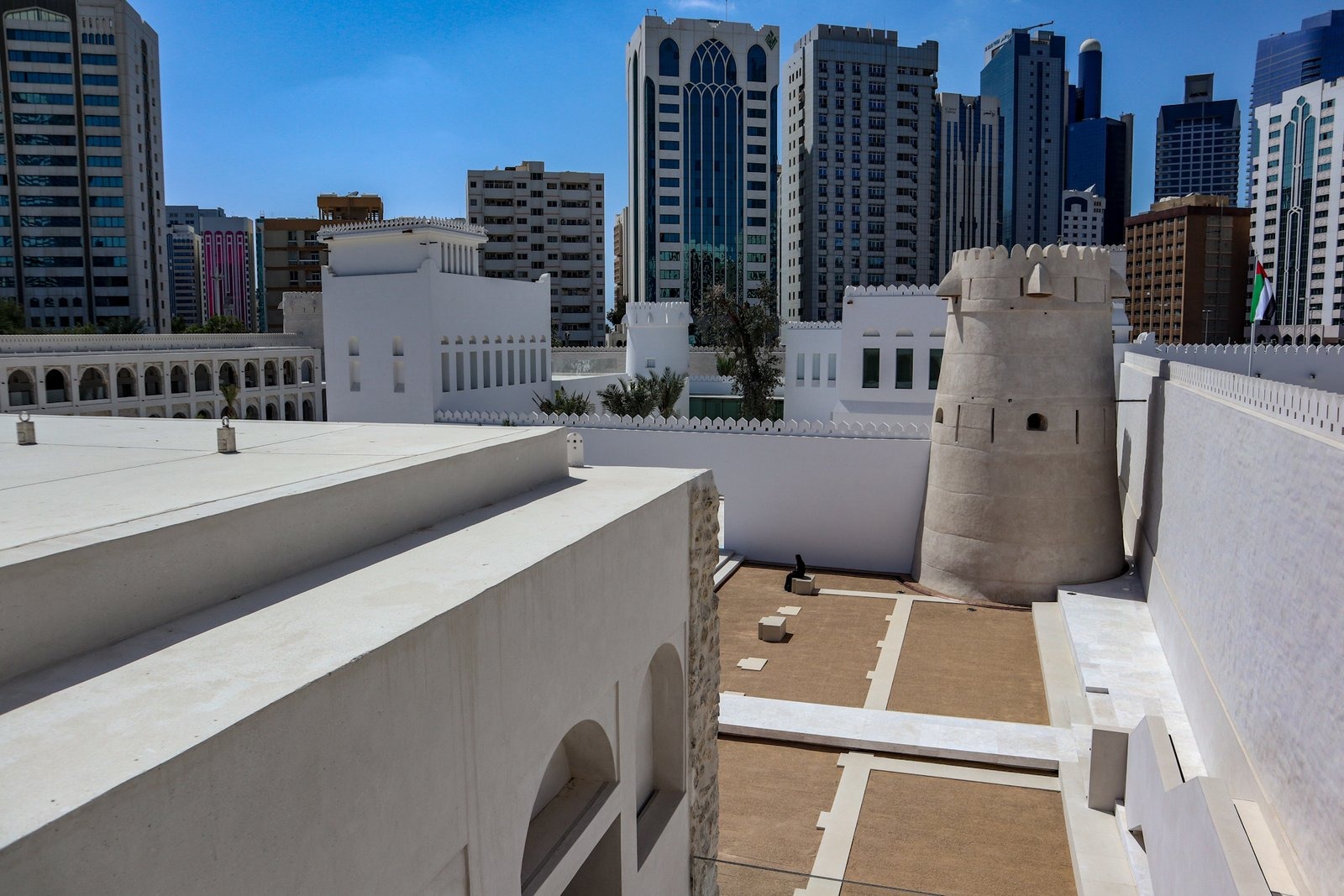
A watchtower raised to guard a freshwater source, the oil-era palace around it and the buildings that followed.
Listen to one stop before you buy
Photo: Aeroid (CC BY-SA 4.0)
Abu Dhabi's story starts with Qasr Al Hosn: around 1761 a freshwater source was found on the island, and Sheikh Dhiyab bin Isa had a watchtower built to guard it. Oil was found offshore in 1958 and first exported in 1962, and in 1971 Sheikh Zayed led the federation of the United Arab Emirates with Abu Dhabi as capital. The guide follows how that history turned into stone and glass.
The tour has 11 stops, grouped in three districts far apart: the old city centre with the Corniche, the Ras Al Akhdar headland, and the mosque and museums on Saadiyat Island. The stops lie many kilometres apart, and each narration plays on foot at its stop. Stops include the Cultural Foundation, Heritage Village, Emirates Palace, Qasr Al Watan, Wahat Al Karama, the Louvre, the Zayed National Museum and the Abrahamic Family House. The guide plays in the browser, starts each stop by GPS and works offline once downloaded.
Coral-stone watchtower of the 1760s, expanded about 1793 or 1795 and enclosed by an outer palace in 1939. Conservation removed a later white render that trapped corrosive moisture against the coral bricks.
Opened in 1981 by The Architects' Collaborative, the firm Walter Gropius founded. It closed in 2008 for a decade of renovation and reopened in 2018, with turquoise and orange glazed tiles on its colonnades.
A reconstructed pre-oil settlement with barasti huts, a replica souq and a falaj irrigation display. The guide is clear that these are reconstructions and explains why fishing and pearling were the island's economy until the pearl trade collapsed.
Built between 2001 and 2005 on reclaimed land as a government guest palace as well as a hotel. The Grand Atrium dome is 72.6 metres high, and the beach sand was imported from Algeria.
Built from 2010 to 2017 and opened to the public in March 2019. Its Great Hall is 100 by 100 metres under a 37-metre dome, and the Spirit of Collaboration room is circular so no leader is visually raised above the others.
Construction began on 5 November 1996 and the mosque opened in 2007. The guide covers its arcades of more than 1,000 columns, four corner minarets and the mausoleum of Sheikh Zayed, who died in 2004.
A national memorial opened in 2016 with 31 leaning tablets by the artist Idris Khan. Names of the fallen are engraved on more than 2,700 plates cast from recycled aluminium from decommissioned armoured vehicles.
Jean Nouvel's dome, about 180 metres across, is built from eight layers with 7,850 stars that make a 'rain of light'. The museum grew from a 2007 agreement with France and opened in November 2017.
Only at each stop. The guide places the stops in three districts many kilometres apart, and each narration plays where you arrive on foot, starting by GPS when you reach its stop.
The oldest building in the city: a coral-stone watchtower from the 1760s, later a fort, then a palace and the ruler's residence. After a period as a national archive, it is now a museum of Abu Dhabi's heritage.
Three houses of worship, a mosque, a church and a synagogue, share a garden and forum, each in an identical concrete cube. Designed by David Adjaye and opened in 2023, it grew out of the 2019 Document on Human Fraternity.
Qasr Al Hosn and the Cultural Foundation date from earlier eras, while Heritage Village is a reconstruction. Emirates Palace, Qasr Al Watan, the Grand Mosque, the Louvre and the Zayed National Museum are late twentieth century or later.
Yes. The guide gives its construction dates, the workforce of over 3,000, the materials, the Pietra dura columns and its dome layout. The neighbouring Wahat Al Karama memorial is its own stop.
No, once you have downloaded the tour. It plays in the phone's browser with no app to install, and GPS starts each stop as you arrive.