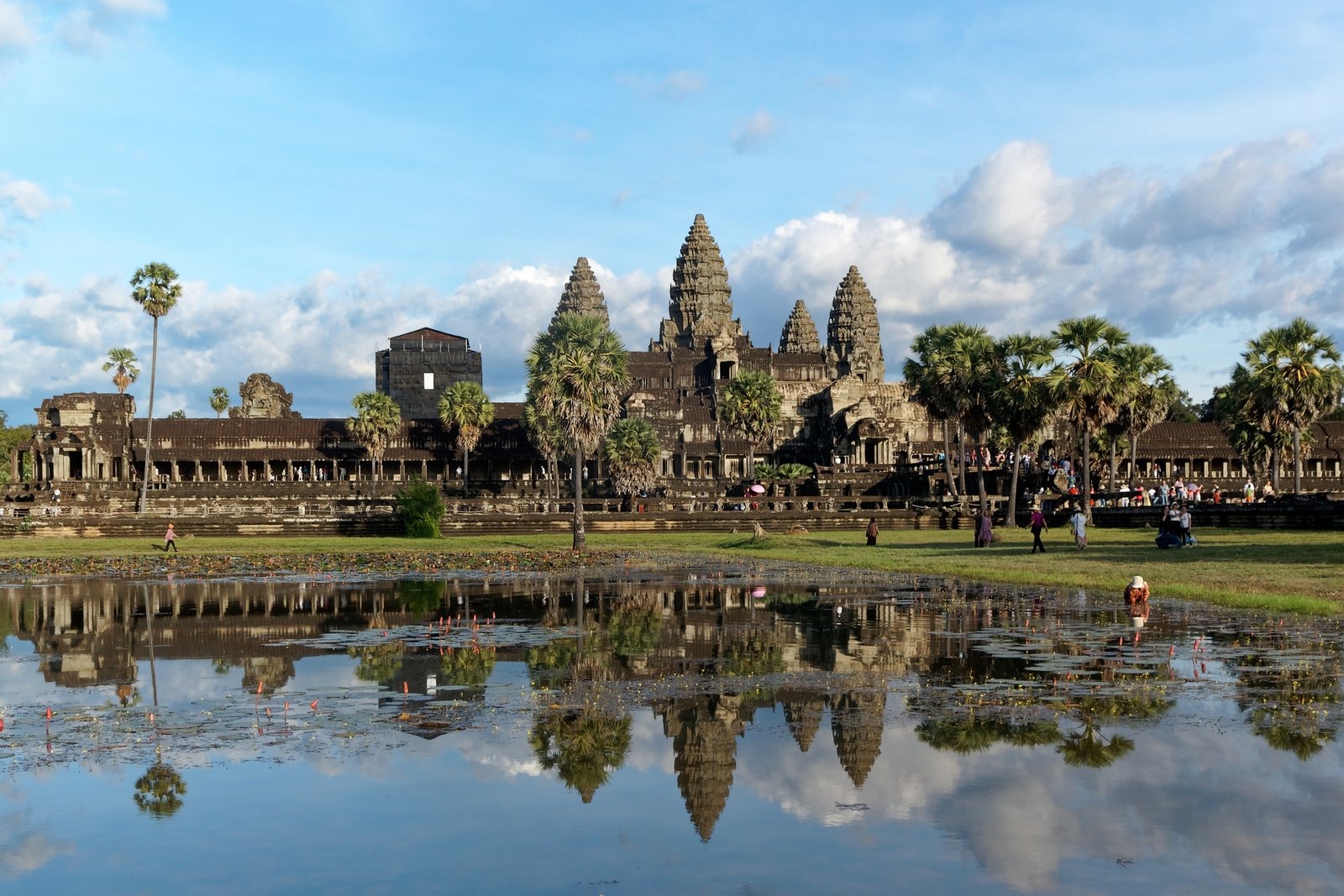
Moat and western causeway
The rectangular moat measures about 1.5 kilometers east to west and 1.3 north to south, and helped steady the foundations by moderating groundwater. The causeway across it runs about 350 meters, lined with multi-headed naga balustrades.
The reflecting pools
Set between the libraries and the cruciform terrace, they mirror the temple when full. For the classic sunrise view with all five towers reflected, the guide says to stand on the north bank of the northern pool, facing east.
Relief of Suryavarman II's army
About ninety-three meters long, carved on the southern gallery wall, with twenty-eight small inscriptions naming commanders. The king rides an elephant about two meters above ground under fifteen parasols, and Siamese mercenaries appear near the right end.
Relief of the Churning of the Ocean of Milk
An approximately 49-meter panel in which gods and asuras pull the serpent Vasuki around Mount Mandara. The asuras are usually counted at eighty-eight and the gods at ninety-two. The central Vishnu seems carved from behind.
Relief of heaven and hell
Carved in three registers, with heavens above, a middle zone below them where Yama sits on his buffalo judging souls, and hells at the bottom. The panel depicts 37 heavens and 32 hells.
Relief of Vishnu defeating the asuras
A 52-meter relief whose inscriptions show work began in 1546 and ended in 1564 under King Ang Chan. The sixteenth-century sculptors probably followed twelfth-century designs whose black-ink traces remained on the wall.
Preah Poan and the Hall of Echoes
The cruciform cloister, known as Preah Poan, is still a place of Buddhist worship, with pilgrims' inscriptions on its pillars, including one from the 17th century. Opposite is the Hall of Echoes, where a sound at the far end returns as a deep resonance.
The central sanctuary (Bakan)
The highest level, where the central tower rises above four others to represent Mount Meru. The shrine, once open on every side and holding Vishnu, was enclosed with walls carved with Buddha images. A 1934 excavation found a robbed pit and a gold-leaf deposit.