Katoomba Railway Station
A timber station on an island platform, built in 1891 beside a sandstone quarry. The stop describes the walk, then covers Gundungurra country, the 1813 crossing by Blaxland, Wentworth and Lawson, and how the quarry siding became a resort town's front door.
The Paragon Café
Opened in 1916 by Zacharias Theodore Simos and fitted out in 1925 with Moruya marble, Queensland maple booths and mirrored walls. It closed in 2018. Behind the boarded front, the dining room keeps alabaster figures from Greek mythology.
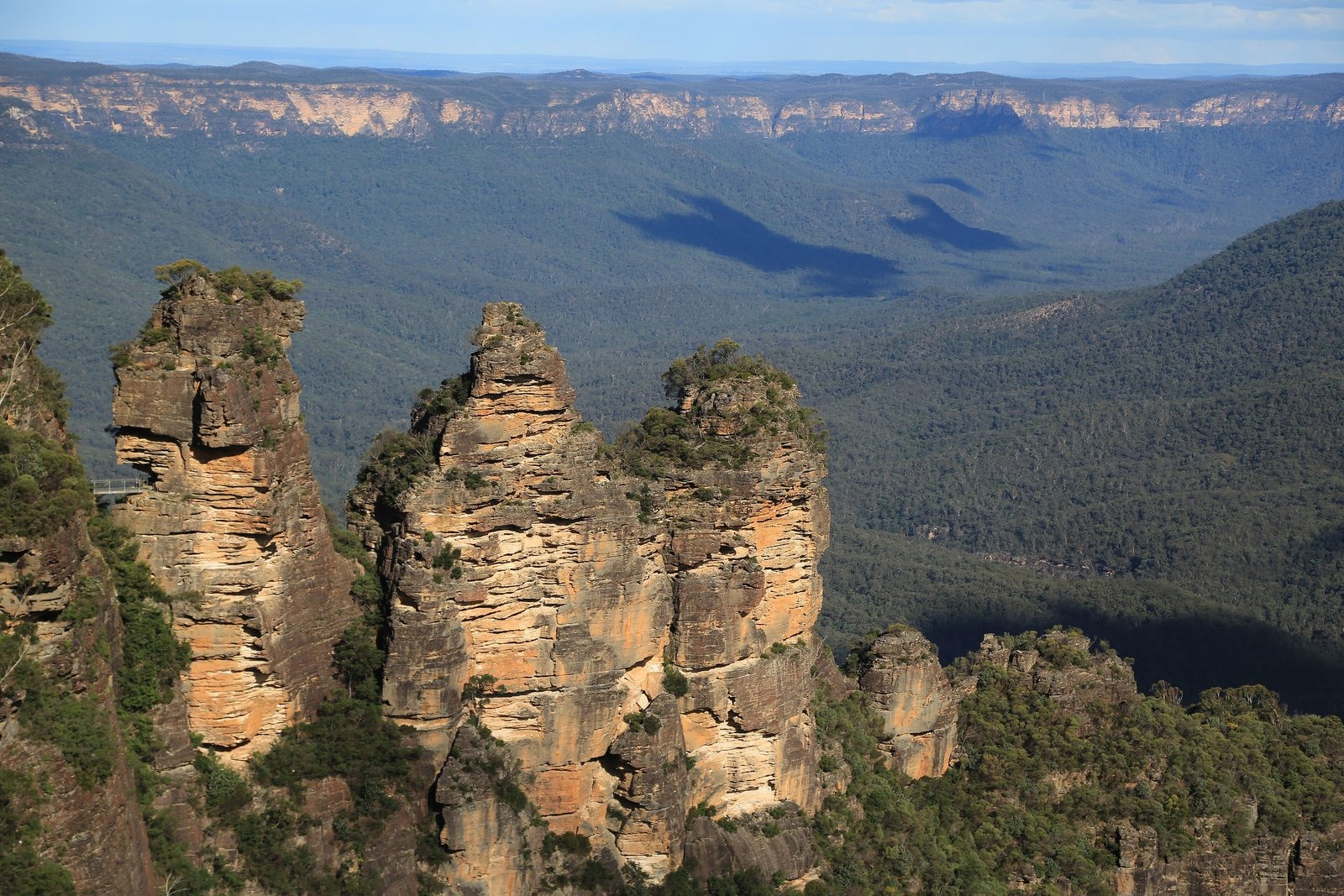
The Three Sisters
Eroded sandstone towers of about 922, 918 and 906 metres, declared an Aboriginal Place in January 2014. The guide weighs the popular Meehni, Wimlah and Gunnedoo story against the Gundungurra Seven Sisters Dreaming and a Darug account.
Giant Stairway
998 steps of stone and steel, begun in 1916, stopped in 1918 because cutting into the cliff cost too much, and opened on 1 October 1932. The builders used picks, crowbars, chisels and dynamite, and some steps are carved from the sandstone.
Orphan Rock
A lopsided sandstone pinnacle beside Katoomba Falls. Steps were hewn into it in 1934 and it was floodlit by 1936, but a slide in 1974 destroyed the access track. The top has been closed ever since, so you view it from the lookouts.
Furber Steps
Built in 1908 to replace the bush-pole steps and wooden ladders of the Federal Pass, with long sections hand-carved into the cliff with hammers and chisels. The route runs beside Katoomba Falls into the rainforest.
Scenic Railway
Descends 310 metres on a 52-degree incline, following the old coal-haulage route. The guide notes that its builder is disputed, with historians favouring J. B. North, and that Harry Hammon bought the cable system after the mine closed.
The Gathering Place
An amphitheatre at Echo Point designed with Darug and Gundungurra elders so that Traditional Owners can share their stories with visitors. Its concrete stage floor is etched with a Map of Country showing significant waterways.