Bridgetown and the Garrison
Barbados · Saint Michael

Bridgetown and its Garrison, in two parts

A harbour town whose assembly first met in 1639, and the military base where Barbados became independent.

$10.9911 stops · one payment
Already bought it? Open your tour

Listen to one stop before you buy

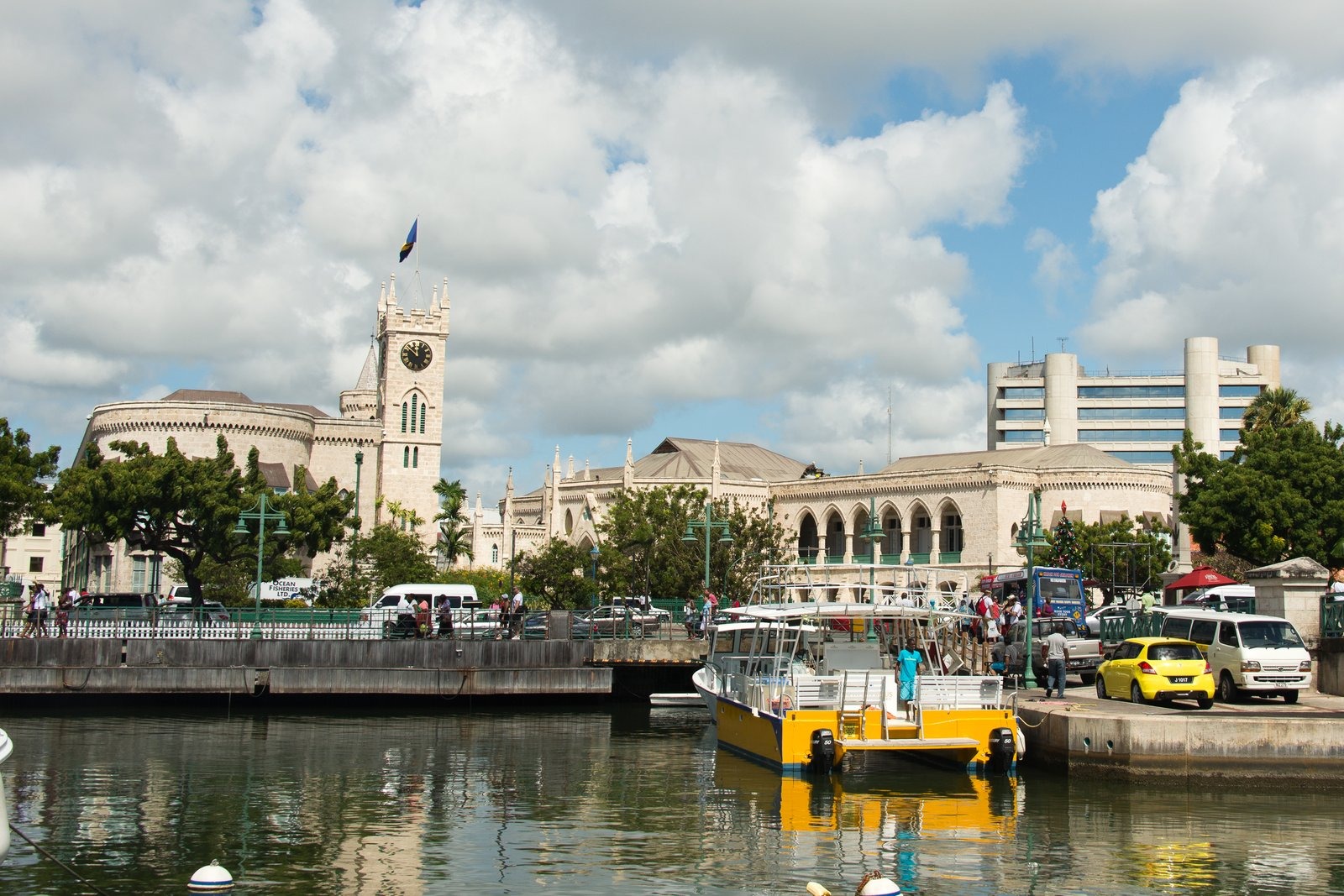
Photo: Barry haynes (CC BY-SA 4.0)

Barbados's House of Assembly first met on the twenty-second of June 1639, which makes it the third-oldest legislature in the Americas, after Virginia's and Bermuda's. In 1661 the same body passed the first comprehensive slave code in any English colony. This tour keeps both facts in view: the town's representative history and the system of slavery it legislated, set against Bussa's revolt of 1816 and Clement Payne's 1937 meetings.

Eleven stops divide between central Bridgetown and the Garrison, Britain's first permanent military base in the Caribbean, established in 1705. In town you cross the Chamberlain Bridge, stand in National Heroes Square and visit Nidhe Israel Synagogue. At the Garrison you reach the parade ground, the Main Guard, the museum in the old military prison and the house where George Washington stayed in 1751.

What you hear along the way

Parliament Buildings

Neo-Gothic coral-stone buildings put up between 1870 and 1874 on ground cleared by the fire of 1860. The tour covers the 1661 slave code that Jamaica adapted in 1664 and South Carolina later copied. The West Wing now holds the Museum of Parliament.

National Heroes Square

Formerly Trafalgar Square, with Nelson's statue from 1813 until 2020. Bussa, the first National Hero named in 1998, led the revolt of the night of the fourteenth of April 1816. A hundred and forty-four people were executed afterwards.

Golden Square Freedom Park

Where Clement Payne held meetings in 1937. After his deportation order on the twenty-sixth of July, four days of rioting left fourteen dead. The park's Builders of Barbados Wall carries engraved surnames, and the 1937 Memorial Wall has everyday objects set in it.

Chamberlain Bridge

A lift bridge over the Careenage that replaced the swing bridge of 1872. At its southern end the Independence Arch shows the broken trident, the Pride of Barbados flower, a pelican, a dolphin and flying fish, with the National Pledge at its base.

Nidhe Israel Synagogue

Founded around 1654 by Sephardic settlers from Dutch Brazil and Holland. The 1831 hurricane destroyed the first building and the present one dates from 1833. Archaeologists found a seventeenth-century mikveh beside it in 2008.

St Michael's Cathedral

Rebuilt in coral stone after the 1780 hurricane. After the 1831 hurricane the damaged church served as a hospital. The marble font was saved from the 1665 building, and the Lady Chapel roof is shingled in wallaba heartwood.

Garrison Savannah and the Main Guard

A twelve-hectare parade ground where the Barbados flag first rose on 30 November 1966. The Main Guard of 1804 faces it, with a George III coat of arms in Coade stone above the portico.

George Washington House

Built around 1717. Washington came in 1751, aged nineteen, with his half-brother Lawrence, who hoped the climate would cure his tuberculosis. It was the only time he left mainland North America, and there he caught smallpox and survived it.

The 11 stops

  1. Chamberlain Bridge
  2. Parliament Buildings
  3. National Heroes Square
  4. Golden Square Freedom Park
  5. St Michael's Cathedral
  6. Nidhe Israel Synagogue
  7. The Main Guard
  8. Garrison Savannah
  9. George Washington House
  10. Barbados Museum
  11. St. Anne's Fort

Before you go

Starts at
In central Bridgetown beside the Careenage and at the Garrison, a separate group of stops; each plays as you reach it.
The route
11 stops: a group in central Bridgetown around the Careenage and National Heroes Square, and a group at the Garrison around the Savannah.
Good to know
St. Anne's Fort is a working military headquarters, so most of it is seen from outside; the National Armoury Museum in its magazine can be visited when open. The Chamberlain Bridge is a lift bridge used mostly by pedestrians.
By ship
Bridgetown (BB) is the port linked to this tour. See Bridgetown.
How it plays
In your phone's web browser, with no app to install. GPS starts each stop as you reach it, and once downloaded the tour plays without a signal.

Questions

Why does the Garrison matter?

It became Britain's first permanent military base in the Caribbean in 1705 and was the army's eastern Caribbean headquarters until 1905. It also hosted the independence ceremony on 30 November 1966, when the Union Flag was lowered.

Is George Washington House open?

The restored lower floor displays period furniture, books and paintings when the house is open. The property also gives access to the Garrison tunnels and has stables, a bathhouse and a windmill.

What happened to Nelson's statue?

It stood in the main square from 1813, which was then Trafalgar Square, and distances on Barbados were measured from it. Since 2020 the bronze statue has been held in the Barbados Museum.

Does it deal with slavery and emancipation?

Yes, at several stops: the 1661 slave code at Parliament, Bussa's 1816 revolt in National Heroes Square, abolition by law in 1834 with full freedom in 1838, and Payne's labour campaign in Golden Square Freedom Park.

What is in the Barbados Museum?

It is in the former British military prison, upper section completed in 1817 and lower section in 1853. Galleries run from Indigenous peoples through colonialism, slavery, emancipation and independence, and it is run by a society founded in 1933.

How does the GPS audio work?

It plays in your phone's browser, with no app to install. Each stop starts by GPS as you arrive, and once the tour is downloaded it plays offline.

Bridgetown, Barbados — the Historic Town and its Garrison

$10.99Tax included
Already bought it? Open your tour