The Maison des Têtes
A stone Renaissance house of 1609 with 106 carved heads and grotesque masks on its façade. A cooper statue by Bartholdi crowns the gable, a reminder of the wine exchange that moved in from 1898.

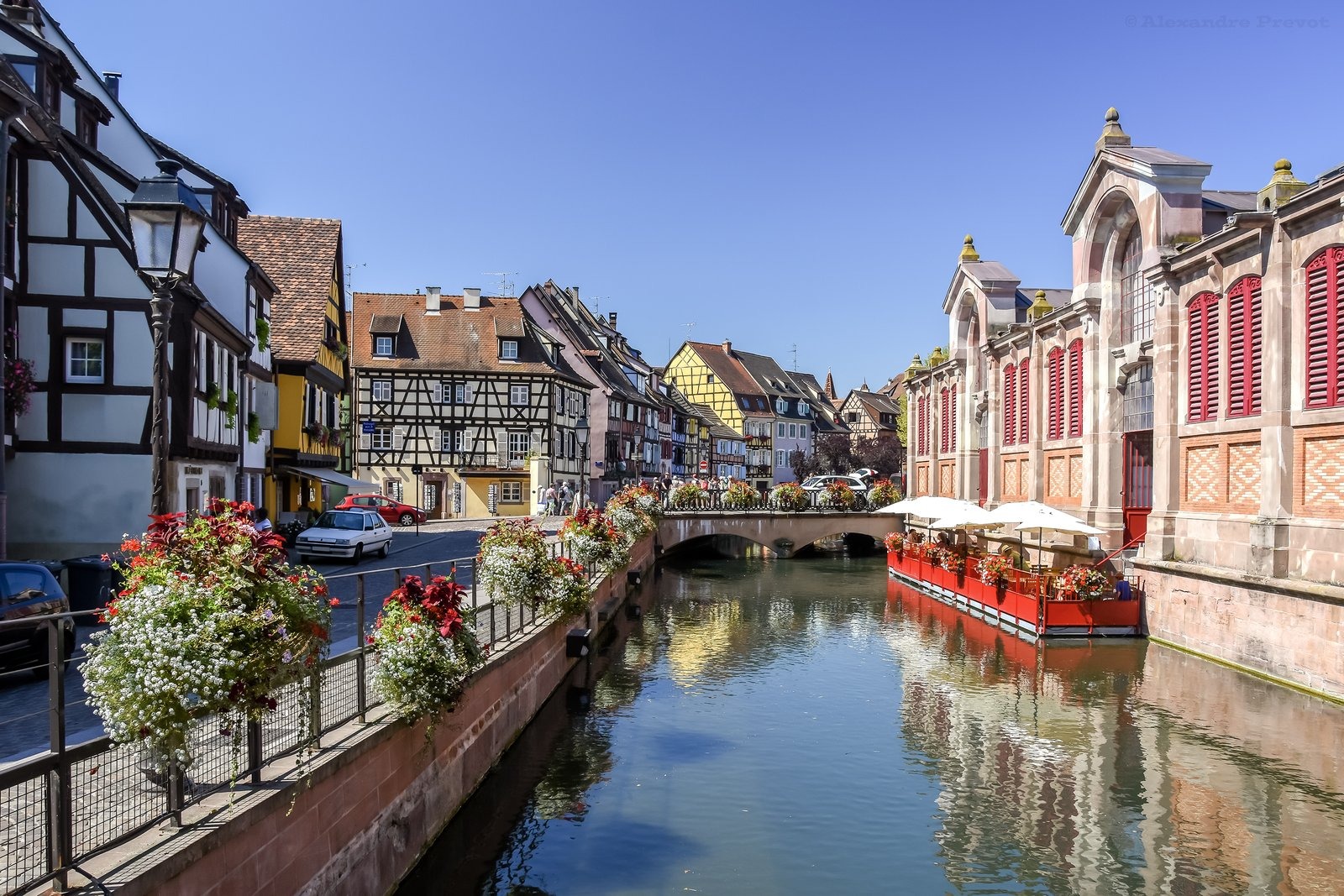
Timber houses, a customs hall, a toy museum and the squares where each Christmas market stands.
Listen to one stop before you buy
Colmar's old town packs its history into a few streets and a river. The Lauch runs through Petite Venise and the Tanners' Quarter, flat-bottomed boats once brought vegetables to the Covered Market, and Gothic churches built by friars face Renaissance houses covered in carved heads.
This tour has 14 stops. Besides the buildings, it explains where the Advent markets stand: the Dominicans' square, the square beside Saint-Martin, Place Jeanne-d'Arc, the Koïfhus and Petite Venise. The guide is plain that the markets are a recent creation, not a medieval survival, even though the town's Advent customs are old. It plays in your browser, starts each stop by GPS and works offline once downloaded.
A stone Renaissance house of 1609 with 106 carved heads and grotesque masks on its façade. A cooper statue by Bartholdi crowns the gable, a reminder of the wine exchange that moved in from 1898.
The old customs house, built between 1476 and 1480, where the Décapole of ten imperial cities met upstairs. In Advent it holds an indoor craft market, and the Schwendi fountain stands in front.
Timber-framed houses along the Lauch on formerly marshy ground, with flat-bottomed boats still running. A restoration from 1978 to 1981 exposed the timber framing beneath plaster.
A church begun in 1283 that holds Schongauer's Madonna of the Rose Bush. The guide also weighs Sélestat's 1521 record, the oldest written mention of a Christmas tree, and what it really says.
A Gothic church built between 1235 and 1365, with a south tower rebuilt in 1575 and topped by a bulbous lantern. It served as the constitutional cathedral of the Haut-Rhin from 1790.
Tall, narrow half-timbered houses beside the canal, with open lofts for drying hides. A restoration between 1968 and 1974 treated 33 properties and converted them into about 108 apartments.
A former Dominican convent extended by Herzog & de Meuron after a competition in 2009. From the tribune above the old chapel, visitors see the Isenheim Altarpiece.
The birthplace of the sculptor of the Statue of Liberty, and a museum to Hansi, the illustrator born in Colmar in 1873 whose watercolours shaped the picture-book image of Alsace.
No. The guide says Colmar's markets are a recent creation, and that the town's Advent customs are old while its markets are young. Each stop notes which market sits in front of it, so the tour works as a map of where they stand.
Sélestat, about twenty kilometres north, keeps a 1521 account book recording a payment to forest wardens. It is presented as the oldest written record of the Christmas tree, though strictly it records a payment for guarding the forest, and other places put forward their own records.
The Unterlinden stop describes the museum that shows it: the former Dominican convent, the new wing and the underground gallery. The Dominican Church stop adds that the Dominican Altarpiece of about 1475 is also kept at the museum.
The sculptor Auguste Bartholdi, born in the house on Rue des Marchands that is now a museum. The museum covers his work on the Statue of Liberty. His statues also appear at the Koïfhus fountain, the Covered Market and the Maison des Têtes.
Market gardeners could arrive by flat-bottomed boat and unload at its riverside edge. It opened in 1865 and was a car park until 2010, when it returned to its first role as a market.
Not once the tour is downloaded. It runs in your phone's browser with no app to install, and GPS starts each stop as you reach it.
More in France: Marseille