Portón de Campo
The gate that was the main land entrance, with a moat and a drawbridge raised by chains. What stands is largely a 1970s reconstruction, with bronze tacks marking where original masonry meets the rebuilt parts.

Thirteen stops in a small walled quarter that changed hands for almost a century.
Listen to one stop before you buy
Photo: Banfield (CC BY-SA 3.0)
Portugal founded Colonia in January 1680, directly across the river from Spanish Buenos Aires, and Spain took it before that year was out. It changed hands through sieges and treaties for almost a century, until a Spanish force under Pedro de Cevallos took it for good in 1777. The Portuguese laid the town out to fit the ground of a peninsula, so the streets follow no Spanish grid.
The tour has 13 stops in the old quarter. You walk in through the Portón de Campo, with its wooden drawbridge, and pass the irregular Plaza Mayor, the Calle de los Suspiros and the ruined Casa del Virrey. Along the way are museums of Portuguese, Spanish, tile and Indigenous collections, the excavated governors' house, a lighthouse built on a convent ruin and the old port. The guide plays in your browser, starts each stop by GPS and works offline once downloaded.
The gate that was the main land entrance, with a moat and a drawbridge raised by chains. What stands is largely a 1970s reconstruction, with bronze tacks marking where original masonry meets the rebuilt parts.
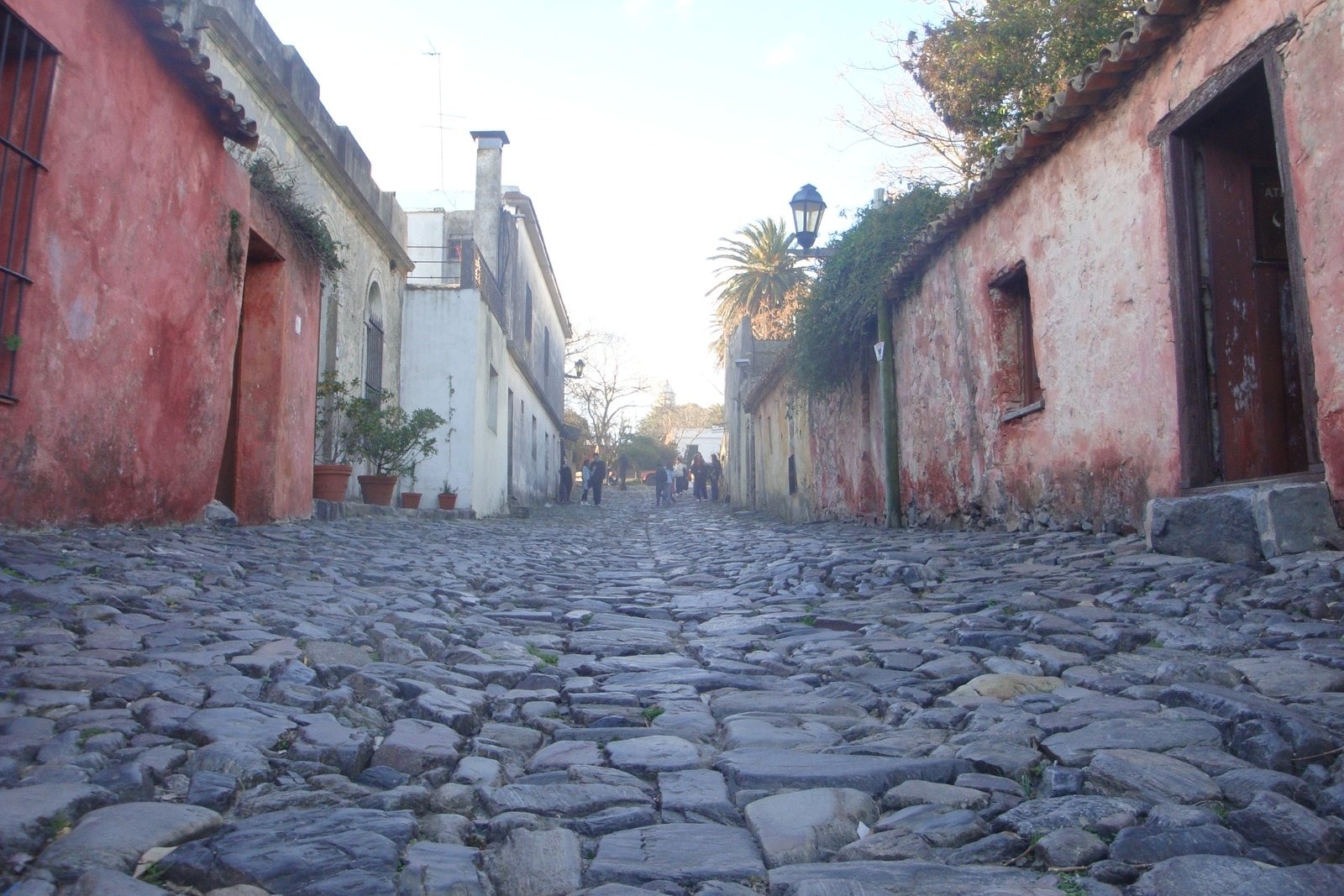
A short lane that keeps its Portuguese layout, with no pavement or kerb and a drainage channel down the middle. Nobody knows where the name comes from, and every explanation is treated as a legend.
An excavation of the governors' residence, dug between 1991 and 1992. Finds included Portuguese pottery, English creamware and Chinese porcelain, plus the ash of a great hearth full of river fish and deer bones.
An open-air ruin of walls, doorways and arches. Colonia never had a viceroy, so the name is a puzzle, and the mortar holds corals that do not come from this region.
A lighthouse built in January 1857 on one of the convent's old square towers. It rises 26 metres, and you can walk the roofless ruins before climbing the narrow spiral stair.
Rebuilt between 1808 and 1810, then wrecked in 1823 when lightning set off gunpowder stored in the sacristy. Charles Darwin, who came in 1833, called it a curious ruin.
Built on the collection of Roberto Banchero, who rescued objects from sand workings and noted where each was found. Reopened in 2023, it centres on the stone and pottery technology of the river's first peoples.
A wooden pier from the late 1860s, now a marina. In 1722 eleven ships came in and sailed out loaded with hides and silver, a trade the Spanish crown forbade.
Colonia never had a viceroy. The Portuguese town was run by a governor and, after 1777, answered to Buenos Aires, so the name has been explained many ways and none is settled. What remains is a group of stone walls and arches.
It was Portuguese. The Portuguese laid Colonia out to fit the peninsula, not a Spanish grid, so its Plaza Mayor is irregular and lanes such as the Calle de los Suspiros leave it at odd angles.
The Museo Portugués, Museo Español, Museo del Azulejo and Museo Indígena. The Museo Portugués stop also points out the original coat of arms from the Portón de Campo.
Lightning struck on 14 December 1823 and detonated gunpowder in the sacristy, destroying the sacristy and the high altar. It was rebuilt between 1836 and 1841 and restored in 1976, and it became a minor basilica in 1997.
Not once the tour is downloaded. The guide plays in your phone's browser with no app, and each stop starts by GPS as you arrive.