Korčula
Croatia · Dalmatia

Inside Korčula's fish-bone town

Gates, towers, churches and a medieval law code on an oval rock in the Pelješac Channel.

$10.9920 stops · one payment
Already bought it? Open your tour

Listen to one stop before you buy

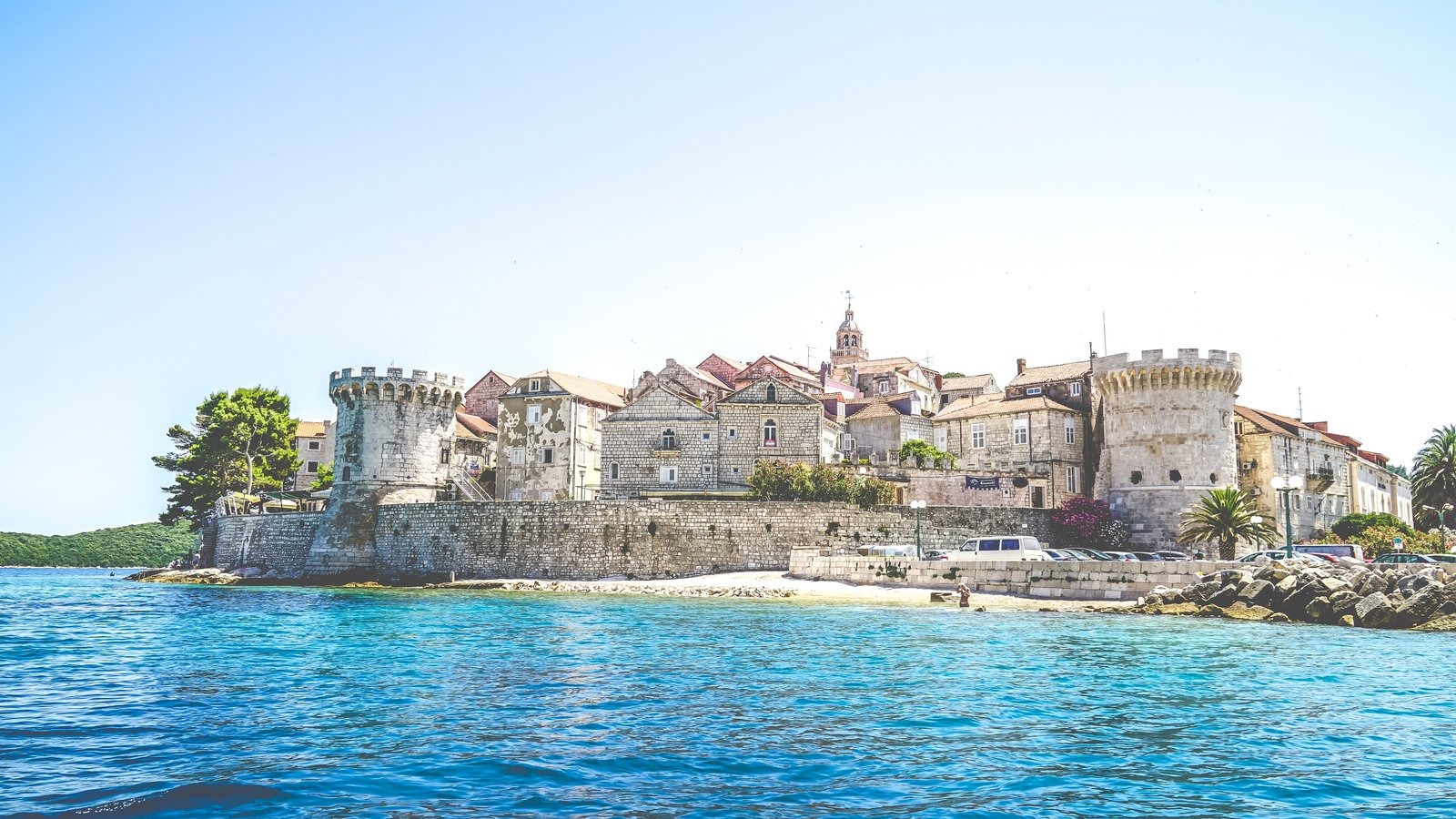
Photo: Hilthart Pedersen h3p (CC0)

Korčula's old town sits on an oval spur of rock, and its streets are laid out like the bones of a fish: one main street along the crest, side streets stepping down to a lane inside the walls. The guide explains why the plan bends where it does, how the walls were rebuilt for gunpowder after a siege in 1483, and why the town spread beyond them only in the eighteenth century.

The tour has 20 stops. They include the Land Gate and the Veliki Revelin, St Mark's Cathedral and its bell tower, the Town Hall and Rector's Palace, small churches, the Abbey Treasury and icon collection, and the hilltop Forteca. Marco Polo's supposed birthplace is covered with the evidence laid out, and so is the Moreška sword dance. The guide plays in your phone's browser, starts each stop by GPS and works offline once downloaded.

What you hear along the way

Land Gate and Veliki Revelin

The only way in from the land side, under a Venetian lion, with a triumphal arch of 1650 for Leonardo Foscolo. Outside stands the bastion Marko Andrijić led after the Aragonese siege of 1483 showed that thin walls could not stand up to guns.

Street of the Statute of Korčula

The street sign carries the date 1214. The guide explains what survives of the law code, which redactions exist, and the fifteenth-century rules against the slave trade, which restricted it but did not abolish slavery.

St Mark's Cathedral and bell tower

Bonino of Milan is credited with the portal, Marko Andrijić carved the ciborium in 1485 or 1486, and the altarpiece is by Tintoretto. The bell tower is joined to the church and was struck by lightning in 1715 and 1783.

Marco Polo House

Korčula shows this house as his birthplace, but the guide calls the claim weak. The real link is the Battle of Curzola in September 1298, when the Genoese fleet destroyed most of the Venetian fleet.

Moreška sword dance venue

A dance that is also a play: Black King Moro and White King Osman, twenty-four dancers, seven figures called kolapi. You hear the earliest record from 1666 and why Korčula is the only town in the region where it survived.

Town wall circuit

Thirteenth-century origins, four new towers built between 1485 and 1507, and the Ottoman fleet under Uluz Ali in 1571, when about two hundred armed men, with women and boys carrying powder, faced it. The walls were disarmed in 1858 and partly pulled down from 1875.

Zbirka ikona and Opatska riznica

Fourteen Cretan icons said to have been left by a galley returning from the War of Candia, and a treasury in the former bishop's palace holding a Blaž Jurjev polyptych, vestments and works by Meštrović.

Tvrđava sv. Vlaha

A Venetian fort built in the autumn of 1617 with about five hundred islanders working at once, later topped by a British Martello tower from 1813 that replaced the church of Saint Blaise.

The 20 stops

  1. Land Gate
  2. Marco Polo House
  3. St. Mark’s Cathedral
  4. Veliki Revelin Tower
  5. Korčula Old Town street plan
  6. Cathedral bell tower
  7. Moreška sword dance venue
  8. Street of the Statute of Korčula
  9. Town Hall and Rector’s Palace
  10. Town wall circuit
  11. Crkva Sv Mihovila
  12. Kapela Sv Katarine
  13. Crkva svetog Petra
  14. Crkva svih svetih
  15. Gradski Muzej Korčula
  16. Opatska riznica
  17. Zbirka ikona
  18. Crkva sv. Justine
  19. Bishop’s Palace
  20. Tvrđava sv. Vlaha

Before you go

Starts at
Within the old town and on the hill beside it; each stop plays as you reach it, in whatever order you walk.
The route
20 stops on foot: the gate and bastion at the southern approach, the main street and cathedral square, small churches and museums inside the walls, the wall circuit, and the fortress on the hill to the south-west.
Good to know
Most side streets are flights of steps. The Moreška is covered at the open ground beside the Revelin, and the Revelin itself has housed an exhibition on the dance since 2003.
By ship
Korčula is the port linked to this tour. See Korcula.
How it plays
In your phone's web browser, with no app to install. GPS starts each stop as you reach it, and once downloaded the tour plays without a signal.

Questions

Was Marco Polo really born in Korčula?

The guide treats it as a local tradition with weak evidence. Polo is generally thought to have been born around 1254 in Venice, though no archive records it. Korčula's real link is the Battle of Curzola in 1298, fought in the channel off the island.

What is the Moreška?

A sword dance that is also a play, in which the Black King carries off the White King's bride Bula and two armies of twelve fight over her. The venue stop covers its history, the 1937 music by Krsto Odak and how the main performance date changed.

Why is the old town shaped like a fish bone?

One main street follows the crest of the rock and side streets run down to a lane behind the walls. The plan follows the ridge, and the main gate stands at its bend. The guide also gives the local explanation involving the wind and the bora.

Does the tour go inside the churches and museums?

The guide describes what is inside St Mark's, All Saints, the Town Museum, the Abbey Treasury and the icon collection, so you know what to look for in each. They do not give opening arrangements.

Which period of history does it cover?

Mostly the Venetian centuries, 1420 to 1797, with earlier medieval law and building and later British, French and Austrian changes, including the Martello tower of 1813 and the demolition of walls from 1875.

Do I need a data connection while walking?

No, once the tour is downloaded. It plays in the phone's browser with no app to install, and GPS starts each stop as you arrive.

Korčula

$10.99Tax included
Already bought it? Open your tour

More in Croatia: Split · Dubrovnik — Game of Thrones