Oranjestad
Aruba · Oranjestad

Oranjestad from Horses Bay to autonomy

Aruba's oldest building, a street named for the leader of its separation, and the small stories packed between them.

$10.9911 stops · one payment
Already bought it? Open your tour

Listen to one stop before you buy

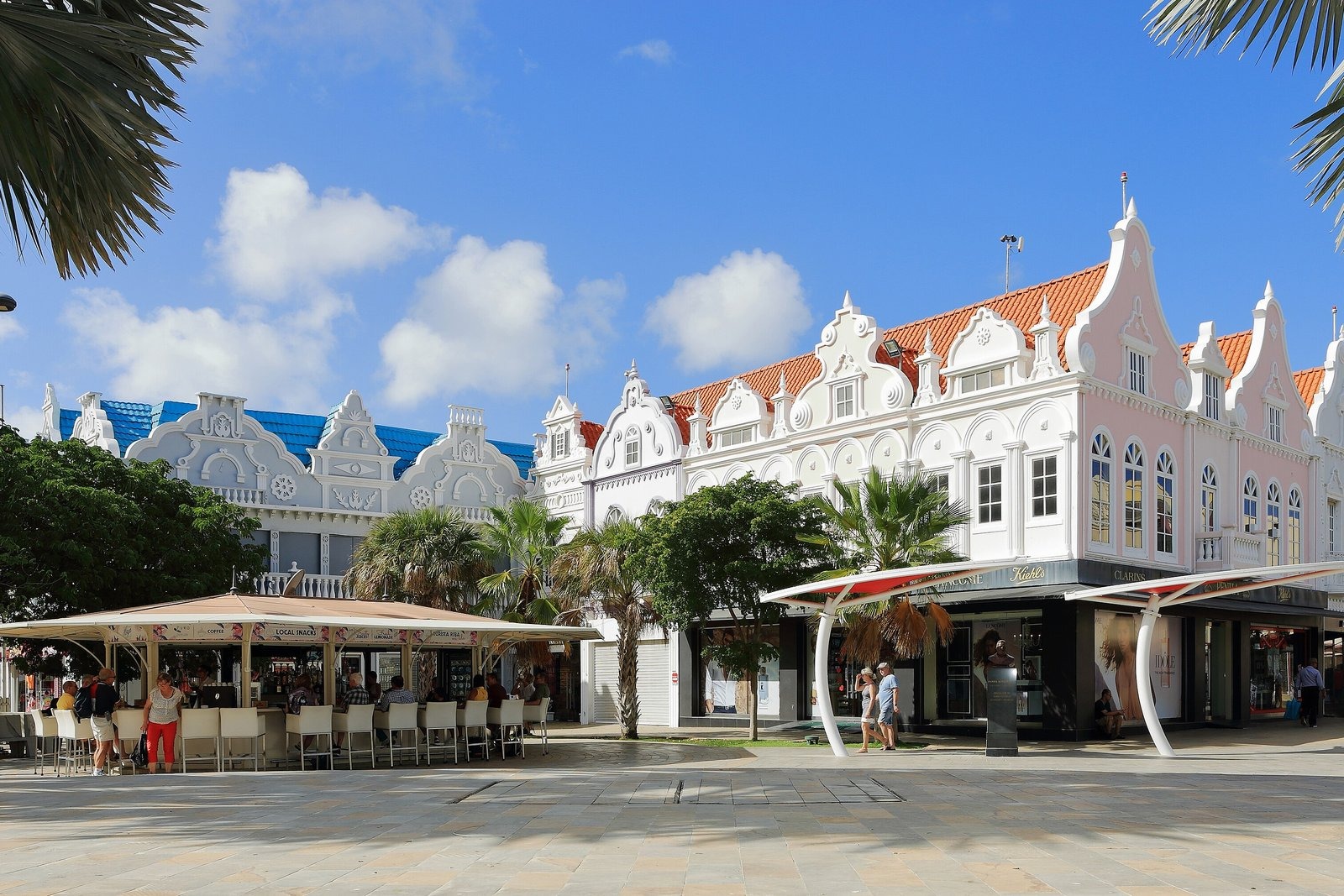
Photo: Martin Falbisoner (CC BY-SA 4.0)

Oranjestad grew late. After trade restrictions eased in 1795 and 1796, merchants and artisans moved to the bay then called Paardenbaai, Horses Bay. A fort went up against privateers, gold was found in the north-east in 1824, and the settlement took the name of the House of Orange. This tour follows that sequence through eleven stops, and keeps the island's earlier history in view: the Caquetio, the Spanish deportation of 1515 and the Dutch West India Company's long use of Aruba as a ranch.

You hear about slavery on an island that was never a sugar colony, the Second World War, and status aparte on 1 January 1986, when Aruba became an autonomous country within the Kingdom of the Netherlands.

What you hear along the way

Fort Zoutman

Aruba's oldest surviving building, completed at Paardenbaai in 1798 with four cannons. The Willem III Tower was added in 1868 as lighthouse and clock tower. On 1 July 1863 about four hundred and eighty people on Aruba were freed, two hundred and nineteen of them children under fifteen.

National Archaeological Museum Aruba

Housed in the Ecury family complex, with a cunucu house from 1870 and a mansion from 1929. The Spanish arrived around 1499 to find the Caquetio, an Arawak-speaking people, and in 1515 deported most of them to Hispaniola.

Caya G. F. Betico Croes

Main Street began as Nassaustraat and linked the harbour with the gold-mining areas after 1824. It was renamed on 25 January 1990 for the leader of the status aparte movement, who died in November 1986 after a car crash on the last night of 1985.

Plaza Daniel Leo

The square sits where the early nineteenth-century Commander's House once overlooked the bay, before land reclamation moved the beachfront inland. The statues of blue horses by the fountain recall the town's first name, Horses Bay.

Old Protestant Church

Built in 1846 over the basement of the Arends family home, reusing its stones. A bell from Coro, Venezuela, hangs in the tower, and the building now holds the A. van den Doel Bible Museum and hosts concerts.

St Francis of Assisi Church

The present site has held five successive churches. One foundation stone was laid in 1864, but that structure collapsed before consecration. The current church dates from 1919, and its tall tower once served as a maritime landmark.

Wilhelmina Park

Laid out in 1955 on reclaimed land, with a Carrara marble statue of the Queen. It is linked to 16 February 1942, when German submarines torpedoed tankers off Aruba and shelled the Lago refinery. Anne Frank has a statue here too.

Boy Ecury Monument

Boy Ecury, born in Oranjestad in 1922, joined the Dutch resistance and was executed on 6 November 1944. He was reburied in Aruba with military honours in 1947. His bust stands on a pedestal inscribed with a Bible passage.

The 11 stops

  1. National Archaeological Museum Aruba
  2. St Francis of Assisi Church
  3. Caya G. F. Betico Croes (Main Street)
  4. Plaza Daniel Leo
  5. Old Protestant Church
  6. City Hall
  7. Fort Zoutman
  8. Parliament of Aruba
  9. Wilhelmina Park
  10. Boy Ecury Monument
  11. Beth Israel Synagogue

Before you go

Starts at
The tour opens at the National Archaeological Museum Aruba, on Schelpstraat; other stops play as you reach them.
The route
11 stops on foot around central Oranjestad, from Main Street and the old fort to Wilhelmina Park and the Beth Israel Synagogue.
Good to know
A tram runs along Caya G. F. Betico Croes, connecting the harbour terminal with the centre. The Old Protestant Church doubles as an exhibition and concert space and the fort is a museum, both can be entered when open.
By ship
Aruba (AW) and Oranjestad (AW) are the ports linked to this tour. See Aruba, Oranjestad.
How it plays
In your phone's web browser, with no app to install. GPS starts each stop as you reach it, and once downloaded the tour plays without a signal.

Questions

Why was Aruba never a plantation island?

The Dutch West India Company took the island in 1636 and long used it as a ranch rather than a plantation colony. Slavery was still real here: about four hundred and eighty people were freed in 1863.

What is status aparte?

It took effect on 1 January 1986 and made Aruba an autonomous country within the Kingdom of the Netherlands. The Parliament of Aruba then succeeded the Island Council and took over its building on L.G. Smith Boulevard.

Does the tour include a synagogue?

Yes. Beth Israel Synagogue was consecrated on 4 November 1962. Its design is attributed to Morris Lapidus but was presented as the work of Geo Scott, to avoid delays at the public works department.

Who was Boy Ecury?

A resistance fighter born in Oranjestad in 1922 who left for the Netherlands in 1937 and was executed in 1944. His family home is part of the archaeological museum complex, and a second monument stands at the Catholic cemetery.

What is City Hall?

A building from 1922 to 1925 that began as a doctor's home, practice and pharmacy. The government acquired it in 1988 and, after restoration in 1997, it became City Hall, which now handles civil registration, passports and marriages.

How does the GPS audio work?

It plays in your phone's browser, with no app to install. Each stop starts by GPS as you reach it, and once the tour is downloaded it works offline.

Oranjestad — Fort Zoutman and the Old Town, Aruba

$10.99Tax included
Already bought it? Open your tour