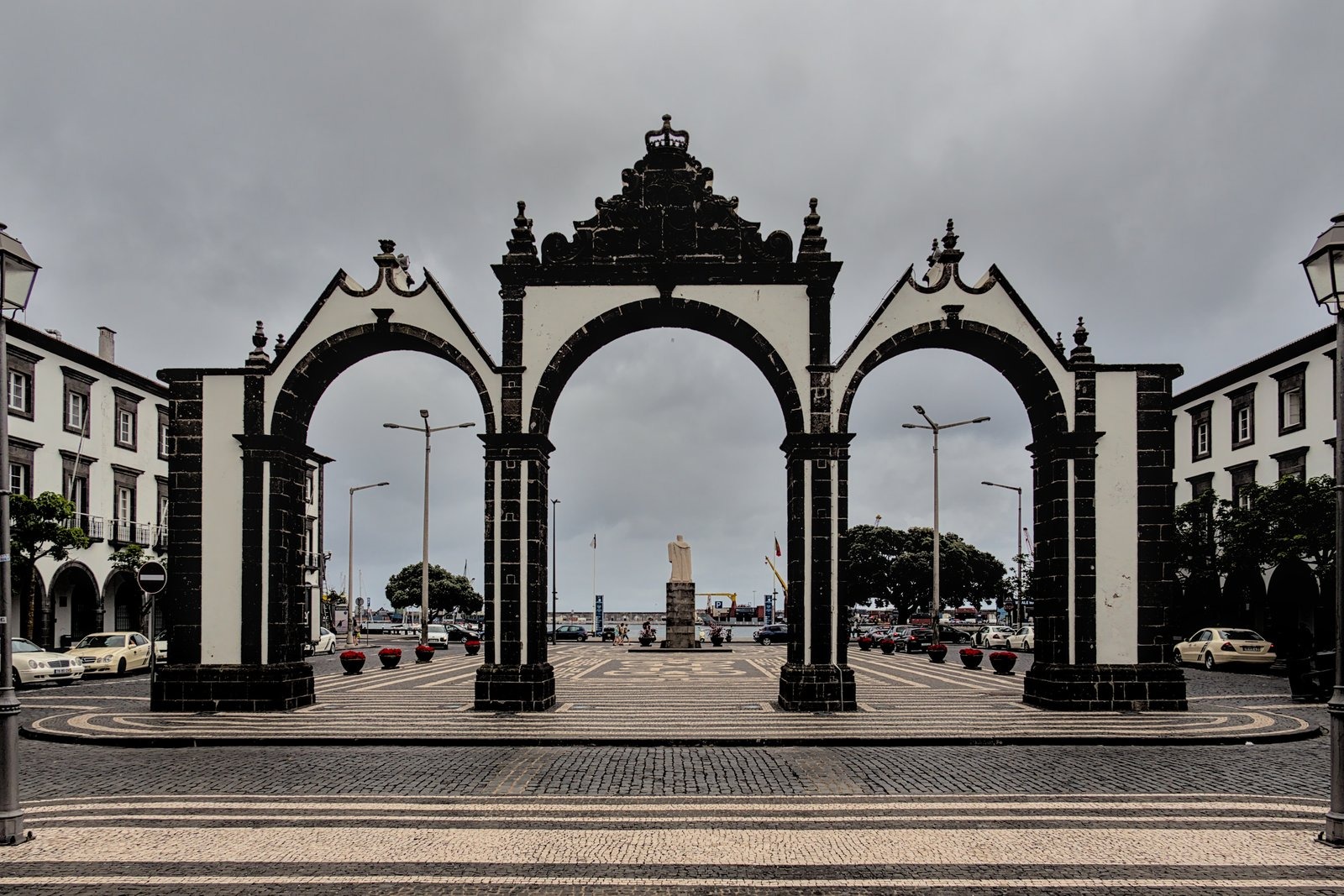
Portas da Cidade
Built in 1783 as a gate in the walls beside the old quay. They were dismantled in 1948 for the new waterfront avenue and reassembled in 1952, and now close nothing.

Twenty-three stops on São Miguel, from a fishing settlement that became the island's capital after an earthquake.
Listen to one stop before you buy
Photo: Šarūnas Burdulis (CC BY-SA 2.0)
Ponta Delgada began in the mid-fifteenth century as a small fishing settlement. After the earthquake and landslides of 22 October 1522 devastated Vila Franca do Campo, the island's centre shifted here, and King João the Third raised it to a city on 2 April 1546. The walk reads that history in the Portas da Cidade, the Matriz and the town hall, then follows it outward.
Stops include the seafront fort, a Franciscan square, two convents, two botanical gardens, two palaces, a synagogue, a market and the Museu Carlos Machado, finishing at a hilltop chapel that overlooks the harbour.
Built in 1783 as a gate in the walls beside the old quay. They were dismantled in 1948 for the new waterfront avenue and reassembled in 1952, and now close nothing.
Built against pirates and privateers and reworked in 1569 by the Italian engineer Tommaso Benedetto into a bastioned plan. It has housed the Azores Military Command since the 1940s and a military museum since 1999.
An Ecce Homo of the early sixteenth century, kept in a chapel blessed in 1771 and carried through the streets each year. It is covered in gold, silver and gemstones and dressed in embroidered cloaks.
An Orthodox synagogue concealed in a rabbi's simple house on Rua do Brum, built when non-Catholic worship was expected to stay out of sight. It has sixty-seven built-in seats and a surviving mikvah.
A seventeenth-century convent for an enclosed order, now home to government offices since 1976. On the night of 12 April 1979 the official Azorean flag was formally raised here for the first time.
A botanical garden and acclimatisation ground laid out from 1861 with a design by the French landscape architect Barillet-Deschamps. It has been open to the public since August 2014.
Its first stone was laid on All Saints' Day 1592. The altarpiece's gilding was left unfinished when the Jesuits were expelled in 1760, and the church now serves the Museu Carlos Machado.
Demolished in 1915 because it might serve as a landmark for German submarines. Women of São Miguel rebuilt it, and it was completed in early 1947.
The walk starts at the Portas da Cidade: west to the Campo and the fort on the shore, up through the gardens, and back east through the old town. You can take the stops in any order.
Vila Franca was the island's capital until 22 October 1522, when an earthquake and landslides devastated it, with some five thousand reported dead. The island's administrative and economic centre then shifted to Ponta Delgada.
Yes. The Jardim António Borges and the Jardim José do Canto both have stops, along with the Campo de São Francisco, where a New Zealand Christmas tree planted around 1870 still grows.
It plays in the browser on your phone, so there is no app to install. GPS starts each stop as you arrive, and a downloaded tour works offline.
Not after the tour is downloaded. The audio is stored on the phone, so every stop starts without a signal.