Quito historic centre
Ecuador · Pichincha

Quito's colonial centre, church by church and square by square

Twenty-five stops from the main plaza to the hill above the city.

$10.9925 stops · one payment
Already bought it? Open your tour

Listen to one stop before you buy

Photo: Cayambe (CC BY-SA 3.0)

Quito was refounded as San Francisco de Quito on December 6, 1534, when Sebastián de Benalcázar reached a city that the Inca general Rumiñahui had destroyed or burned to keep it from the Spanish. The walk begins at the Plaza Grande, can be taken in any order, and ends at the hills that frame the city.

The tour has 25 stops. A large part of the colonial city is religious: the cathedral, the Jesuit church, San Francisco with its broad stone staircase, Santo Domingo, La Merced, San Agustín and the cloistered monasteries. Around them are the Carondelet Palace, two theaters, Sucre's house, museums, the lane called La Ronda and the Basílica del Voto Nacional. The guide plays in your browser, starts each stop by GPS and works offline once downloaded.

What you hear along the way

Plaza Grande

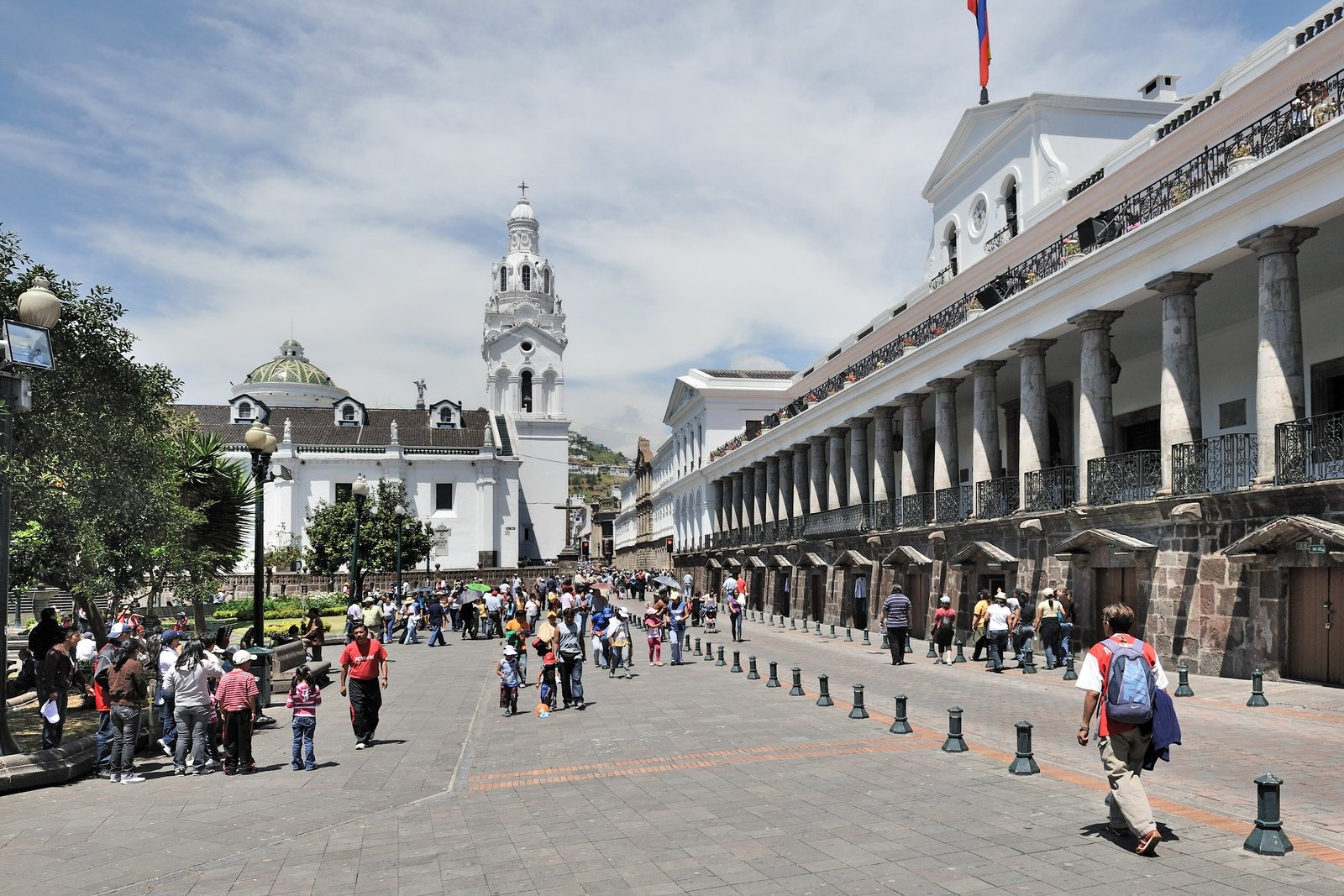
The square at the center of the colonial grid, surrounded by the Carondelet Palace, the cathedral, the Archbishop's Palace and the Municipal Palace. The stop suggests using the central La Libertad monument as a sightline to pick out the four powers around the square.

Iglesia de la Compañía de Jesús

Work ran from 1605 to 1765, following the Roman Gesù. Inside, the stone pillars carry carved Indigenous faces and Ecuadorian plants, and sun motifs are carved over the entrance and appear in the dome.

Iglesia y Convento de San Francisco

Reached by a broad concave-convex staircase from the plaza. Above the main altar is a small winged Virgin of Quito standing on a dragon, and the church mixes Mudéjar and Baroque decoration.

Capilla de Cantuña

Construction started in 1581 under a brotherhood whose members were Indigenous sculptors and painters, who took the little church over from the Franciscans. Outside, a wall in the San Francisco atrium holds the missing stone from the legend of Cantuña.

Casa de Sucre

The home of Antonio José de Sucre and Mariana Carcelén, now a museum. In the dining room hangs the household shopping list prepared for Bolívar's visit, with unusually large quantities of food, and Sucre's guitar hangs in the bedroom.

Arco de la Reina

Two arches over Calle García Moreno that let cloistered Carmelite nuns reach a chapel without entering the street. Look through them toward the winged Virgin on El Panecillo.

Basílica del Voto Nacional

A basilica whose gargoyles are Ecuadorian animals, not Gothic monsters: iguanas, Galápagos tortoises, armadillos, condors, monkeys and frogs. It hosted its first Mass in 1924.

El Panecillo y la Virgen de Quito

A copy of Bernardo de Legarda's 1734 Virgin, assembled from roughly 7,000 numbered aluminum pieces. The base has a small exhibit on how it was put together, and a balcony gives a panorama.

The 25 stops

  1. Plaza Grande
  2. Palacio de Carondelet
  3. Catedral Metropolitana de Quito
  4. Iglesia de El Sagrario
  5. Palacio Arzobispal
  6. Real Monasterio de la Inmaculada Concepción
  7. Iglesia y Convento de La Merced
  8. Iglesia de la Compañía de Jesús
  9. Centro Cultural Metropolitano
  10. Casa de Sucre
  11. Iglesia y Convento de San Francisco
  12. Capilla de Cantuña
  13. Museo Casa del Alabado
  14. Monasterio del Carmen Alto
  15. Arco de la Reina
  16. Museo de la Ciudad
  17. Calle La Ronda
  18. Iglesia de Santo Domingo
  19. Teatro Bolívar
  20. Monasterio de Santa Catalina
  21. Iglesia y Convento de San Agustín
  22. Teatro Sucre
  23. Iglesia de San Blas
  24. Basílica del Voto Nacional
  25. El Panecillo y la Virgen de Quito

Before you go

Starts at
At the Plaza Grande, where the walk begins; the route can be taken in any order, and each stop plays as you reach it.
The route
25 stops on foot through the colonial grid, from the main plaza to the churches, convents, museums, theaters and the lane of La Ronda, finishing on the hill of El Panecillo.
Good to know
Many interiors are described when open: the cathedral's domed roof is reached by a narrow spiral staircase, and the Panecillo monument has a balcony reached by stairs inside. At Santa Catalina, a four-room museum occupies part of a Dominican convent for cloistered women.
How it plays
In your phone's web browser, with no app to install. GPS starts each stop as you reach it, and once downloaded the tour plays without a signal.

Questions

Do I have to follow the stops in order?

No. The route can be taken in any order, beginning at the plaza and ending at the hills that frame the city. Each stop starts by GPS when you reach it.

Who was Sucre, and where does the tour mention him?

Antonio José de Sucre appears at the cathedral, where a chapel holds his tomb, at the Casa de Sucre, his home with Mariana Carcelén, and on the Teatro Sucre, where a bronze figure of him raises a woman whose chains have been broken.

What is the legend of Cantuña?

The tour points you to a missing stone in a wall of the San Francisco atrium that is tied to the legend, and explains that the chapel was run by a brotherhood of Indigenous sculptors and painters from 1581, with Francisco Cantuña holding a burial place inside.

Is the Virgin on El Panecillo the original?

No. The monument is a large replica of Bernardo de Legarda's 1734 Virgin of Quito, designed by Agustín de la Herrán Matorras. The original, a smaller wooden sculpture, is elsewhere in the historic centre.

Can I use it offline?

Yes. After you download the tour it works without a connection. The guide runs in your phone's browser, so there is no app to install.

Quito — the Historic Centre, the First World Heritage City

$10.99Tax included
Already bought it? Open your tour