Cais do Valongo
A wharf begun in 1811 to land enslaved Africans away from the city centre, buried by later quays and rediscovered in 2011. UNESCO inscribed it in 2017, estimating that up to 900,000 captives entered the Americas through it.

Twenty stops from Praça Mauá through colonial Centro to the tram, Lapa's arches and the Selarón steps.
Listen to one stop before you buy
Photo: Cyro A. Silva from Rio de Janeiro, Brasil (CC BY 2.0)
The walk begins at Praça Mauá on Guanabara Bay, runs several kilometres through the Centro and then climbs to Santa Teresa by tram. The route follows Rio from its working port to its imperial square, its 1909 opera house and the old aqueduct that now carries the tram.
The tour has 20 stops. The port stops deal with the history of slavery: the Cais do Valongo, a wharf built from 1811 where enslaved Africans were landed, and the Pedra do Sal, once a salt-unloading point and still a place for samba. In the Centro, the Paço Imperial, Carmo and Candelária churches, the Real Gabinete Português de Leitura and the Confeitaria Colombo each cover a different layer of the city. The guide plays in your browser, starts each stop by GPS and works offline once downloaded.
A wharf begun in 1811 to land enslaved Africans away from the city centre, buried by later quays and rediscovered in 2011. UNESCO inscribed it in 2017, estimating that up to 900,000 captives entered the Americas through it.
A granite outcrop in the port district known as Pequena África, where enslaved Africans unloaded salt. It remains a place connected to Candomblé, and a roda de samba gathers at the foot of its carved steps.
Built between 1738 and 1743 and later the royal and imperial palace. On the thirteenth of May 1888, Princess Isabel signed the Golden Law here, abolishing slavery in Brazil.
Begun in 1775, with a dome completed in 1877 and stained glass made in Munich. The stop also covers its role in public events, including the Candelária massacre of July 1993, and points out the wave-patterned stone paving outside.
Opened in 1894 and enlarged in 1922. Look for the huge Belgian crystal mirrors framed in rosewood, and walk to the back of the dining room to see the upstairs tearoom's stained-glass skylight.
A Neo-Manueline building modelled on Lisbon's Jerónimos Monastery, opened in 1887. Inside, an iron-and-glass skylight lights the main reading room, with medallions of navigators and Camões around it.
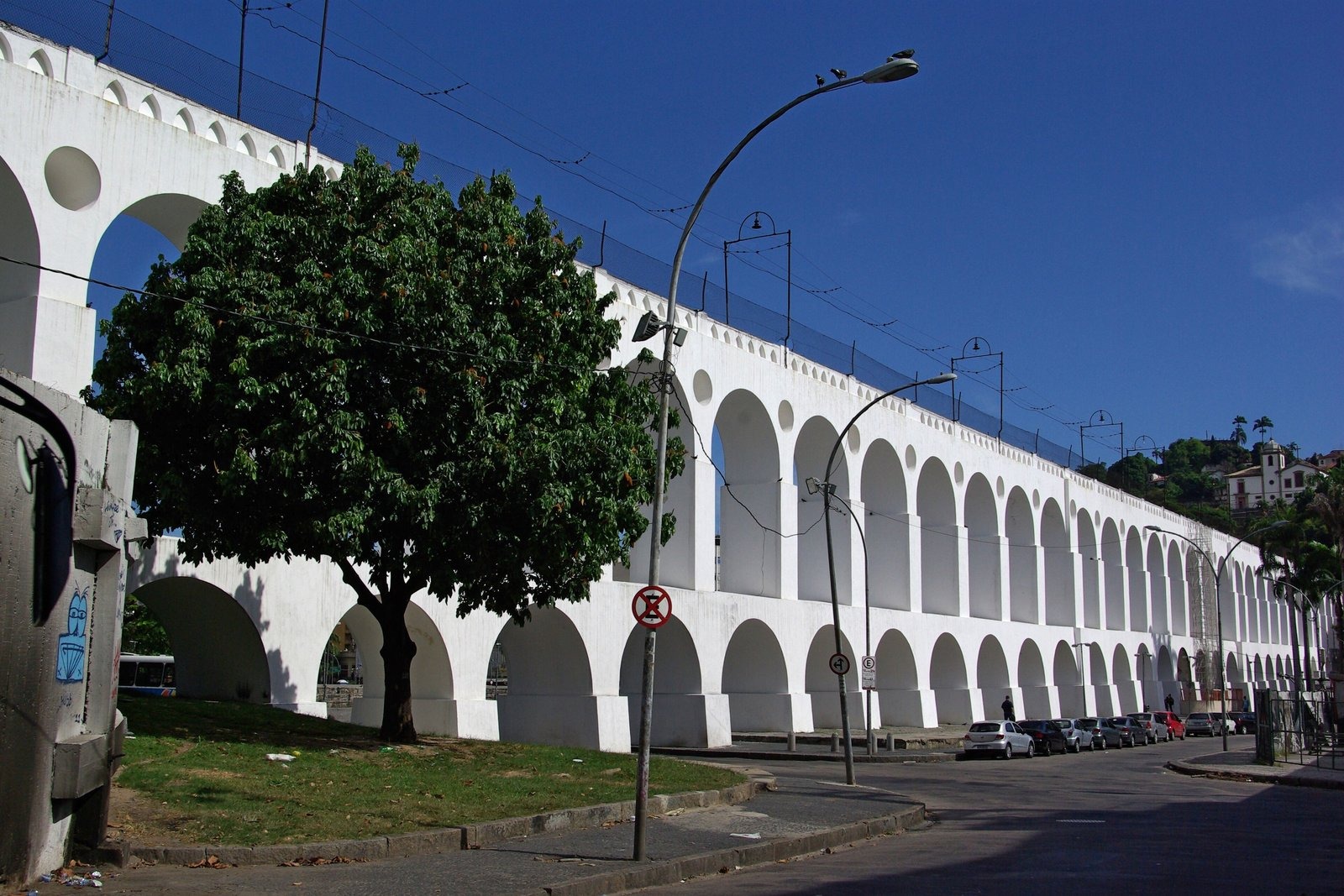
An aqueduct rebuilt from 1744 and deactivated as a water conduit in 1896. The yellow Santa Teresa tram now crosses it, and enslaved Indigenous and African people built it.
A staircase that Jorge Selarón decorated from 1990 until his death in 2013, with tiles from more than 60 countries. Look for the repeated pregnant African woman and his self-portraits as a pregnant man.
At Praça Mauá, where the walk begins. It then runs several kilometres through the Centro and climbs to Santa Teresa by tram. Each stop starts by GPS as you arrive.
The Cais do Valongo stop covers the wharf where enslaved Africans were landed, the Pedra do Sal covers the enslaved workers who unloaded salt, and the Paço Imperial records the Golden Law of 1888. The Arcos da Lapa and São Bento stops note enslaved labour in their building.
The Museum of Tomorrow, designed by Santiago Calatrava and opened in December 2015 on Píer Mauá. Its roof has movable wing-like elements with photovoltaic panels, and water pumped from Guanabara Bay helps regulate the interior temperature.
The aqueduct was deactivated as a water conduit in 1896 and adapted to carry the Santa Teresa tram line. Today the yellow tram crosses over its arches between Largo da Carioca and Santa Teresa.
Not after you download it. The guide runs in your phone's browser with no app, each stop is triggered by GPS, and the offline download covers the whole walk.