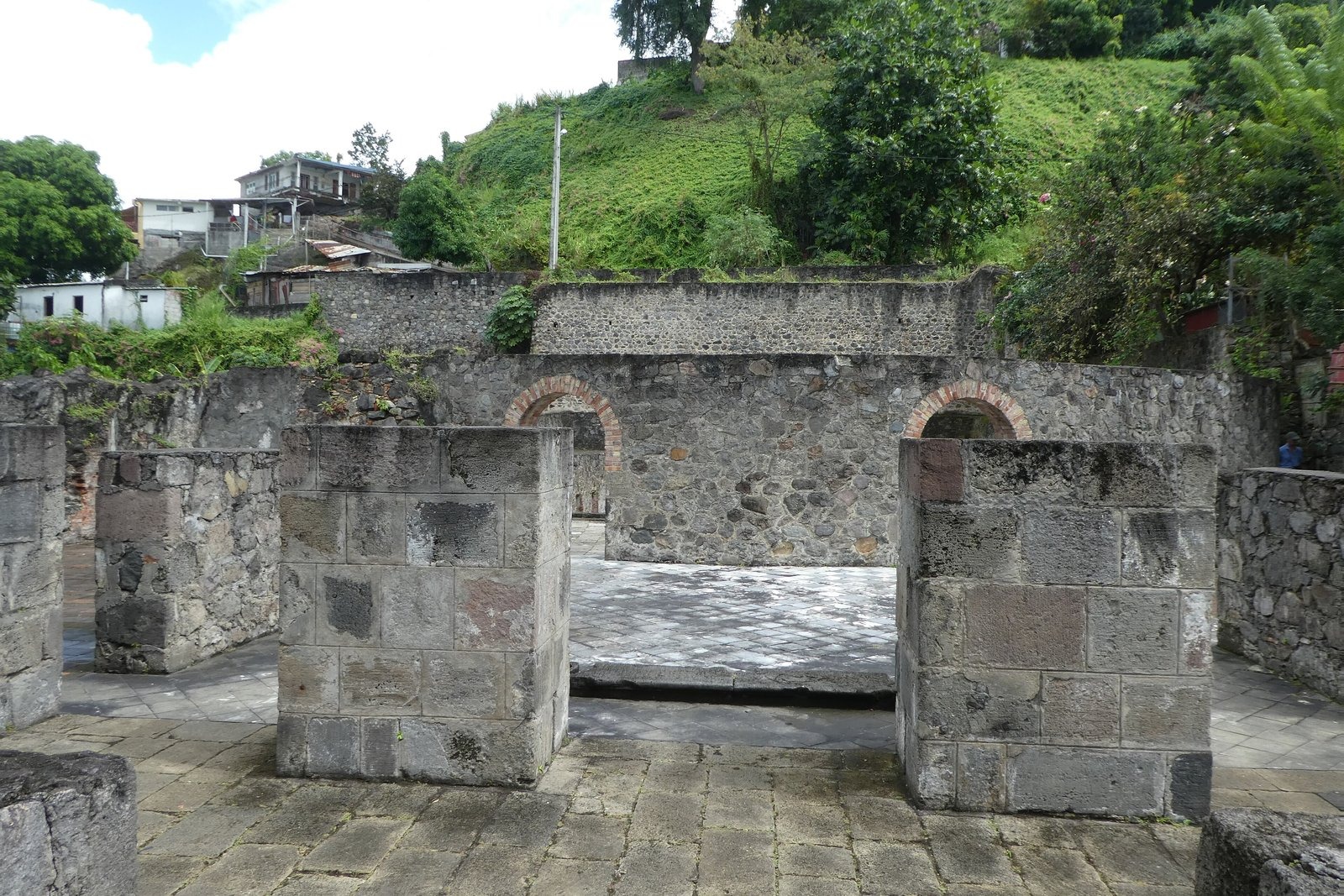
Cachot de Cyparis
A vaulted punishment cell in the former prison. Louis-Auguste Cyparis was held in it during the eruption and found alive on May 11. Its few openings face southwest, away from the path of the cloud, and that other survivors are named in other sources.
Théâtre de Saint-Pierre
Opened in 1786 by four merchants, it welcomed free people of color and fed the emergence of new musical styles, including biguine. Climb the surviving steps to the upper terrace and look for the two bronze dolphins.
Église du Fort
Rebuilt between 1895 and 1899 and destroyed during a solemn communion mass on May 8, 1902. The open-air ruins keep the Latin-cross layout, the chevet and ambulatory, and the remains of the main altar.
Maison coloniale de santé
A psychiatric hospital that opened in 1839, with hydrotherapy among its treatments. In the ruins, look for the metal restraint chair still bolted to the tiled floor, and the Sisters' courtyard with its hydrotherapy basins.
Cathédrale Notre-Dame-de-l'Assomption
The lower façade is from before the eruption; the upper stories and towers date from the 1923 reconstruction. Inside, the main altar of 1794 shows the Last Supper, and the stained glass of 2006 is by Victor Anicet.
Pont Roche
A single-arch stone bridge ordered in 1765 and completed in 1766, linking the Fort and Mouillage districts. In the nineteenth century storytellers nicknamed 'senators' gathered on its parapets, while washerwomen worked in the river below.
Place Bertin
Created in 1803 as a seafront esplanade for storing and trading goods. A covered market built between 1923 and 1925, inspired by Baltard's halls in Paris, now stands in the middle of it.
Mémorial de la catastrophe de 1902
A museum opened in 1933 on the site of the Batterie d'Esnotz, with a charred-black wood façade using the Japanese Shu sugi ban technique. Look for the bronze church bell warped by the heat of the eruption.