Tikal
Guatemala · Petén

Tikal, the city its kings called Yax Mutal

Twenty-one stops across the plazas, temples and causeways of a Maya capital that lay under forest for a thousand years.

$10.9921 stops · one payment
Already bought it? Open your tour

Listen to one stop before you buy

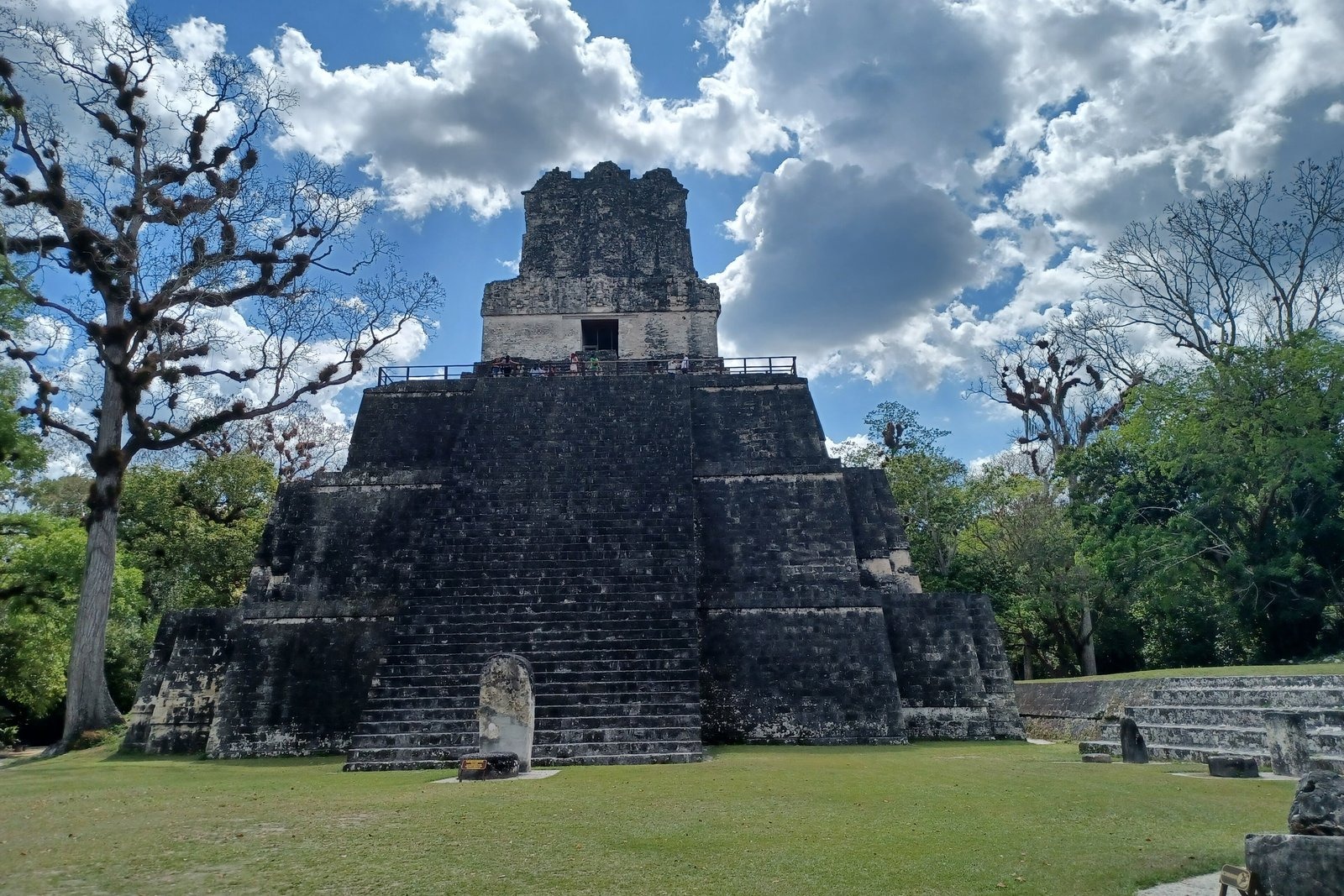
Photo: Simon Burchell (CC BY-SA 4.0)

The city its kings called Yax Mutal grew here for more than a thousand years, then lay under the forest until the Guatemalan official Modesto Méndez and the Petan governor Ambrosio Tut reported it in 1848. The tour walks the sites that follow its dynastic story: a lord named Siyaj K'ak' arriving in 378, defeat by Caracol in 562, and the revival under Jasaw Chan K'awiil, who beat Calakmul in 695.

The 21 stops include the Great Plaza with Temples I and II, the North and Central Acropolis, Temples III to VI, the Lost World complex, three twin pyramid complexes and two museums. The tour keeps to what the evidence supports. A palace may have housed elites, yet nothing found confirms it. A tomb is proposed for Temple IV, but none has turned up.

What you hear along the way

Great Plaza and Temples I and II

Temple I faces west toward the setting sun and holds Burial 116 of Jasaw Chan K'awiil. Temple II faces it across the plaza, and its summit shrine had a lintel beam carved with a royal woman, now in New York. A modern wooden stairway is the only way up Temple II, when open.

North Acropolis

A royal necropolis where successive rulers built over and enshrined earlier temples. The visible front-centre structure, 5D-33, has superimposed temples inside it, and a double row of stelae and altars stood in the plaza before it.

Temple IV

At some sixty-five metres it is the tallest building at Tikal, built by Yik'in Chan K'awiil around 741. Two carved lintels were taken to Basel in 1877. From the viewing platform you see Temples I, II and III above the canopy, the view used for the Rebel base in the 1977 Star Wars film.

Temple VI, the Temple of the Inscriptions

Far off the main circuit, at the end of the Méndez Causeway. Its roof comb carries an eroded text of at least 186 glyphs, including the largest glyphs in the Maya world. Stela 21 records its dedication in 736.

The Lost World Pyramid

One of the oldest ceremonial groups at Tikal, first raised in the Middle Preclassic. The pyramid rises about 31 to 32 metres with stairways on all four sides, and three small temples on the eastern platform mark equinox and solstice sunrises.

Twin Pyramid Complexes N, Q and R

Complexes built to mark the end of a k'atun, each with two flat-topped pyramids facing each other. Complex N has Stela 16 and Altar 5, among Tikal's finest monuments. Q dates from 771 and R has Stela 19 for the k'atun ending of 790.

Central Acropolis

A palace complex that grew upward rather than outward, with six enclosed courtyards linked by passages and stairs. One palace is identified as that of Chak Tok Ich'aak I, who died in 378. Canals fed a reservoir system beside it.

Museo Sylvanus G. Morley and Museo Lítico

The Morley museum displays about 250 pieces and a reproduction of Burial 116, plus Stela 31, raised in 445. The Museo Lítico shelters stelae and altars removed from the site, including the seated figure called El Hombre de Tikal.

The 21 stops

  1. The Great Ceiba
  2. Museo Lítico
  3. Museo Sylvanus G. Morley
  4. Twin Pyramid Complex Q
  5. Twin Pyramid Complex R
  6. Great Plaza
  7. Temple I
  8. Temple II
  9. North Acropolis
  10. Central Acropolis
  11. The Great Plaza Ball Court
  12. Temple III
  13. Bat Palace
  14. Twin Pyramid Complex N
  15. Temple IV
  16. The Lost World Pyramid
  17. The Talud-Tablero Temple
  18. Plaza of the Seven Temples
  19. Temple V
  20. Group G
  21. Temple VI, the Temple of the Inscriptions

Before you go

Starts at
The walk opens at the Great Ceiba by the visitor centre, called the first monument of the walk; every later stop plays as you reach it.
The route
21 stops on foot through the plazas, causeways and forest of the archaeological zone, with the two museums beside the visitor centre.
Good to know
Distances are long; the walk to Temple IV and back is several kilometres. The original stairs of Temples I, II, IV and V are not climbed, Temple III is closed to visitors, and Temple VI lies a long walk from the main circuit.
How it plays
In your phone's web browser, with no app to install. GPS starts each stop as you reach it, and once downloaded the tour plays without a signal.

Questions

Can I climb the temples?

The original stairs are not climbed. Temple II and Temple IV have a modern wooden stairway at the side, which is the only way up, when it is open. Temple III is closed to the public.

Who was Jasaw Chan K'awiil?

He is the king of Tikal's revival. In 695 he defeated Yuknoom Yich'aak K'ak' of Calakmul, the rival that had overshadowed the city since 562. Temple I holds his tomb, Burial 116, and Twin Pyramid Complex N marks a k'atun ending in 711 under him.

Does the tour cover the link with Teotihuacan?

Yes. It describes Siyaj K'ak' arriving in 378, and notes that whether this was conquest or alliance with Teotihuacan is still debated. Stela 31 and the Talud-Tablero Temple, a style associated with Teotihuacan, come into it.

Where are the long distances?

Temple VI is a long walk through the forest from the main circuit, reached by the Méndez Causeway, and Group G lies along the same causeway. The walk to Temple IV and back is several kilometres.

How does the GPS audio work?

Open the tour in your phone's browser, no app needed. Each stop plays by GPS when you reach it, and once downloaded it works without a data connection, which suits a forest site.

What is a twin pyramid complex?

A type distinctive to Tikal, built to commemorate the end of a k'atun, a 20-year period in the Maya Long Count. Two flat-topped pyramids face each other, with a walled enclosure holding a stela and altar.

Tikal — Yax Mutal, the Great City of the Petén

$10.99Tax included
Already bought it? Open your tour

More in Guatemala: Antigua Guatemala — the Ruined Capital of the Kingdom