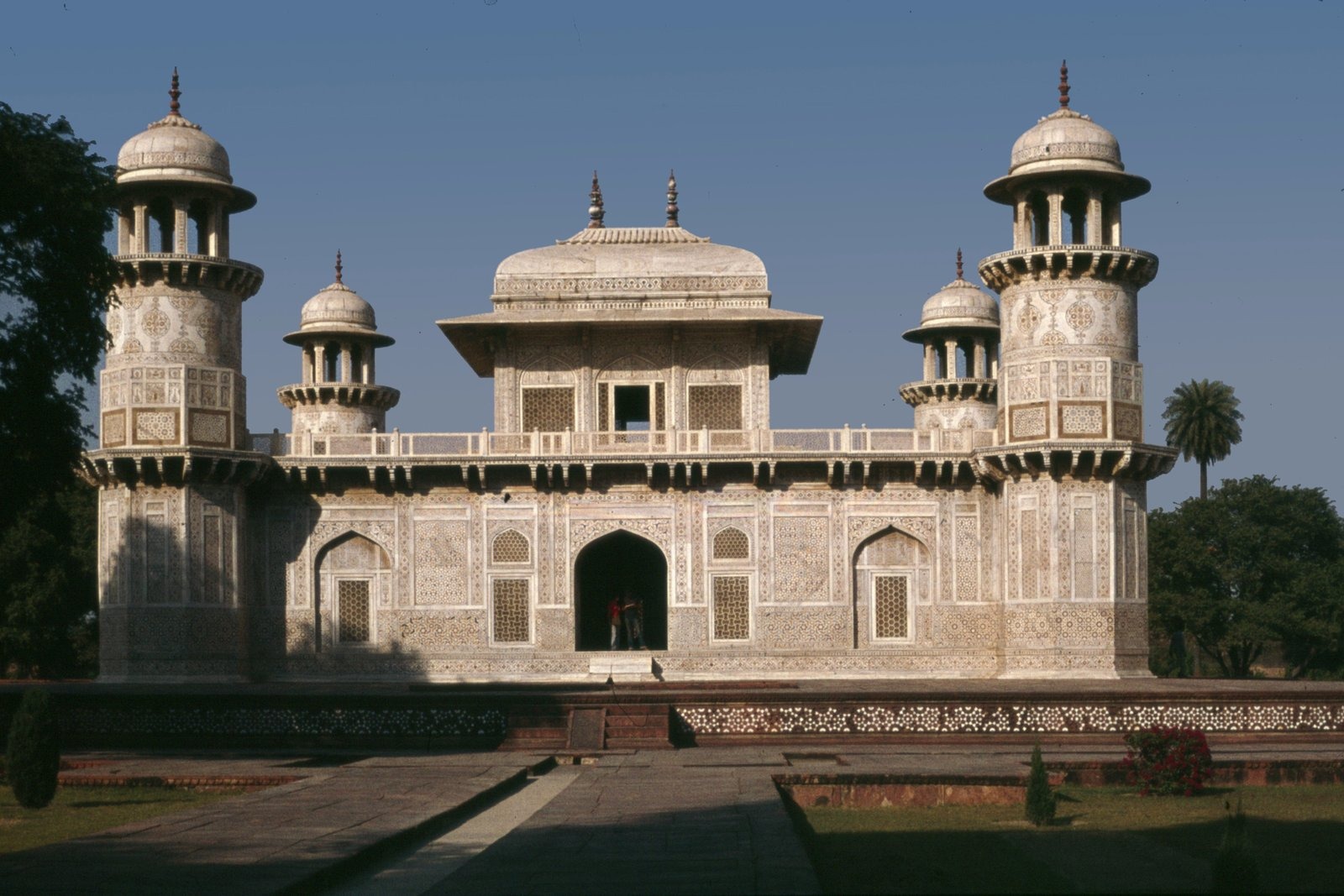
Tomb of Itimad-ud-Daulah
Built on a hasht-bihisht plan with marble jali screens. The outer panels are pietra dura, some inlaid stones no bigger than a fingernail, and a band of Quranic calligraphy by Abd al-Nabi al-Qarshi runs beneath the brackets between the two storeys.
Chini ka Rauza
The brick tomb of Afzal Khan Alami, a wazir of Shah Jahan, named for its glazed tiles. The river-facing wall keeps scattered blue, turquoise, yellow and green tiles, and the dome has seven honeycombed rings.
Mehtab Bagh
The Moonlight Garden sits directly opposite the Taj Mahal. Excavation brought back to light an octagonal tank placed to reflect the mausoleum, and found nothing to support the story of a black-marble Taj on this side of the river.
Chauburji
A small stone building on a raised platform, once Emperor Babur's temporary burial place before his remains went to Kabul. Its square plan, corner towers and arches made it a prototype for the Tomb of Itimad-ud-Daulah.
Agra Fort
A balcony on the river-facing wall of the Musamman Burj lines up precisely with the Taj. The guide also covers the so-called Somnath Gates, which are made of deodar rather than sandalwood, so the popular identification does not hold.
Jama Masjid
Commissioned by Jahanara Begum, Shah Jahan's daughter, in red sandstone with marble inlay. About 5,000 workers took six years to build it, and its open forecourt was constructed in 1648.
Taj Mahal
Built between 1631 and 1648 for Mumtaz Mahal. The guide explains that the calligraphy above the entrance arch grows larger towards the top to offset the viewing angle, and the flowers in the marble are cut stones, not paint.
Taj Mahal Masjid
The red-sandstone mosque west of the mausoleum, mirrored on the east by its pair, the jawab. The prayer floor is marked with the outlines of 569 prayer rugs, set in black marble.