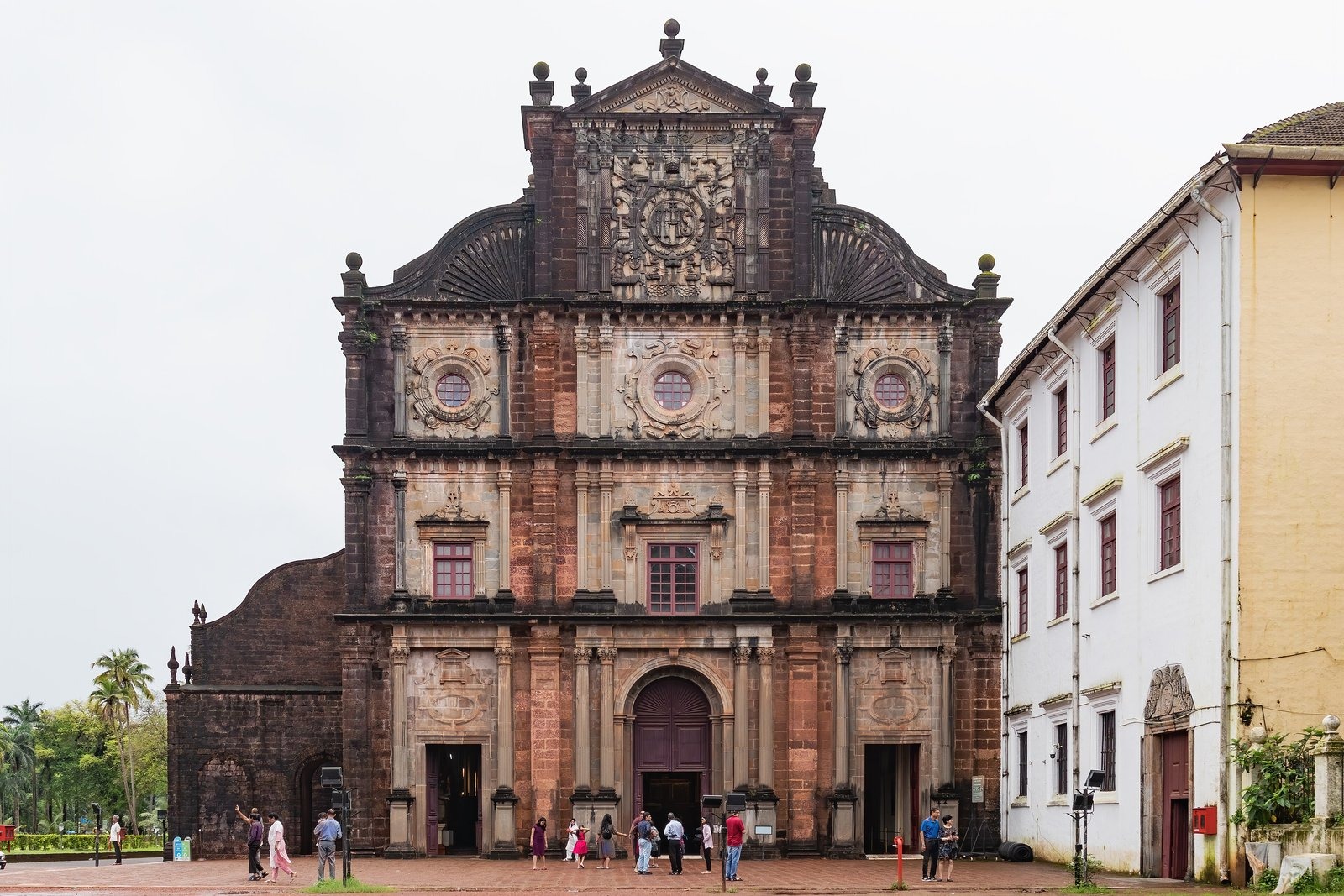
Basilica of Bom Jesus
A Jesuit church built between 1594 and 1605 of local laterite to house the relics of St Francis Xavier. The silver casket stands raised in its chapel, with relief panels on the sides showing episodes from his life and death.

A walking loop through the laterite churches, ruined convents and gates of a once-great Asian port.
Listen to one stop before you buy
Photo: iMahesh (CC BY-SA 4.0)
The open ground at Old Goa once held one of the great cities of Asia. The Bahmani sultans founded a port here on the Mandovi in the fifteenth century, the Adil Shahis of Bijapur used it as a second capital, and in November 1510 Afonso de Albuquerque took it for Portugal. As the capital of Portuguese India it grew rich on horses, gold, ivory and spices, and at its height travellers counted more than fifty churches and convents.
Cholera, malaria and the decline of trade emptied it: the population fell from about twenty thousand in 1695 to about sixteen hundred in 1775. What survives are the churches, and this tour visits 19 stops among them. The walk loops about four kilometres from the Bom Jesus Basilica to the river, up Holy Hill and out to the gate of St Paul's College, and you can cut it short at any point. The audio plays in your browser, triggers each stop by GPS and works offline once downloaded.
A Jesuit church built between 1594 and 1605 of local laterite to house the relics of St Francis Xavier. The silver casket stands raised in its chapel, with relief panels on the sides showing episodes from his life and death.
Begun in 1562 on the orders of King Sebastian and dedicated to St Catherine. One of its two towers collapsed in 1776 and was never rebuilt. The narration also places the Goa Inquisition's palace just south of the courtyard.
Built for the Theatine friars on Roman models by Italian architects. Beneath the central dome, an opening on a raised platform lets you look down an unusually deep well, with a Latin inscription running round the cupola above.
Rebuilt between 1952 and 1954 after it collapsed, it was raised by Viceroy Francisco da Gama to honour his great-grandfather Vasco da Gama. The river side carries Vasco's statue and the deer from his coat of arms.
A fortress-like church on Monte Santo above the old road to Panjim. A marble slab records Albuquerque's reconquest of Goa on 25 November 1510, and the altar carvings include mangoes and cashews among European decoration.
A lone basalt pillar where offenders were tied and publicly whipped. It is popularly called the hand-cutting pillar, but the guide stresses the documented use was whipping. Its shape suggests it may once have belonged to a temple.
Behind the surviving four-storey tower, the Augustinian complex stands open to the sky after its vault collapsed. The guide points to a relic associated with Queen Ketevan of Georgia, found in the chapter chapel area by excavation.
A basalt gateway reached by six steps, resembling a Hindu temple doorway rather than a purpose-built Islamic palace entrance. It served the palace of Adil Shah, who used Old Goa as an auxiliary capital and port.
The Basilica of Bom Jesus, the Sé Cathedral, the churches of St Francis of Assisi, St Cajetan, St John of God and the Carmelites, the Convent of St Monica, the Augustinian tower and ruins, plus chapels, two gates, the Viceroy's Arch and the Pillory.
The tour says his relics were moved to the Basilica of Bom Jesus in 1624 and rest in a silver-covered casket in the Chapel of St Francis Xavier, off the south transept. The casket stands high above the chapel floor.
The guide points to cholera, malaria and the decline of trade. The population fell from about twenty thousand in 1695 to about sixteen hundred in 1775, the viceroy moved to Panjim in 1759, and the capital was formally transferred in 1843.
Yes. The first stop describes a loop of about four kilometres and says you can cut it short at any point. Each stop is triggered by GPS, so the audio plays whenever you reach one.
The guide plays in your phone's browser with no app to install. Once you have downloaded the tour for offline use, the audio keeps working without a data connection while you walk between stops.
More in India: Agra — Itmad-ud-Daulah (the Baby Taj), Chini ka Rauza and the Yamuna Riverbanks