Ayutthaya Historical Park
Thailand · Central Thailand

The ruins of Ayutthaya, temple by temple

Thirteen stops across the old Siamese capital, from its first monastery to the river's far bank.

$10.9913 stops · one payment
Already bought it? Open your tour

Listen to one stop before you buy

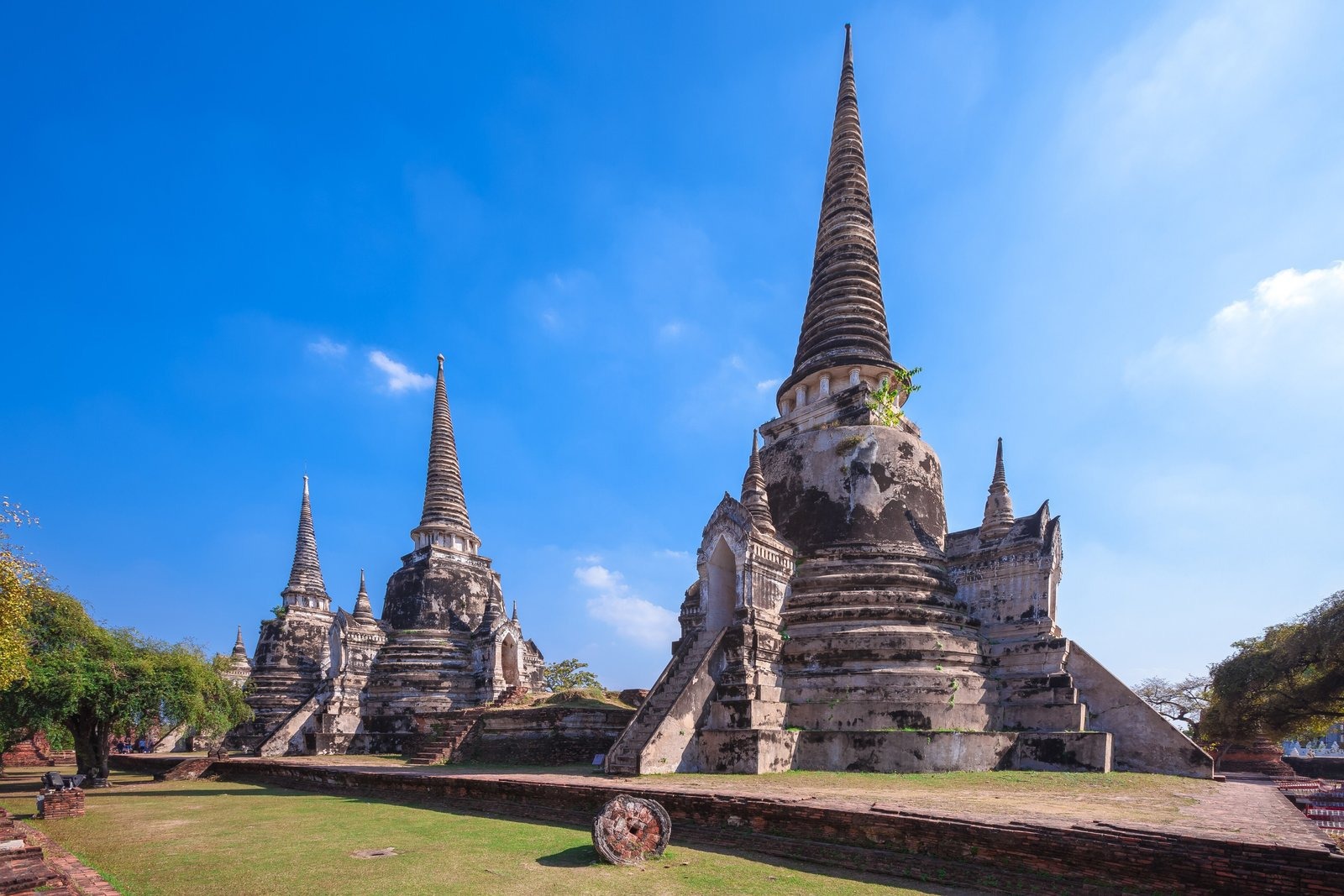
Photo: This Photo was taken by Supanut Arunoprayote. ()

Ayutthaya was founded as the Siamese capital in 1351 by the usual reckoning, and for roughly four centuries it was a cosmopolitan trading city. In 1767 the Burmese army conquered it, razed it and looted it, and royal palaces, temples, records and art were destroyed or lost. The ruins were registered as an ancient monument in 1935, became a Historical Park in 1967 and were inscribed by UNESCO in 1991.

The tour opens at Wat Maha That, about 80 kilometres north of Bangkok, and covers the island where the old capital stood. Stops include the crypt of Wat Ratchaburana, the three royal chedis of Wat Phra Si Sanphet, a brick Reclining Buddha, the museum built for the Ratchaburana treasures and a house compound showing central-Thai building methods. The last two stops are across the river. Each plays by GPS as you reach it.

What you hear along the way

Wat Maha That

Founded under King Borommaracha I, with construction recorded from 1374 to 1388. Seven nested miniature chedi were found in its relic chamber, and a sandstone Buddha head sits held by the roots of a tree. The guide notes the face is not carved into the roots.

Wat Ratchaburana

Founded in 1424 by King Borom Rachathirat II on the site where his two elder brothers fought and died in a duel for the throne. A steep staircase leads down into a three-level crypt with faded 15th-century murals of the Buddhist cosmos.

Wat Phra Si Sanphet

Built on the former Grand Palace grounds as a royal chapel with no resident monks. Three bell-shaped chedis hold the remains of kings. The bronze core of its great golden standing Buddha was moved to Wat Pho in Bangkok after 1767.

Wat Thammikarat

A working temple where monks still follow daily routines. The Sing Lom chedi has a ring of 52 lion figures at its base, and a courtyard is filled with rooster statues from human-sized down to tiny. A replica of the bronze Thammikarat Head stands here.

Wat Lokkayasutha

An outdoor brick Reclining Buddha, 42 metres long and 8 metres high, with twenty-four octagonal pillars standing around it. The guide suggests looking for the folds of the robe still visible in the plaster.

Wihan Phra Mongkhon Bophit

Shelters a gigantic image made by molding rather than sculpting. It was moved to this western site in King Songtham's reign, and the current building replaced one struck by lightning. Look for traces of repeated repairs on the bronze.

Phra Chedi Si Suriyothai

A white chedi with a gilded spire, built in 1912 to commemorate Queen Suriyothai, who died in battle. Relics found in a restoration in 1990 are kept at the Chao Sam Phraya National Museum.

Wat Chai Watthanaram

Commissioned by King Prasat Thong in 1630 on the west bank of the Chao Phraya River. Its central prang rises 35 metres to stand for Mount Meru, with eight merus around it that served as crematoria for the royal family.

The 13 stops

  1. Wat Maha That
  2. Wat Ratchaburana
  3. Wat Thammikarat
  4. Wat Phra Ram
  5. Chao Sam Phraya National Museum
  6. Wihan Phra Mongkhon Bophit
  7. Khum Khun Phaen's Residence
  8. Wat Phra Si Sanphet
  9. Grand Palace
  10. Wat Worachettharam
  11. Wat Lokkayasutha
  12. Phra Chedi Si Suriyothai
  13. Wat Chai Watthanaram

Before you go

Starts at
At Wat Maha That on the old city island, about 80 kilometres north of Bangkok; each later stop plays as you reach it.
The route
Thirteen stops across the island of Ayutthaya, spread over several kilometres, with the last two across the river.
Good to know
The ruins are spread out, so the guide notes that the walk from Wat Maha That to Wat Lokkayasutha alone is a few kilometres. The Wat Ratchaburana crypt is described for when it is open.
By ship
Laem Chabang is the port linked to this tour. See Laem Chabang.
How it plays
In your phone's web browser, with no app to install. GPS starts each stop as you reach it, and once downloaded the tour plays without a signal.

Questions

Where is Ayutthaya?

It is about 80 kilometres north of Bangkok, on an island where the old Siamese capital stood. The tour covers the ruins on that island, plus Wat Chai Watthanaram and the Suriyothai chedi across the river.

What happened to Ayutthaya?

The Burmese army conquered and destroyed it in 1767. The guide describes the loss of palaces, temples, records and art, and how excavation began in 1956, major renovation in 1969 and UNESCO inscription in 1991.

Can I go inside a crypt?

At Wat Ratchaburana, when it is open, you can descend a steep, narrow staircase in the central prang to a crypt with faded murals. Many of the gold objects and votive tablets found there are in the Chao Sam Phraya National Museum.

Is it all ruins?

Mostly, but not entirely. Wat Thammikarat is an active temple, the Mongkhon Bophit image sits in a restored hall, and Khum Khun Phaen's Residence is a compound of traditional central-Thai wooden houses.

Do I need mobile data?

No. The tour plays in your browser with no app, each stop starts by GPS as you arrive, and once downloaded it works offline.

How far apart are the sites?

Far enough that you should expect to cover several kilometres. The guide says the ruins are spread across the island, and the Suriyothai chedi and Wat Chai Watthanaram lie across the river.

Ayutthaya — the Ruined Capital of Siam

$10.99Tax included
Already bought it? Open your tour

More in Thailand: Bangkok's Grand Palace and Rattanakosin — Wat Phra Kaew, Wat Pho and the Royal Core