Grand Palace and Rattanakosin Island
Thailand · Bangkok

Rattanakosin Island, from palace to riverbank

Twenty-eight stops through the royal core of Bangkok, from the Emerald Buddha's temple to the porcelain prang of Wat Arun.

$10.9928 stops · one payment
Already bought it? Open your tour

Listen to one stop before you buy

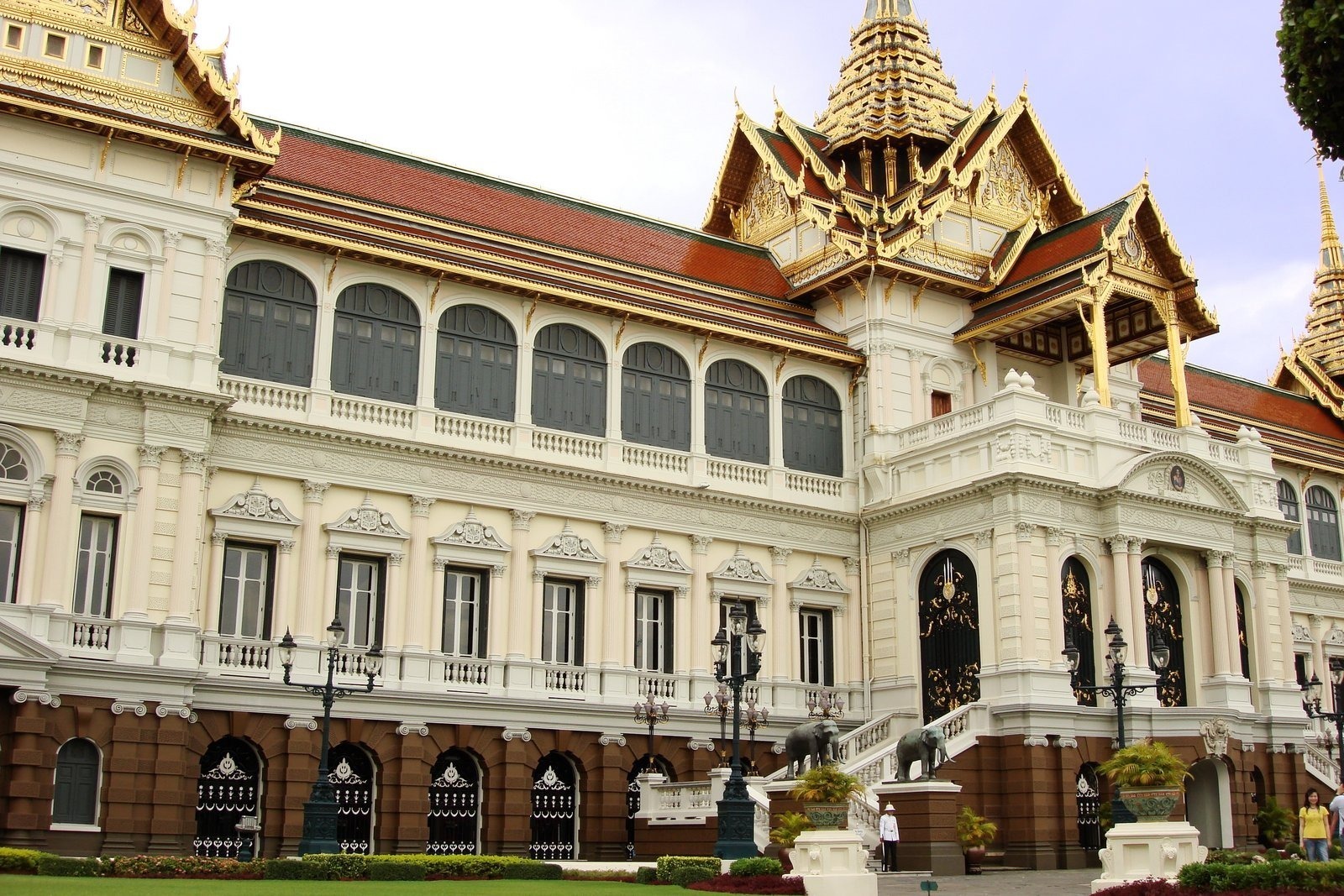
Photo: Jorge Láscar from Australia (CC BY 2.0)

In 1782 King Rama I moved the capital from Thonburi to the eastern bank of the Chao Phraya and commissioned the Grand Palace on the artificial island of Rattanakosin. His aim was a royal capital that recalled Ayutthaya, and much of what you see echoes it: the ubosot modeled on an Ayutthaya temple, prangs taller and thinner than Ayutthaya's, a replica of Angkor Wat.

The tour begins outside the walls of the Grand Palace, though the guide says it can be taken in any order. It covers Wat Phra Kaew and its Ramakien cloister, the throne halls, the City Pillar Shrine, Sanam Luang, the Democracy Monument, the Golden Mount, Wat Suthat and the Giant Swing, Wat Pho with its Reclining Buddha, and Wat Arun across the river. Each stop plays by GPS as you reach it.

What you hear along the way

Phra Ubosot and the Emerald Buddha

The ordination hall of Wat Phra Kaew was modeled on Wat Phra Sri Sanphet in Ayutthaya. A row of 112 small golden garudas, each pinning a naga's tail, runs along its base, and the Emerald Buddha inside is only 66 centimeters tall and carved from green jasper.

Ramakien Mural Cloisters

A covered corridor around the temple with 178 painted scenes of the Ramakien, from the royal births to Rama and Sita's reunion. In Mural 128, Thotsakan's palace resembles Prasat Phra Thep Bidon, because the story was set in a Thai world.

Chakri Maha Prasat Hall

Begun in 1876 and inaugurated in 1882, it was reportedly designed as an entirely Western building, then given Thai roofs and three spires. Look for the Chakri dynasty emblem above the entrance doors: a three-bladed sword through a sharpened discus.

Model of Angkor Wat

A detailed scale replica commissioned by King Rama IV and completed under King Rama V in 1869, so that court audiences could see Angkor Wat without travelling to Cambodia. A visitor account says crossing the passage beneath it is considered lucky.

Democracy Monument

Commissioned in 1939 to commemorate the 1932 change of government. The number 24 recurs for the date of the revolution, 24 June, and its 75 small cannons refer to the Buddhist-calendar year 2475, which is 1932.

Golden Mount

An artificial hill at Wat Saket. King Rama III's planned giant chedi collapsed in Bangkok's soft soil, and Rama IV changed the plan to a reinforced mound. Vulture statues on the spiral staircase recall its past as a cremation ground during epidemics.

Wat Pho and its Reclining Buddha

The Reclining Buddha is about 46 meters long and 15 meters high, with 108 mother-of-pearl symbols on its soles, and a row of 108 bronze bowls beside it. The four great chedis commemorate the first four Chakri kings in green, white, yellow and dark blue.

Wat Arun

On the west bank, its central prang stands for Mount Meru and was completed in 1851 under Rama III. Its surface is set with Chinese export porcelain carried as ballast by trading ships, and Indra on the three-headed elephant Erawan appears in niches.

The 28 stops

  1. Grand Palace
  2. Phra Ubosot of Wat Phra Kaew
  3. Phra Si Rattana Chedi
  4. Phra Phothithat Phiman
  5. The Eight Prangs of Wat Phra Kaew
  6. Phra Suwannachedi
  7. Model of Angkor Wat
  8. Ramakian Mural Cloisters
  9. Pavilion of Regalia, Royal Decorations and Coins
  10. Amarin Winitchai Throne Hall
  11. Chakri Maha Prasat Hall
  12. Dusit Maha Prasat Hall
  13. Museum of the Emerald Buddha Temple
  14. Queen Sirikit Museum of Textiles
  15. Lak Mueang, the City Pillar Shrine
  16. Sanam Luang
  17. Wat Mahathat
  18. Bangkok National Museum
  19. Democracy Monument
  20. Loha Prasat
  21. Golden Mount
  22. Wat Suthat
  23. Giant Swing
  24. Wat Ratchabophit
  25. Wat Pho
  26. The Reclining Buddha, Wat Pho
  27. The Four Great Chedis of Wat Pho
  28. Wat Arun

Before you go

Starts at
Outside the walls of the Grand Palace, at the heart of Rattanakosin Island; the stops can be taken in any order.
The route
Twenty-eight stops on foot around Rattanakosin Island, inside the palace and Wat Phra Kaew, through the surrounding temples and squares, and across to Wat Arun.
Good to know
The Model of Angkor Wat cannot be entered and is viewed from beside it. The Golden Mount is climbed by an external spiral staircase, and the Giant Swing has no rope attached today. Several museums are described for when they are open.
When to go
Sanam Luang hosts the Royal Ploughing Ceremony each May, and from February through April the windy season brings traditional Thai kites to the field.
How it plays
In your phone's web browser, with no app to install. GPS starts each stop as you reach it, and once downloaded the tour plays without a signal.

Questions

Where does the tour begin?

The first stop places you at the Grand Palace, outside its walls, at the heart of Rattanakosin Island. It also says the tour can be taken in any order, and each of the twenty-eight stops plays when you reach it.

Is the Emerald Buddha really emerald?

No. The guide on the Phra Ubosot says the Emerald Buddha is only 66 centimeters tall and carved from green jasper, not emerald. It sits inside a consecrated area marked by boundary stones.

What are the Four Great Chedis at Wat Pho?

Memorials to the first four Chakri kings, about 42 meters high and colour-coded: green for Rama I, white for Rama II, yellow for Rama III and dark blue for Rama IV. The green one contains the remains of the Ayutthaya standing Buddha Phra Si Sanphet.

Why does the Giant Swing have no swing?

It was built in 1784 for Brahmin swing ceremonies honoring Shiva and Vishnu. The guide says the swinging stopped, after fatal accidents by some accounts or for economic reasons by another, and the red frame remained as a landmark.

Does the tour cover more than the palace?

Yes. Beyond the Grand Palace and Wat Phra Kaew it takes in Sanam Luang, the National Museum, Loha Prasat, Wat Suthat, Wat Ratchabophit, Wat Mahathat and Wat Arun, among others.

How does it work on my phone?

The tour plays in your browser, so no app is needed. Each stop starts by GPS as you arrive, and once you have downloaded it, it works offline.

Bangkok's Grand Palace and Rattanakosin — Wat Phra Kaew, Wat Pho and the Royal Core

$10.99Tax included
Already bought it? Open your tour

More in Thailand: Ayutthaya — the Ruined Capital of Siam