Corpus Clock
A gold-plated stainless-steel face with no hands, showing the time as blue-lit slits. The grasshopper-like Chronophage on top opens its jaws and snaps them shut to appear to consume time, and runs deliberately erratically.

Gates, chapels, bridges and a market square, with the myths about them sorted from the records.
Listen to one stop before you buy
Photo: Christopher Hilton (CC BY-SA 2.0)
Cambridge keeps its history in specific objects, and several of them come with a legend attached. The Mathematical Bridge is said to have been built by Isaac Newton without nuts or bolts, but Newton died in 1727 and the bridge dates from 1749. A missing stone ball on Clare Bridge is said to be a builder's revenge for being underpaid, which nobody has shown. This tour gives you the stories and what the records say.
It has 18 stops, from Peterhouse, founded in 1284 as the oldest college, to the Corpus Clock with its time-eating Chronophage. Along the way are the gates of Caius and Trinity, King's College Chapel, the Senate House, the Round Church and the market. The guide plays in your browser, triggers each stop by GPS and works offline once downloaded.
A gold-plated stainless-steel face with no hands, showing the time as blue-lit slits. The grasshopper-like Chronophage on top opens its jaws and snaps them shut to appear to consume time, and runs deliberately erratically.
Erected in 1575 to John Caius's design, the last of three gates marking a student's path from humility through virtue to honour. It introduced Italian Renaissance classical architecture to Cambridge, and students usually pass through only at graduation.
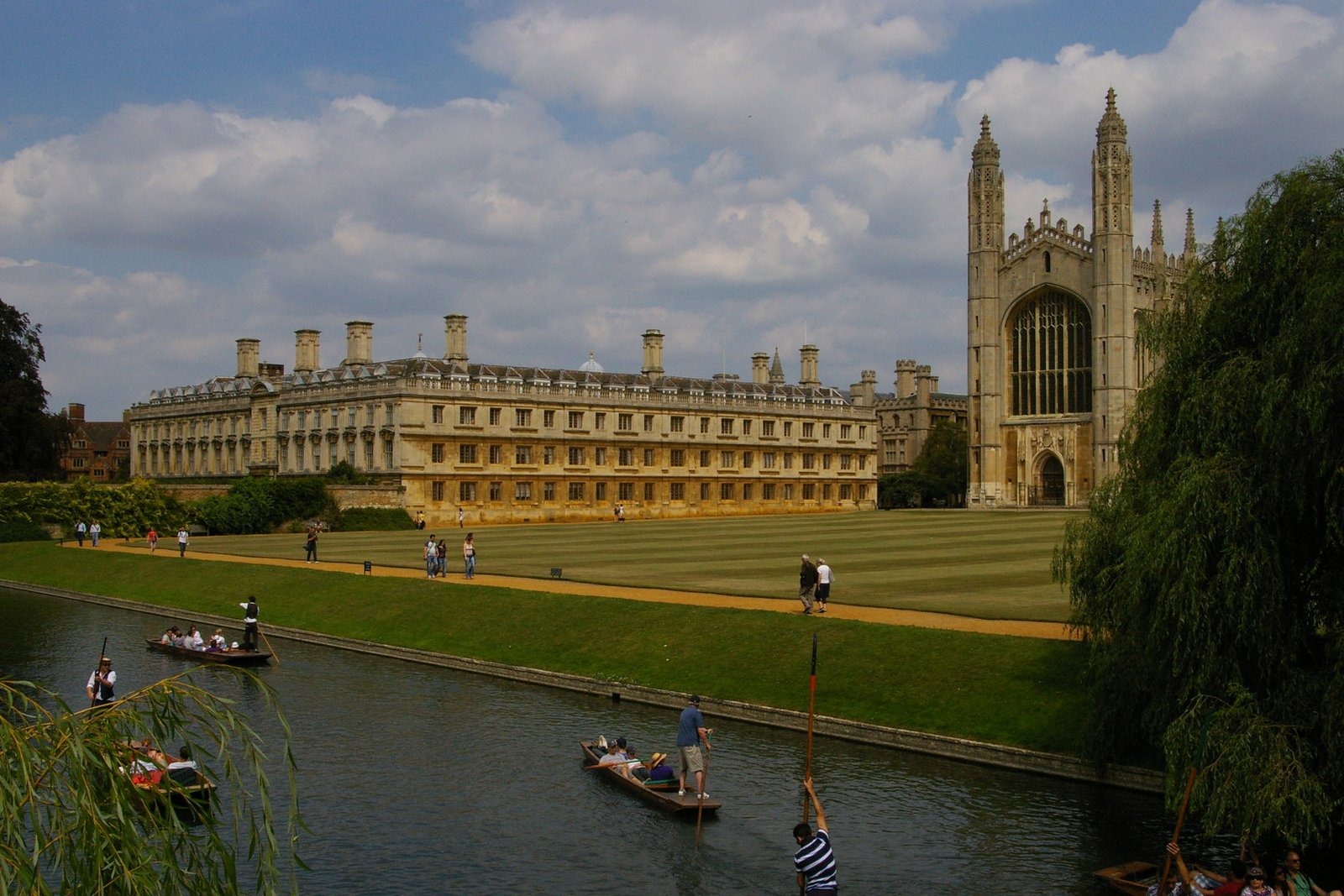
Begun by Henry VI in 1446, who cleared a quarter of the medieval town for it. John Wastell finished the fan vault around 1515, and the windows are the largest surviving set of early sixteenth-century stained glass.
A coaching inn that opened in 1667. In 1953 Francis Crick announced the DNA double helix here, and in the Second World War airmen burned their names and squadron numbers into the ceiling of the rear bar.
Designed by William Etheridge in 1749 with straight timbers arranged as tangents to a circular arc. The guide explains why the Newton story is a myth and where to stand on Silver Street Bridge for the best free view.
Built at Trinity between 1676 and 1695, with Christopher Wren's services secured without payment. Look for the marble statue of Lord Byron and a five-metre window showing Newton presented to George III.
One of only four medieval round churches still in use in England, modelled on the Church of the Holy Sepulchre in Jerusalem. It was founded by a fraternity, though the guide says its exact identity remains unknown.
Samuel Pepys left his three thousand books to Magdalene on strict terms: none added, none taken away, all kept in his own cases. The guide says the library is closed for refurbishment until 2027.
Peterhouse, founded in 1284. Its Hall of about 1290 still keeps parts of its original clunch walls. The foundation housed a Master and fourteen scholars after Hugh de Balsham, Bishop of Ely, moved it to its present site.
No. The tour calls this a myth: Newton died in 1727, twenty-two years before the bridge was built in 1749, and the bridge was always fastened. The straight timbers form a tangent-and-radial lattice that creates the curve.
The pub served Cavendish Laboratory staff at lunch, and in 1953 Francis Crick announced the discovery of the DNA double-helix structure there, with Rosalind Franklin's X-ray data as the evidence. A plaque and a blue plaque mark it.
Three: Clare Bridge, built between 1638 and 1640 and the oldest surviving bridge in Cambridge, the Mathematical Bridge at Queens' College, and St John's Bridge of Sighs, built in 1831, from which students twice suspended a car.
No. The guide plays in your phone's browser without an app, and each stop starts by GPS. After you download the tour, it works offline.
More in United Kingdom: London Bus Tours · Lindisfarne — Holy Island, the Priory, St Cuthbert and the Castle · Avebury