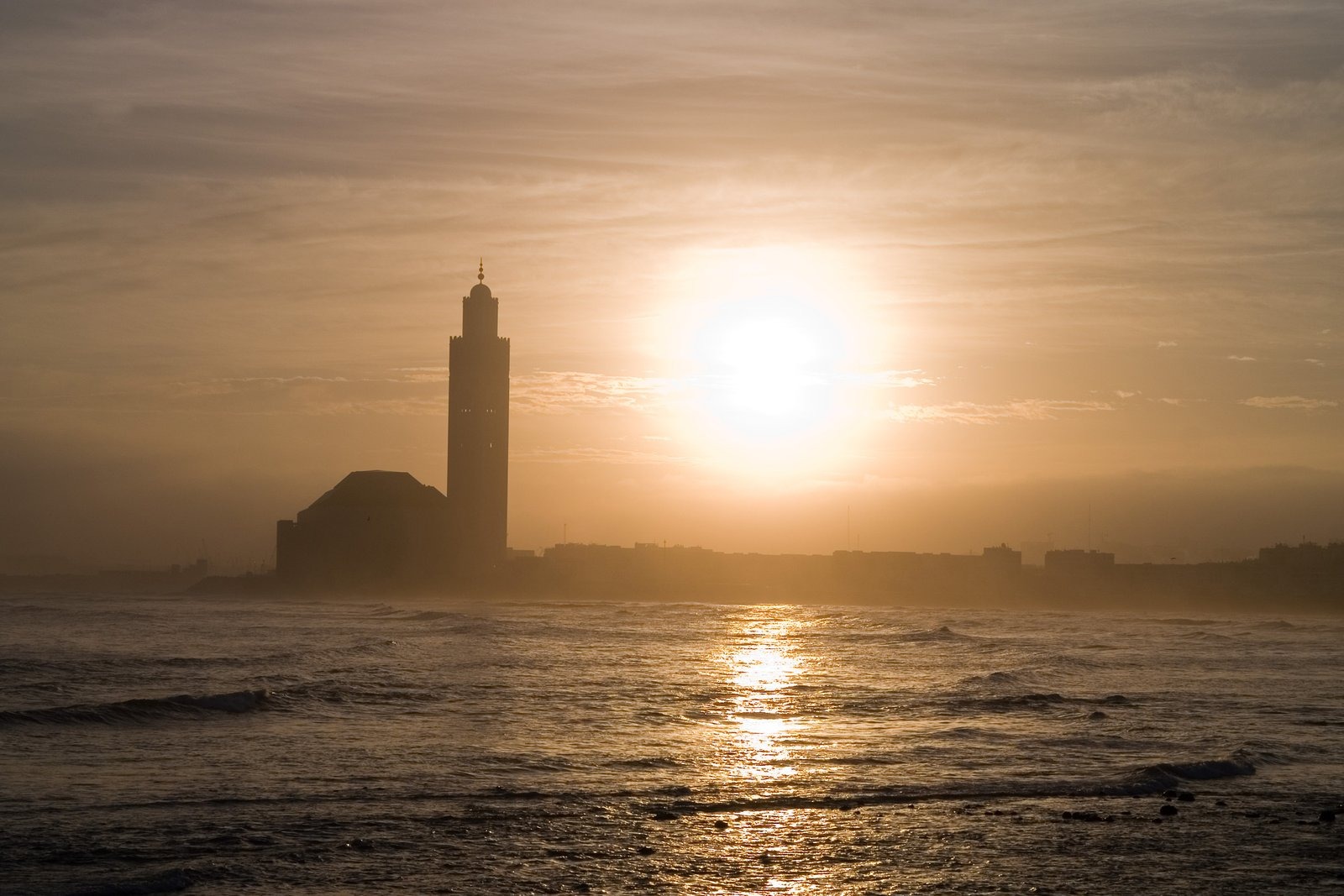
Hassan II Mosque: esplanade and minaret
About fifteen hectares of land reclaimed from the sea, with foundations of 26,000 cubic metres of concrete. The minaret is more than 200 metres high, was first planned at 175 metres and needed a new high-performance concrete.
Hassan II Mosque: hammam and museum
Beneath the esplanade are separate hammam halls for men and women, each with a heated seawater pool, and a museum of the zellige, cedar and stucco samples set aside while the mosque was built.
The Sqala
A fan-shaped artillery bastion of 1769 with a ridge designed to deflect cannonballs. The guide separates it from the Portuguese, since the sea wall belongs to the Alawite rebuilding.
The Old Medina
From Anfa to the Portuguese capture of 1468, Casa Branca from 1515 and the earthquake of 1755. The walled area covers about 48 hectares, and a rehabilitation programme ran from 2010 to 2023.
Ettedgui Synagogue, Ould el-Hamra Mosque and San Buenaventura
Three places of worship in the same part of the medina, often called a monotheistic triangle. The synagogue was bombarded in 1942 and rededicated in December 2016; the church ended services in 1968 and is now a cultural centre.
Place Mohammed V
Planned in 1916 on the site of military barracks. The Wilaya, Palais de Justice, Grande Poste and Bank Al-Maghrib around it dress state institutions in Moroccan and Andalusian forms. The fountain's pigeons gave it the name Pigeon Square.
Place des Nations Unies and Hotel Excelsior
A reinforced-concrete hotel of the 1910s by Hippolyte-Joseph Delaporte, built over a stream bed with an inverted-vault raft foundation to resist groundwater. Nearby, the clock tower is a 1993 reconstruction.
Marché Central and Boulevard Mohammed V
Built in stages between 1917 and 1920 to plans by Pierre Bousquet, with a horseshoe-arched front and eight entrances. The boulevard's 1930s ornament mixes Art Deco with zellige and stucco.