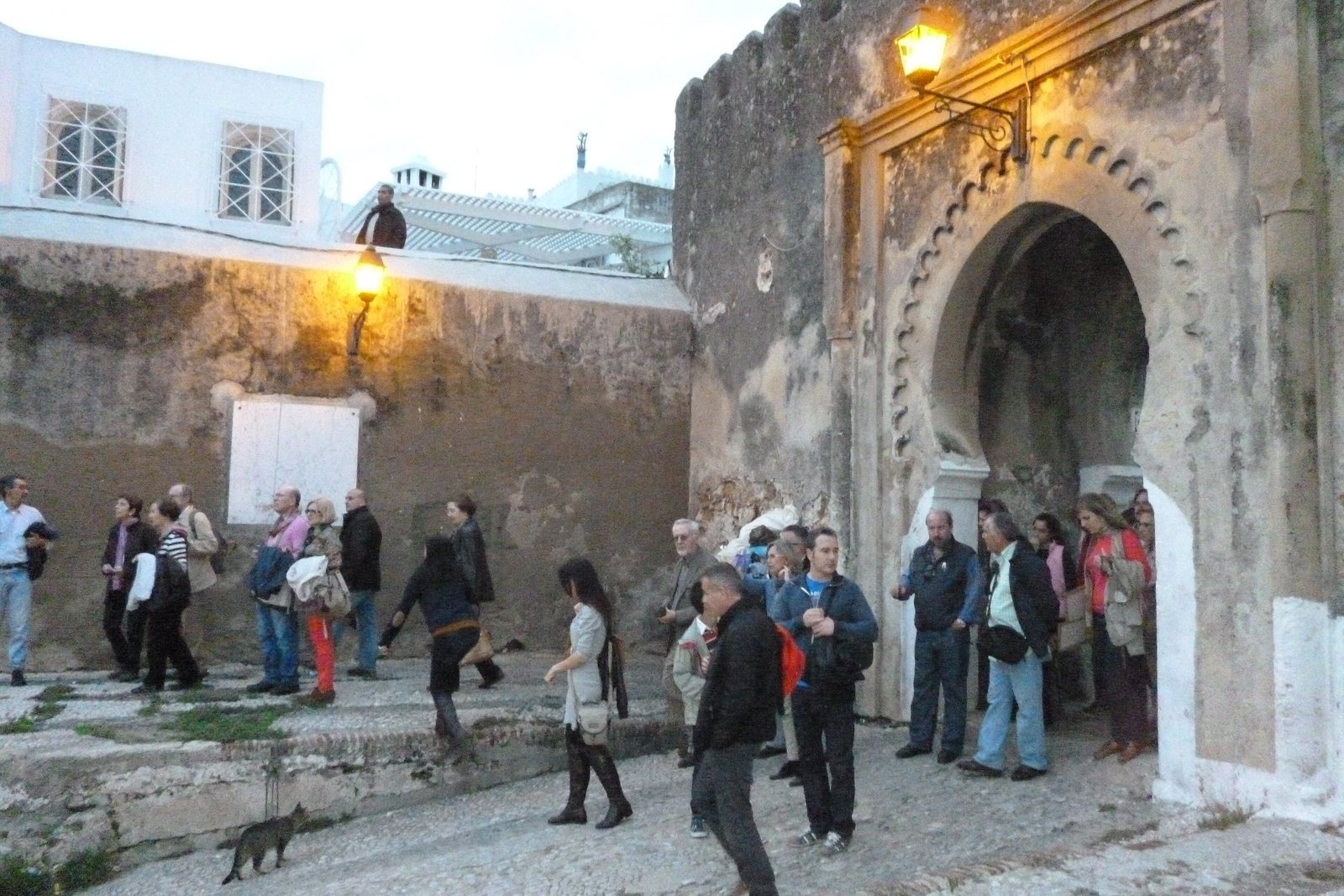
Terrasse des Paresseux
A tiled terrace above the port, lined with antique bronze cannons and fixed binoculars aimed at Spain. The guide uses the view to tell the city's whole story, from Phoenician trading town to Roman Tingis, Portuguese, English and Moroccan hands.
Grand Socco and the Mendoubia Gardens
The square is officially Place du 9 Avril 1947, named for the day Sultan Mohammed V spoke in the neighbouring gardens claiming Morocco's sovereignty. The gardens also hold a banyan tree said to be 800 years old, and the mansion of the Sultan's representative.
St Andrew's Church
Consecrated in 1905 and built and decorated by Moroccan craftsmen, this Anglican church has horseshoe arches, painted star ceilings and the Lord's Prayer in Arabic calligraphy above the altar. Matisse painted it in 1913, and Emily Keene is remembered inside.
Petit Socco
The inner market square on the old Rua Direita axis. Consulates, banks and four foreign post offices once surrounded it, and Café Central and Café Tingis still face the plaza, where writers, spies, smugglers and exiles met during the international zone.
Tangier American Legation
Given to the United States in 1821, it was the first property the American government ever owned abroad. It is now the only US National Historic Landmark in a foreign country, with a wing given to Paul Bowles.
Moshe Nahon Synagogue
Built in the 1870s and named for the community council's president, who interpreted for Sir Moses Montefiore. You reach it through a hidden alley and a small courtyard. Restored in 1994, it holds carved stucco, a wooden ark and community objects.
Tomb of Ibn Battuta
A small building commemorating the traveller born in Tangier in 1304, who covered perhaps 117,000 kilometres between 1325 and 1354. The guide is frank that it is uncertain whether he is actually buried here.
Dar el Makhzen and the Kasbah Museum
The palace on the kasbah's highest point was built in the early eighteenth century by Pasha Ahmed ben Ali al-Rifi. Inside are an iron treasury safe, Roman finds from Lixus, Cotta and Volubilis, and a Roman mosaic of the Voyage of Venus.