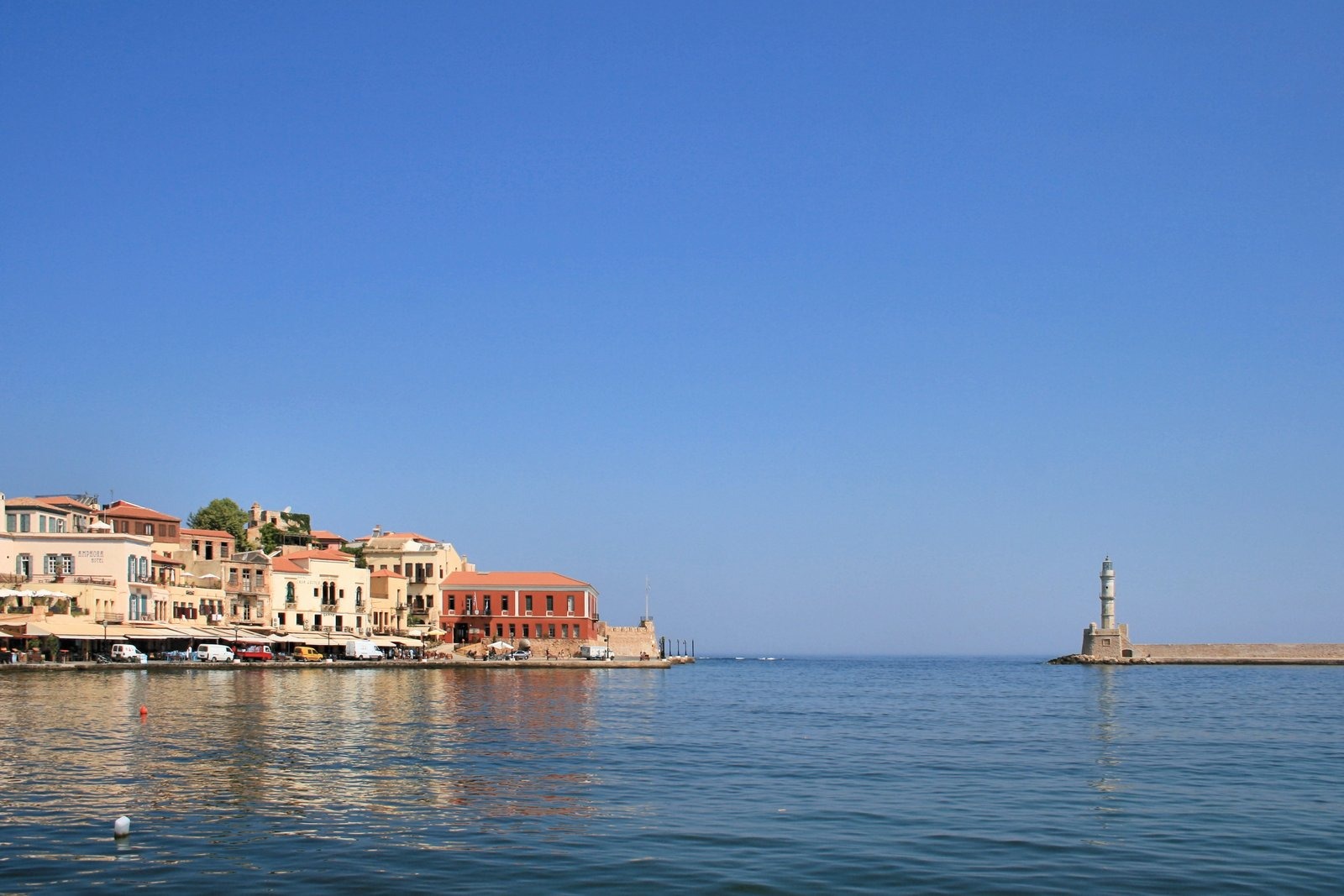
Venetian Harbour, Mole and Lighthouse
The harbour was built for trade, naval control and protection from pirates; the mole's construction was approved in 1302. The lighthouse began as a Venetian beacon of 1595 to 1601, and its present form is the Egyptian administration's rebuilding of the 1830s.
Venetian Arsenals and Megalo Arsenali
Seventeen shipyards once stood side by side, with sea-facing arches that let galleys be hauled in. The Grand Arsenal, built between 1585 and 1600, later served as a school, a hospital and the Town Hall.
Firkas Fortress
The Venetian fortress could stretch a chain across the harbour mouth to the lighthouse. The stop points out the six cannon openings, a 1620 inscription naming the provisor, and the corner turret where the Greek flag was raised on December 1, 1913.
Kastelli Hill and the Byzantine Wall
The hill was the acropolis of ancient Kydonia and the Venetian headquarters from 1252. Wall sections incorporate column drums and carved fragments reused from the ancient city.
Churches that changed faith
Agios Nikolaos was a Dominican church, then the Hünkar Mosque, then Orthodox again in 1918, so it has a minaret beside a bell tower. San Salvatore and St Francis also became mosques and later museums.
Etz Hayyim Synagogue and the Tanais memorial
A Venetian church of St Catherine became a Romaniote synagogue. The stops tell of the arrests of May 1944, the sinking of the Tanais on 9 June 1944, and the 1990s restoration led by Nikos Stavroulakis.
Splantzia Square
The Ottoman Muslim quarter's square has a plane tree where the bishop of Kissamos was hanged in 1821, which gives the square its name. A 27-step staircase leads down to an Ottoman fountain.
Fortifications: Sabbionara and Schiavo
The Sabbionara Bastion has a Lion of Saint Mark dated 1591. The Schiavo Bastion faced the Ottoman siege, and the stop explains how a shallow moat weakened its flanking fire before the surrender on 22 August 1645.