Cave of the Apocalypse
Forty-three steps lead down to a church built around the rock. The stop explains what Revelation says and does not say, how tradition placed John's dictation to Prochoros here, and which features pilgrims are shown.

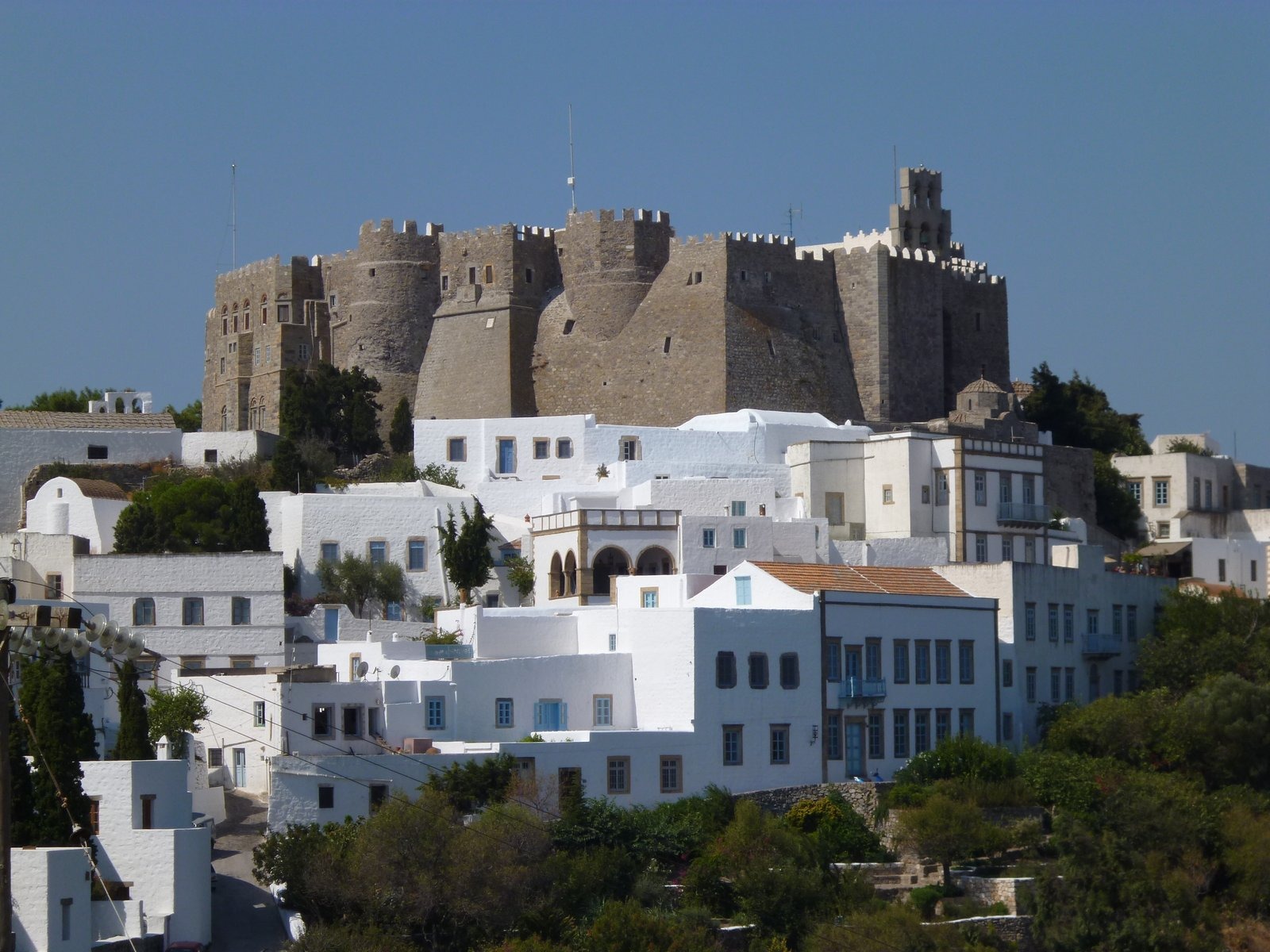
Cave, monastery, hilltop town and a Hellenistic acropolis, explained one stop at a time.
Photo: Valeria Casali (CC BY-SA 3.0)
Patmos is known for a single sentence in the Book of Revelation, in which John says he was on the island for the word of God. The tour keeps that tradition and the evidence apart: the text names no cave, and the devotional sites are described as tradition, not archaeology. What is documented is a monastery created by an imperial grant in April 1088, a town that grew up around its walls, and a school that trained teachers for Greek communities.
The tour has 20 stops: the Cave of the Apocalypse and the Patmias School, the fortified Monastery of Saint John with its katholikon, courtyard and library, Chora's merchants' mansions, the port of Skala, and the acropolis of Kastelli. It plays in your phone's browser, starts each stop by GPS, and can be downloaded for offline use.
Forty-three steps lead down to a church built around the rock. The stop explains what Revelation says and does not say, how tradition placed John's dictation to Prochoros here, and which features pilgrims are shown.
In April 1088 Alexios I Komnenos gave the whole island to Christodoulos, tax-free and closed to laymen settling. The stop covers the terms, the price paid in Kos, and the sanctuary of Artemis believed to have stood on the summit.
The church was completed around 1090 over an earlier basilica. You learn about its marble floor, the Proskynesis icon, and the chapel of Panagia, whose twelfth-century frescoes were covered in 1745 and revealed again in 1958.
The collection began with 330 codices from Christodoulos. It holds more than 1,200 manuscripts today, including the Purple Codex of Mark, whose other leaves are scattered across Saint Petersburg, the Vatican, London, Vienna and Athens.
The town began when laymen settled around the monastery walls. Refugees after 1453 and after Crete's fall in 1669 built separate quarters, and dated merchants' mansions record its trade. Morosini sacked it in 1659.
Founded in 1713 by the monk Makarios Kalogeras to train teachers for Greek lands under Ottoman rule. Pupils came from as far as Russia and Ethiopia, and the monastery credits it with more than 70 bishops and four patriarchs.
Skala only began to build up around 1600, from warehouses and repair sheds. Above it, Kastelli's Hellenistic wall and towers show a prosperous island under Miletus, and the temple of Apollo here turns out to be local tradition.
The Zoodochos Pigi convent was founded in 1607 by a ship captain turned abbot, and two accounts of how he died are given. The Evangelismos convent's nuns keep the spitha embroidery stitch.
It covers the Christian sites in depth, but as history: imperial grants, pirates, library collections, schooling and building dates. It also covers ancient Patmos, the mansions of the Ottoman period, and the Italian occupation after 1912.
It says that tradition holds so, and explains that the text names the author only as John, mentions no cave and gives no date. Scholars still argue whether he was the apostle. The cave's features are described as devotional identifications.
The walls rise about 15 metres and the gate has a balcony for pouring hot oil. The stop lists the Saracen and Norman attacks and the Venetian admiral Morosini's raid in 1659, when Chora was sacked and the monastery was almost untouched.
Yes: the Kastelli acropolis, with a circuit wall of the late fourth century BC and rectangular towers. It is the island's most important pre-Christian monument, and one stop explains that no temple of Apollo has been identified there.
Open it in your phone's browser; there is nothing to install. GPS starts each stop when you reach it. With the tour downloaded in advance, it plays offline.
Yes. The monastery, Chora and the Cave of the Apocalypse were inscribed together in 1999, as the Monastery of Saint John stop explains, after the monastery marked 900 years in 1988.
More in Greece: Delos · Rhodes Old Town · Acropolis & Ancient Athens · Epidaurus · Olympia · Philippi