Philippi
Greece · Northern Greece

A Macedonian fortress, a Roman colony and a Christian city

Nine stops through the ruins of a city shaped by the battle where Brutus and Cassius lost.

$10.999 stops · one payment
Already bought it? Open your tour

Listen to one stop before you buy

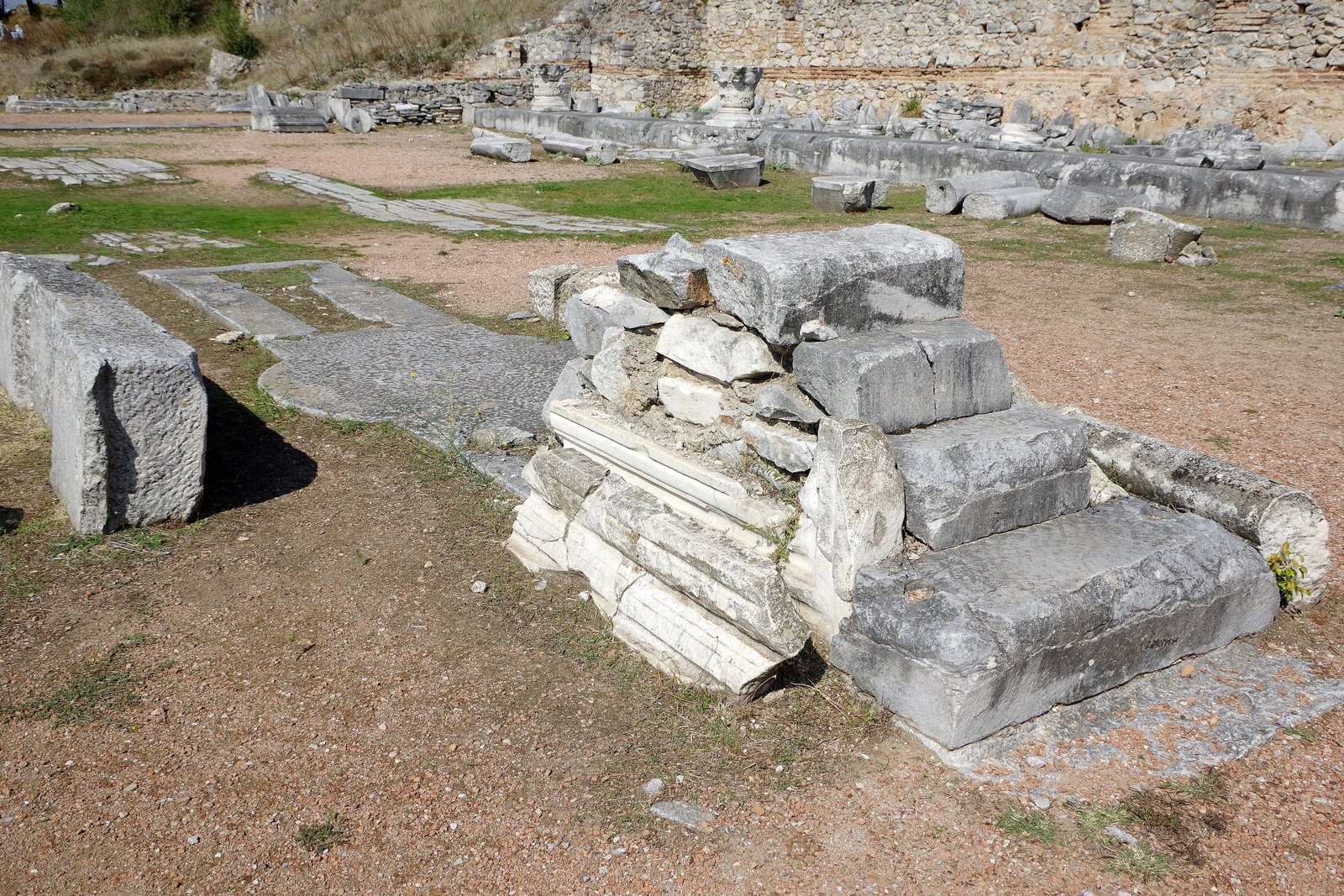
Photo: Berthold Werner (CC BY-SA 3.0)

Philippi was founded by Philip II of Macedon in 356 BC, on a spot a Thasian colony called Krenides had held before. It changed character twice. After the battle of 42 BC it became a Roman colony, and later a church centre with large basilicas and a cathedral.

The tour has nine stops: the theatre, the rock-cut shrines, the Forum and its main road, the great basilicas and the Octagon, the museum, the acropolis above the plain where the battle was fought, and the riverside baptistery of Saint Lydia. The tour keeps tradition apart from evidence, for example on Paul's prison and the exact site of the fighting. It plays in your browser, triggered by GPS, with an offline download.

What you hear along the way

Acropolis and the battlefield of 42 BC

From the summit you see the plain where Brutus and Cassius blocked the Via Egnatia against Antony and Octavian. The stop describes both engagements and says honestly that no certain physical trace of the battle has been found.

Ancient Theatre

A stone theatre of the mid-fourth century BC, converted by the Romans into an arena for gladiators and wild beasts. You can still see the missing front rows, the protective wall and the animal chamber, and the theatre is used for drama again.

The Forum and the Via Egnatia

A planned Roman complex created under Claudius and rebuilt until the end of the sixth century. The paved road on its north side is identified as the Via Egnatia, though one account disputes that and says the road passed alongside the city.

Basilica A and the Prison of Saint Paul

A vast three-aisled church of about AD 500 stands beside a chamber that was actually a Roman cistern. The stop explains that its identification as Paul's prison rests on tradition and cannot be confirmed by archaeology.

Basilica B

The brick pillars called Direkler were meant to carry a dome. The design changed after the foundations were laid, the dome collapsed before completion, and the church was never finished. Roman public latrines for up to forty-two people lie beside it.

The Octagon

Philippi's cathedral stands over a Late Hellenistic heroon. The stop covers the earlier Basilica of Paul with its mosaic naming Bishop Porphyrios, the church quarter around it, and the processional layout.

Rock-cut sanctuaries and the Museum

More than ninety images of Artemis are cut into the acropolis rock, along with a sanctuary of Pan. The museum follows the city from prehistory through its Roman and Christian phases.

Baptistery of Saint Lydia

Acts 16 places Lydia's baptism by a river outside the gate, but names no spot. The octagonal church, completed in 1974, and its cross-shaped open-air font in the stream commemorate it.

The 9 stops

  1. Ancient Theatre of Philippi
  2. Rock-cut sanctuaries of the acropolis hill
  3. Basilica A and the Prison of Saint Paul
  4. Basilica B
  5. The Octagon
  6. The Forum and the Via Egnatia
  7. Acropolis and the battlefield of 42 BC
  8. Archaeological Museum of Philippi
  9. Baptistery of Saint Lydia

Before you go

Starts at
Within the ruins of Philippi, from the acropolis hill to the Forum and the riverside baptistery; each stop plays as you reach it, in whatever order you walk.
The route
9 stops, mostly on foot within the ruins: the theatre and rock-cut shrines on the hill, the Forum, basilicas and Octagon in the city centre, the acropolis summit, the museum, and the baptistery by the river outside the ancient city.
Good to know
The battlefield is unmarked: there is no sign or monument on the plain, and the tour suggests asking a guide or guard to point out the marshes from the acropolis. The Prison of Saint Paul and Lydia's baptism site are tradition, not established fact.
By ship
Kavala is the port linked to this tour. See Kavala.
How it plays
In your phone's web browser, with no app to install. GPS starts each stop as you reach it, and once downloaded the tour plays without a signal.

Questions

Is the battlefield a place you can visit?

Not as a marked site. Scholars place the Battle of Philippi on the plain west and southwest of the city, but no certain trace has been found, and one proposal puts the republican camps about ten kilometres to the southeast. The acropolis stop gives you the view and the accounts.

Is this a Biblical tour?

Partly. Paul and Lydia appear through Acts 16, at the cistern traditionally called his prison and at the river where Lydia is said to have been baptised. The tour says plainly that those identifications are traditional, then turn to the Roman and Byzantine ruins.

Why does the city have two big churches that look so different?

Basilica A, of about AD 500, was a timber-roofed shrine to Paul. Basilica B was planned the same way, then redesigned for a dome after its foundations were laid; the dome collapsed and it was never finished. The stops explain both.

Does the theatre still work as one?

Yes. Ancient drama was staged there in 1957 for the first time in modern times, and that it again hosts drama and concerts. The Romans had turned it into an arena in the second and third centuries AD.

What do I need to use the guide?

Just your phone's browser; there is no app. GPS starts each stop as you reach it, and with the tour downloaded in advance, it works offline.

Philippi

$10.99Tax included
Already bought it? Open your tour

More in Greece: Delos · Rhodes Old Town · Acropolis & Ancient Athens · Epidaurus · Olympia · Patmos