Mdina Gate
Built in 1724 to replace an earlier multi-gate entrance. Look for the stone bridge lions, the blocked medieval gate beside the entrance and three patron-saint sculptures, with Paul in the middle.

21 stops through the walled old capital and the town outside it, from Baroque palaces down to Roman and early Christian burial chambers.
Listen to one stop before you buy
Photo: Berthold Werner (CC BY-SA 3.0)
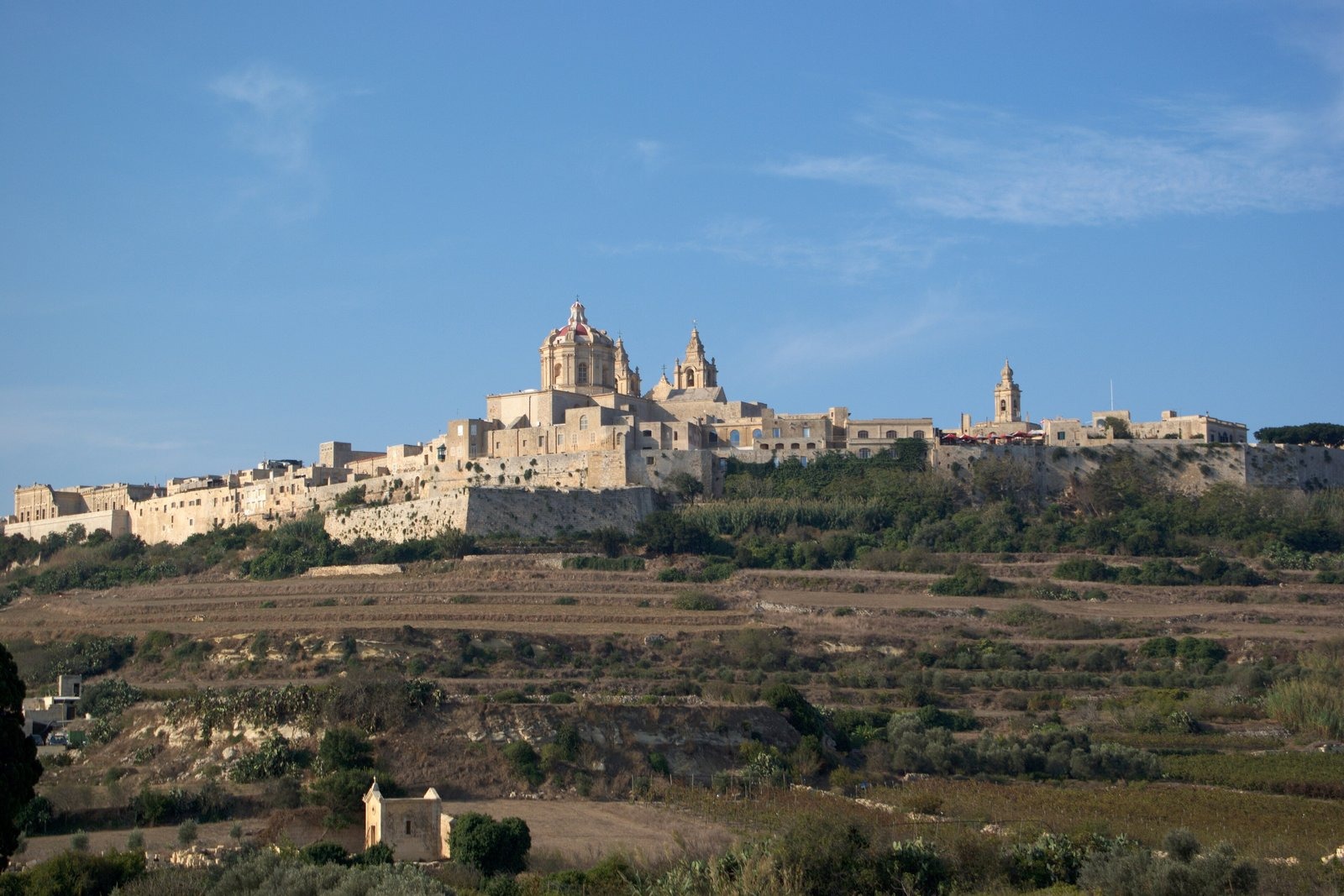
Mdina stands on a ridge in the middle of Malta, about thirteen kilometres from Valletta. The tour opens its account with Mdina Gate, the monumental Baroque entrance Grand Master Vilhena commissioned in 1724 as part of a restoration programme begun in 1722. The gate and nearby stops show how Vilhena and his French engineer Charles François de Mondion reshaped the entrance after the 1693 earthquake.
Past the gate, the route runs through noble palaces, convents and the cathedral rebuilt by Lorenzo Gafà, then leaves the walls for Rabat. There it reaches a Roman townhouse with a mosaic of two doves, the grotto where Saint Paul is said to have stayed, and three separate catacomb complexes. Mdina had long been cut down to about a third of its Roman size, and the stops outside the walls show the rest of the ancient town and its cemeteries.
Built in 1724 to replace an earlier multi-gate entrance. Look for the stone bridge lions, the blocked medieval gate beside the entrance and three patron-saint sculptures, with Paul in the middle.
A French Baroque summer residence for the Grand Master, later a cholera hospital in 1837, a sanatorium for British troops and now the natural history museum. A statue of Justice outside has no blindfold.
A late fourteenth-century palace, one of the earliest Siculo-Norman buildings in Mdina, that survived the 1693 earthquake when much of the medieval city fell.
Look for the date 1233 above a ground-floor window and the four mullioned windows on the upper storey. A public street runs through the old entrance passage on the ground floor.
Rebuilt by Lorenzo Gafà after 1693 on the traditional site of the Roman governor Publius's house. The floor is covered in inlaid tombstones for bishops, nobles and clergy.
A Roman townhouse with a peristyle and polychrome mosaics, including two doves drinking from a bowl. Marble portraits of Claudius and his daughter are among the finds, and a later Muslim cemetery lay above it.
The Baroque church built between 1653 and 1683 over the cave where Saint Paul is said to have lived and preached for three months. A marble statue of him was donated in 1748.
A cemetery used from the Punic period through the Byzantine one, where Christian, Jewish and pagan tombs sit side by side, told apart by crosses, menorahs and the absence of symbols.
No. Mdina is the fortified old capital on the ridge, and Rabat lies outside its walls. The tour covers both and explains that Mdina was cut down to about a third of its Roman size.
It was not a university but Malta's civil governing council, and its building, finished in 1728, later became a school and now holds legal archives from 1530 to 1899.
Yes. Saint Catald, St Agatha's and St Paul's catacombs each have a stop, and the stops describe the circular agape tables carved from the rock for funerary meals.
Repeatedly. It brought down much of medieval Mdina, so the cathedral, Church of Saint Agatha and Vilhena's gate area are Baroque rebuilds, while Palazzo Gatto Murina survived.
In your phone's browser, with no app to install. GPS starts each stop as you arrive, and once downloaded it works offline.
Not after downloading the tour. Playback and GPS triggering work without a connection.
More in Malta: The Three Cities, Malta — Birgu and Fort St Angelo