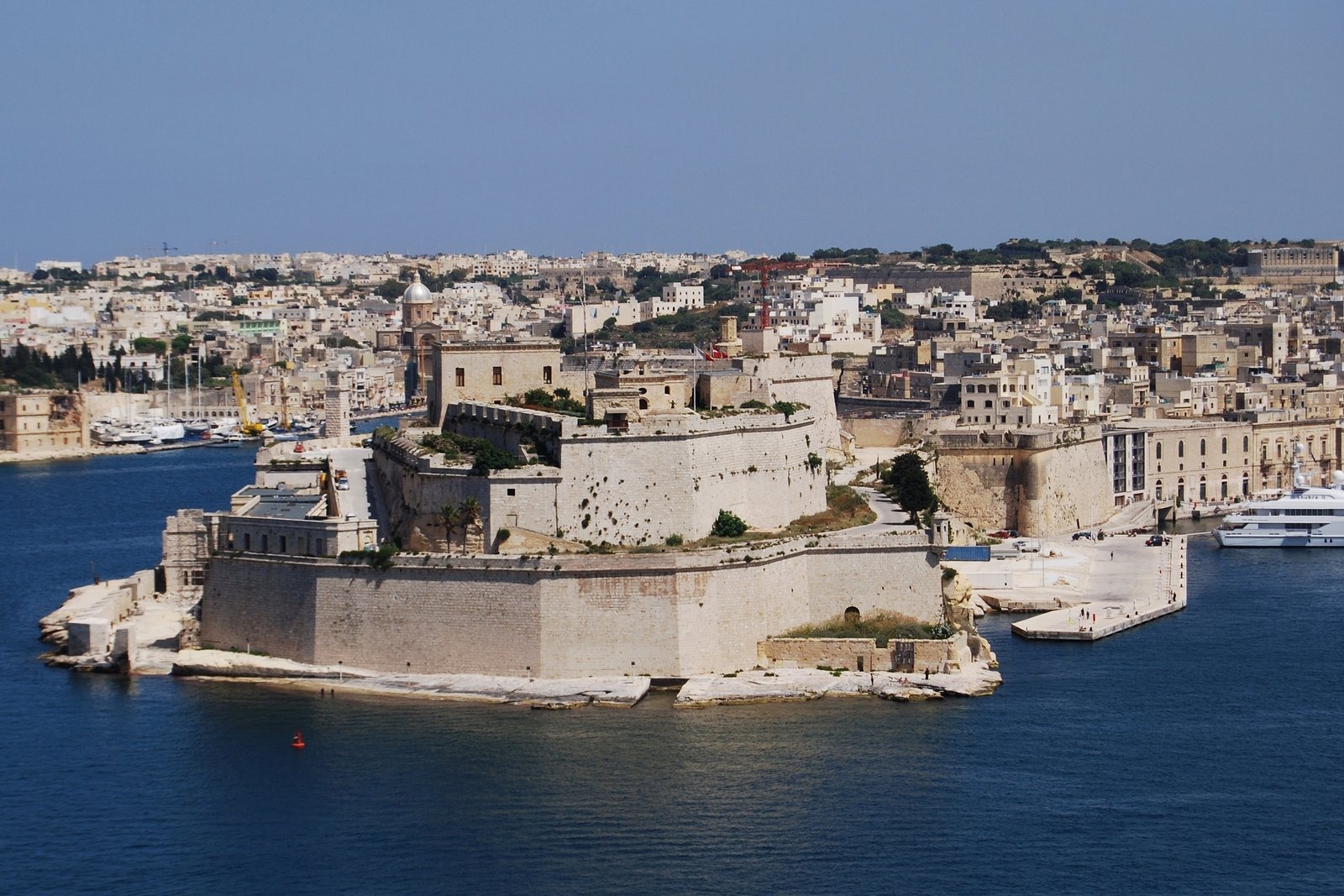
Fort St Angelo
The Knights' headquarters, with the Grand Master's residence here from 1530 to 1558. Under the British it was a Royal Navy establishment, commissioned as HMS Egmont and later HMS St Angelo.

17 stops from the waterfront and Fort St Angelo through the Collachio to the three gates of the land front.
Listen to one stop before you buy
Photo: Felix König (CC BY 3.0)
When the Order of St John arrived in 1530, it made Birgu its seat and headquarters, and the town was shaped by that decision: a fort at the tip of the peninsula, auberges for the langues in the streets behind the main square, a hospital begun in 1532 and a waterfront built to base the Order's galleys. The tour works through those layers, from the Vittoriosa Waterfront to the gates of the land front.
The Great Siege of 1565 and the Second World War both run through the stops. Birgu took its name Vittoriosa from the Ottoman retreat on 8 September 1565, and it was heavily bombed in the Malta Blitz, especially on 10 May 1942, so many buildings here are part original and part reconstruction. The tour says which is which, and covers the later British naval base, the 1979 Freedom Day monument and the Inquisitor's Palace.
The Knights' headquarters, with the Grand Master's residence here from 1530 to 1558. Under the British it was a Royal Navy establishment, commissioned as HMS Egmont and later HMS St Angelo.
Widened and deepened in 1541 on Antonio Ferramolino's advice to isolate the fort. During the siege of 1565 the Order sheltered three of its remaining galleys in it.
Probably built around 1430 and enlarged in 1532 as the Grand Master's private chapel. Its nave arches rest on a single Egyptian granite pillar that local tradition links to a temple of Juno, which has never been proved.
Four life-size bronze figures re-enact Freedom Day, 31 March 1979, when the last British military base closed. A British sailor shakes hands with a Maltese worker.
The Order's first hospital in Malta. L'Isle Adam laid its foundation stone in November 1532, and it was working by 1533. It later passed to Benedictine nuns.
Auvergne-Provence started as two houses, and three doors on the facade give it away. Castille et Portugal, d'Angleterre and others show how each langue was housed, and which parts the bombing took.
Built in the 1530s as the Order's law courts and turned into the Holy Office headquarters in 1574. The lower cells keep graffiti: names, crosses, ships and marks counting days.
Three gates in a row, with ditches between them. Beneath the Couvre Porte, tunnels served in the war as a Combined War Headquarters and later as a NATO tracking post.
The name, meaning victorious, was given to commemorate survival of the Great Siege after the Ottoman retreat on 8 September 1565. The St Lawrence's Church stop describes the Te Deum sung then.
It is the network of narrow streets behind the main square where the Knights' auberges were concentrated. The tour visits the Auberge d'Angleterre, Auvergne-Provence and Castille et Portugal.
Less than it looks. Almost half the town was destroyed by enemy action in the Second World War, so the stops separate what survived from what was rebuilt, as at the Palace of the Captains of the Galleys.
Yes. The Malta Maritime Museum stop covers the Royal Naval Bakery of 1842 to 1845, and the Freedom Monument covers the closing of the last British base in 1979.
In your phone's browser, with no app to install. GPS starts each stop as you arrive, and once the tour is downloaded it works offline.
Not after downloading. Audio and GPS triggering work offline.
More in Malta: Mdina and Rabat — the Old Capital