Porta Reale
Built in 1838 to celebrate King Ferdinand II's arrival, so a late ceremonial gate, not a medieval remnant. Three stone figures crown it: a tower, a dog and a bird usually called a pelican, though it may be a stork.

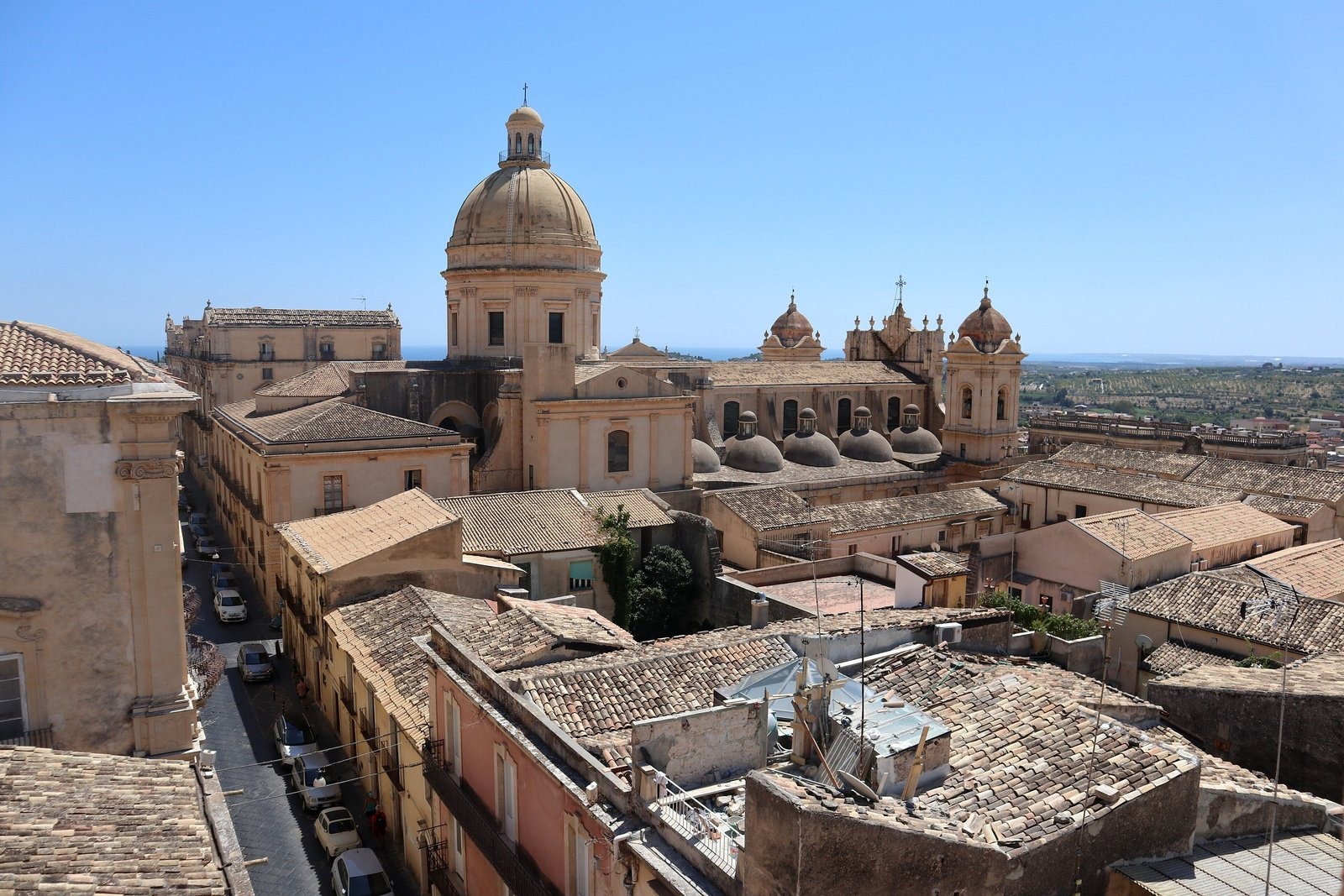
13 stops along Corso Vittorio Emanuele and its side streets, in the Sicilian town built to a new plan.
Listen to one stop before you buy
Photo: Lucamato (CC BY-SA 4.0)
On 11 January 1693 an earthquake destroyed medieval Noto on Monte Alveria, and it was said that more than half its people died. The authorities chose not to rebuild there. They laid out a new town on the slope of the Meti hill, with a regular plan fitted to the hillside, and everything on this walk belongs to it. The old site, Noto Antica, is now an archaeological area where excavation resumed in 2017.
The route follows the main axis from Porta Reale through convents, churches and palaces, many of them attributed to Rosario Gagliardi and Vincenzo Sinatra. You learn who paid for what, why staircases have extra flights after the street level was lowered, where cloistered nuns watched Mass through grilles, and how the cathedral dome fell in 1996 and was reconstructed by 2007.
Built in 1838 to celebrate King Ferdinand II's arrival, so a late ceremonial gate, not a medieval remnant. Three stone figures crown it: a tower, a dog and a bird usually called a pelican, though it may be a stork.
A temporary hut became a church in 1703 and was later absorbed into a larger one finished in 1768. A new cupola replaced one that fell in 1848, and the 1996 collapse led to reconstruction completed in 2007.
The municipal hall sits opposite the cathedral with a convex facade and twenty arches. Inside, its Hall of Mirrors has a ceiling painting of the legendary founder Ducezio, and the upper floor was added in 1951.
Built from 1720 to 1765 with seven projecting balconies on carved corbels, including one with a child playing a flute. Each floor housed a different rank of the household.
Its concave facade closes Via Nicolaci like a stage backdrop. Inside, a permanent exhibition shows the uniforms, banners and insignia of Noto's confraternities.
Look for the oval openings high in the nave where cloistered nuns attended Mass unseen. The original portal on the Corso was left unusable when nineteenth-century excavations lowered the street.
Iron-grilled balconies let nuns hear Mass and look onto the square unseen. Lowering the street exposed a basement cut into bedrock, which masonry now disguises.
In 1860 anti-Bourbon youths raised the first tricolour flag between Hercules's arms, with an inscription threatening death to whoever touched it. The statue now holds Noto's coat of arms.
After the earthquake of 11 January 1693 destroyed the medieval town, a new one was laid out on the Meti hill to a regular plan. The Porta Reale stop explains that everything on the walk belongs to that rebuilding.
Rosario Gagliardi is credited with many, among them San Domenico, Santa Chiara and Santissimo Crocifisso, often alongside Vincenzo Sinatra. The tour notes where attributions are disputed, as for the Santissimo Salvatore.
A new cupola replaced one that collapsed in 1848, and a worse collapse in 1996, blamed on a defect in the nave piers, led to a reconstruction finished in 2007.
At San Francesco all'Immacolata the lowest flight was added after the street level was lowered by about two metres. The Santa Chiara and Santissimo Salvatore stops describe the same lowering.
In your phone's browser, with no app to install. GPS starts each stop as you reach it, and once you download the tour it works offline.
Not after downloading. Playback and GPS triggering then work without a connection.
More in Italy: Ortigia · Colosseum, Roman Forum & Palatine Hill · Ravenna · Messina · Pompeii