Ortigia, Syracuse
Italy · Sicily

A Greek temple inside a cathedral, and what lies around it

22 stops across Ortigia island and the ancient quarry district, told through what excavators and ancient writers recorded.

$10.9922 stops · one payment
Already bought it? Open your tour

Listen to one stop before you buy

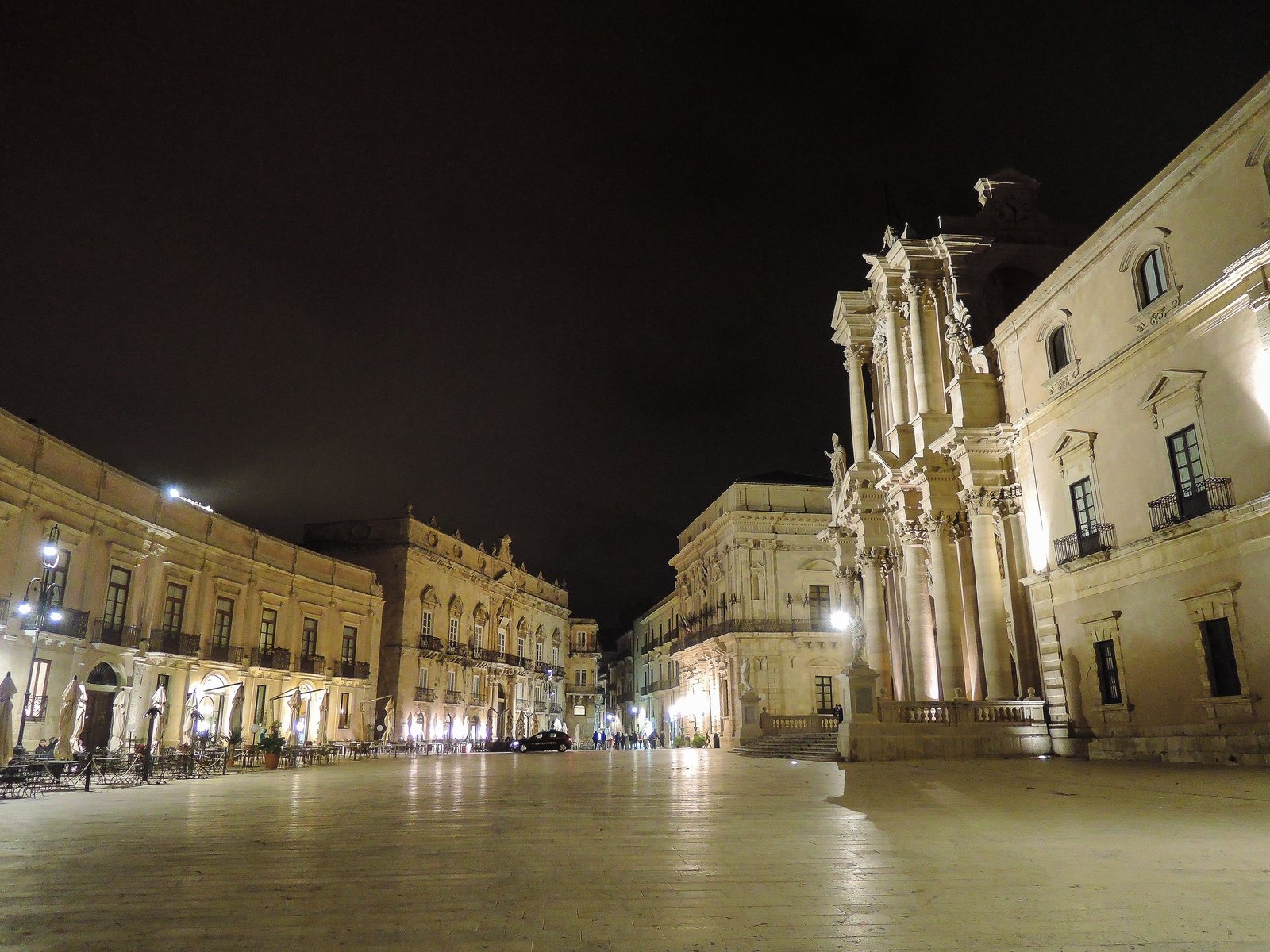
Photo: Yiannis Vacondios (CC BY-SA 4.0)

Cicero said Syracuse was so large it was really four cities, and the first of them was the island of Ortigia: highest ground at Piazza Duomo, home of the old palace of King Hieron, and the spring of Arethusa. Piazza Duomo is home to a cathedral whose aisle walls are a Greek temple of Athena with its Doric columns walled in.

From the island it moves out to the ancient sites: the Temple of Apollo, the Greek theatre cut into the Temenite hill, the quarries where Athenian prisoners were held in 413 BC, and the Roman amphitheatre. In between come a medieval ritual bath, a castle built for Frederick II, a fountain made of artificial stone and Antonello da Messina's Annunciation. The tour keeps separating what ancient writers record from what later tradition added.

What you hear along the way

Temple of Athena and the cathedral

The nave was made by cutting arches through the temple's cella wall, and the outer Doric columns were walled up. You learn what Cicero reported about its gold and ivory doors and the sailors' rite with a cup of flowers.

Temple of Apollo

Probably built between 590 and 580 BC, the oldest Doric temple in stone in Sicily. An inscription on the east step names Kleomenes as its maker, though the worn stone allows other readings.

Greek Theatre

The cavea is 138.6 metres across and once had 67 rows. Names cut above the wedges honour Hieron II's family and Olympian Zeus, and Plutarch describes the blind Timoleon being carried in by mule cart.

Ear of Dionysius

About 23 metres high and 65 metres deep. The name came from Caravaggio's visit in 1608, and the stop weighs the listening-tyrant story against the acoustic measurements made in 2010.

Latomia del Paradiso

The largest of the city's quarries. Thucydides describes the Athenian prisoners held in the stone pits after 413 BC, and the stop notes that naming this quarry is a later tradition.

Mikveh of Syracuse

A ritual bath under Palazzo Bianca with three immersion pools, each 140 centimetres deep, fed by groundwater. The stop explains why the claim that it is the oldest in Europe rests on a disputed date.

Castello Maniace

Built between 1232 and 1239 for Frederick II, 51 metres on a side. In 1704 lightning struck its powder magazine and the explosion killed 33 Spanish soldiers.

Galleria di Palazzo Bellomo

A Gothic portal on thirteenth-century masonry houses Antonello da Messina's Annunciation of 1474, found damaged by damp in 1897 at Palazzolo Acreide.

The 22 stops

  1. Temple of Athena / Syracuse Cathedral (Duomo di Siracusa)
  2. Temple of Athena columns incorporated into Cathedral walls
  3. Aretusa Fountain / Fountain of Arethusa
  4. Temple of Apollo
  5. Jewish Quarter of Ortigia
  6. Mikveh of Syracuse
  7. Ear of Dionysius
  8. Greek Theatre of Syracuse
  9. Latomia del Paradiso
  10. Roman Amphitheatre of Syracuse
  11. Artemision
  12. Biblioteca Alagoniana
  13. Chiesa di Santa Maria della Concezione
  14. Fountain of Diana
  15. Ipogeo di piazza Duomo
  16. Museo del Mare
  17. Palazzo Beneventano del Bosco
  18. Palazzo Vermexio
  19. Piazza Duomo
  20. Castello Maniace
  21. Galleria di Palazzo Bellomo
  22. Ara di Ierone

Before you go

Starts at
On Ortigia island and in the ancient quarter of Syracuse; each stop plays as you reach it, in whatever order you walk.
The route
22 stops on foot, most of them on Ortigia island around Piazza Duomo and the harbour, with a further group at the Greek theatre, the quarries, the Roman amphitheatre and the Altar of Hieron.
Good to know
The Artemision is seen under a modern pavilion with transparent panels over the temple base, and the Ipogeo is reached by a stair down from the cathedral square.
By ship
The tour is listed for travellers arriving at the ports of Catania and Siracusa. See Catania, Siracusa.
How it plays
In your phone's web browser, with no app to install. GPS starts each stop as you reach it, and once downloaded the tour plays without a signal.

Questions

Is the Temple of Athena really inside the cathedral?

Yes. The aisle walls inside are the temple, and from outside the flank is a wall of Doric columns with medieval masonry between them. The conversion to a church dates to the sixth or seventh century AD.

Did Dionysius really listen to prisoners in the Ear?

No ancient writer describes a listening cave. The name comes from Caravaggio's visit in 1608, and a 2023 study rated speech intelligibility inside as only fair.

Does the tour cover Jewish Syracuse?

Two stops do: the Jewish Quarter around Via Alagona, where the community lived until 1492, and the Mikveh. They cover the expulsion decree and the disputed count of surviving baths.

Where is the Altar of Hieron II?

It is one of the stops. About 198 metres long and 22.5 metres wide at its base, it is the largest altar known from the ancient world, and the sculptures belong to the theatre's third phase.

How does the audio play?

In the browser on your phone, with no app to install. Each stop triggers by GPS as you arrive, and once the tour is downloaded it works offline.

Do I need data while walking?

Not after downloading. The audio and GPS triggering work offline.

Ortigia

$10.99Tax included
Already bought it? Open your tour

More in Italy: Colosseum, Roman Forum & Palatine Hill · Ravenna · Messina · Pompeii · Noto — the Baroque Town Rebuilt after 1693