Plaza de Armas Benjamín Muñoz Gamero
Laid out under the city's first plan of 1851 and originally called Plaza Esmeralda. At its center is the 1920 monument to Magellan; visitors rub or kiss the shiny toe of the seated Indigenous figure at its base.

Twenty stops from the pier to the Braun cemetery, past palaces, churches, museums and two monuments.
Listen to one stop before you buy
Photo: W. Bulach (CC BY-SA 4.0)
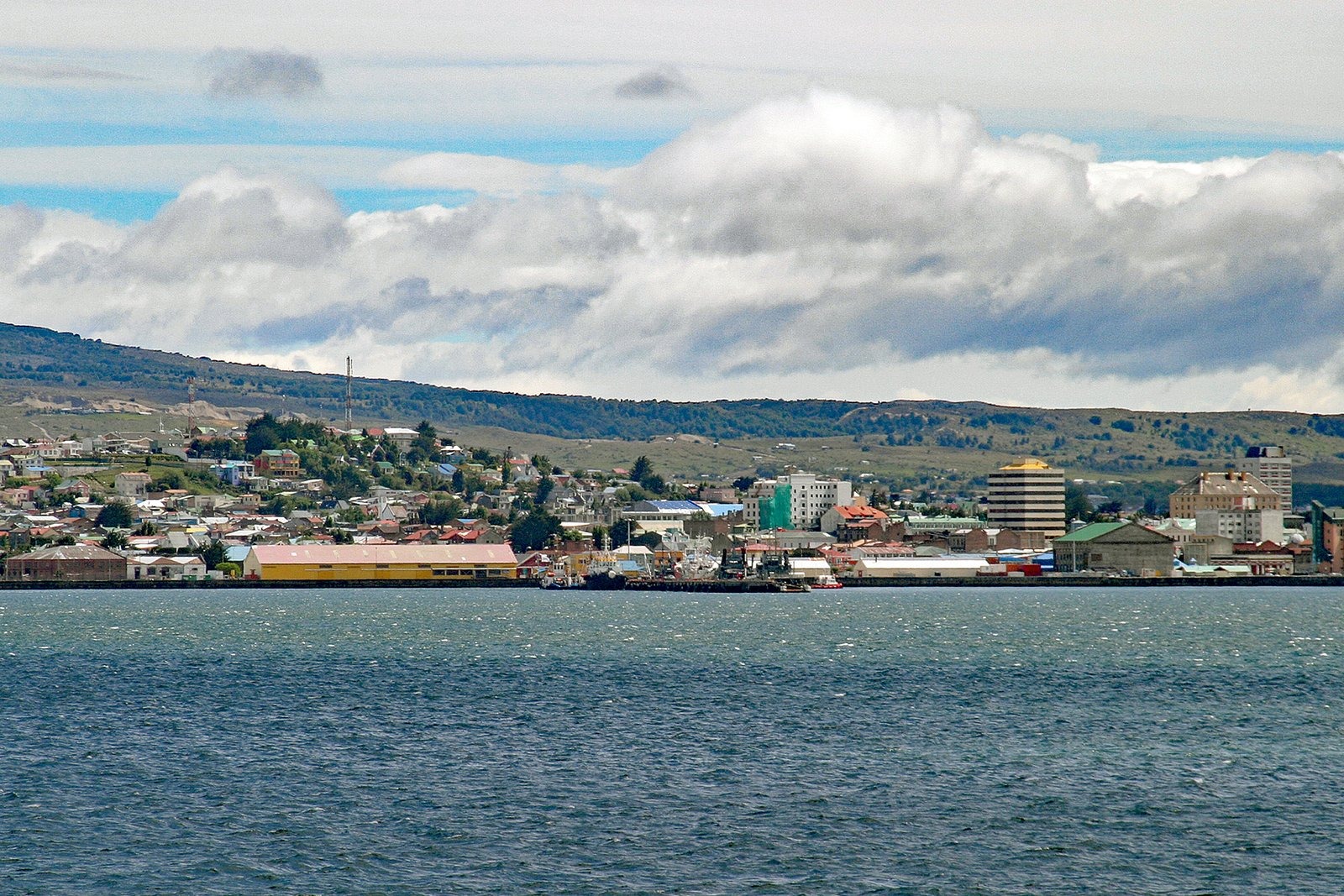
Punta Arenas was settled in 1848 on a broad bay of the Strait of Magellan, after the colony moved from Fuerte Bulnes. It began as a penal colony, survived mutinies in 1851 and 1877, and grew rich on sheep farming and a gold rush from around 1884. Those fortunes built the palaces around Plaza Muñoz Gamero, and the tour spends much of its time with them.
The tour has 20 stops. It covers the Sara Braun, Braun Menéndez, José Menéndez and Montes Pello palaces, the brick cathedral, a wooden Anglican church and the Chalet Milward, where Ernest Shackleton stayed in July 1916. It also takes in museums, among them a Croatian immigration museum and the Salesian museum, which confronts the Dawson Island mission. The guide plays in your browser, starts each stop by GPS and works offline once downloaded.
Laid out under the city's first plan of 1851 and originally called Plaza Esmeralda. At its center is the 1920 monument to Magellan; visitors rub or kiss the shiny toe of the seated Indigenous figure at its base.
Designed by Numa Mayer, with materials, furniture and stylistic details all shipped from Europe. Inside, the music room, golden salon and billiard room survive, and a bar named for Shackleton displays prints about his rescue of his men.
Built between 1903 and 1906 for Mauricio Braun and Josefina Menéndez. Eight rooms are preserved as lived in, and the stop also covers the wool decline that followed the opening of the Panama Canal.
The British consul's residence, where Shackleton lodged in July 1916 while planning a third attempt to rescue the Endurance survivors. Accounts of his stay differ over a stray shot, and the tour gives both.
Established in 1893 by Salesian missionaries. The stop tells the story of the mission on Dawson Island and the Selk'nam and Kawésqar held there, and notes that historians have asked the state to recognise it as genocide.
A six-meter sculpture marking Chile's possession of the Strait on September 21, 1843. The schooner Ancud's bow emerges from a rocky mass, with Captain Juan Williams Wilson pointing toward Punta Santa Ana.
A hill with a wooden cross first placed in 1881, replaced after its removal in 1896 and described as the city's oldest monument. From the top you look over the rooftops to the Strait and Tierra del Fuego.
An octagonal cemetery with avenues of cypress and a monumental portico that is no longer used as the entrance. The stop points out the small bronze Indio Desconocido covered in offerings, and an Egyptian-style pyramid in the English section.
In July 1916 Shackleton stayed at the Chalet Milward, the British consul's house, preparing a third attempt to rescue the men on Elephant Island. The Naval Maritime Museum covers Luis Pardo's rescue, and the archive beside St James Church keeps an old British Club visitors' book signed by Shackleton, Frank Worsley and Tom Crean.
Wool dynasties. José Menéndez made his fortune from sheep and commissioned a brick house on the plaza, Mauricio Braun built the Braun Menéndez palace, and Sara Braun commissioned her own palace and is credited with promoting or donating the cemetery's entrance portico.
Yes. The Salesian museum describes the Dawson Island mission, where the Kawésqar and Selk'nam were gathered, and the museum's Aónikenk, Selk'nam, Kawésqar and Yagán objects. The Magellan monument and the cemetery also mention Indigenous figures.
A bronze sculpture of a shepherd, a horse, two dogs named Black and Valiente and eight sheep, about 30 meters long, inaugurated in 1962. It honors the region's sheep workers, and a plaque beside it shows the poem El Ovejero de mi Tierra.
Once you have downloaded the tour, yes. It plays in your phone's browser with nothing to install, and each stop begins by GPS when you reach it.
More in Chile: Santiago de Chile — the Historic Centre and La Moneda