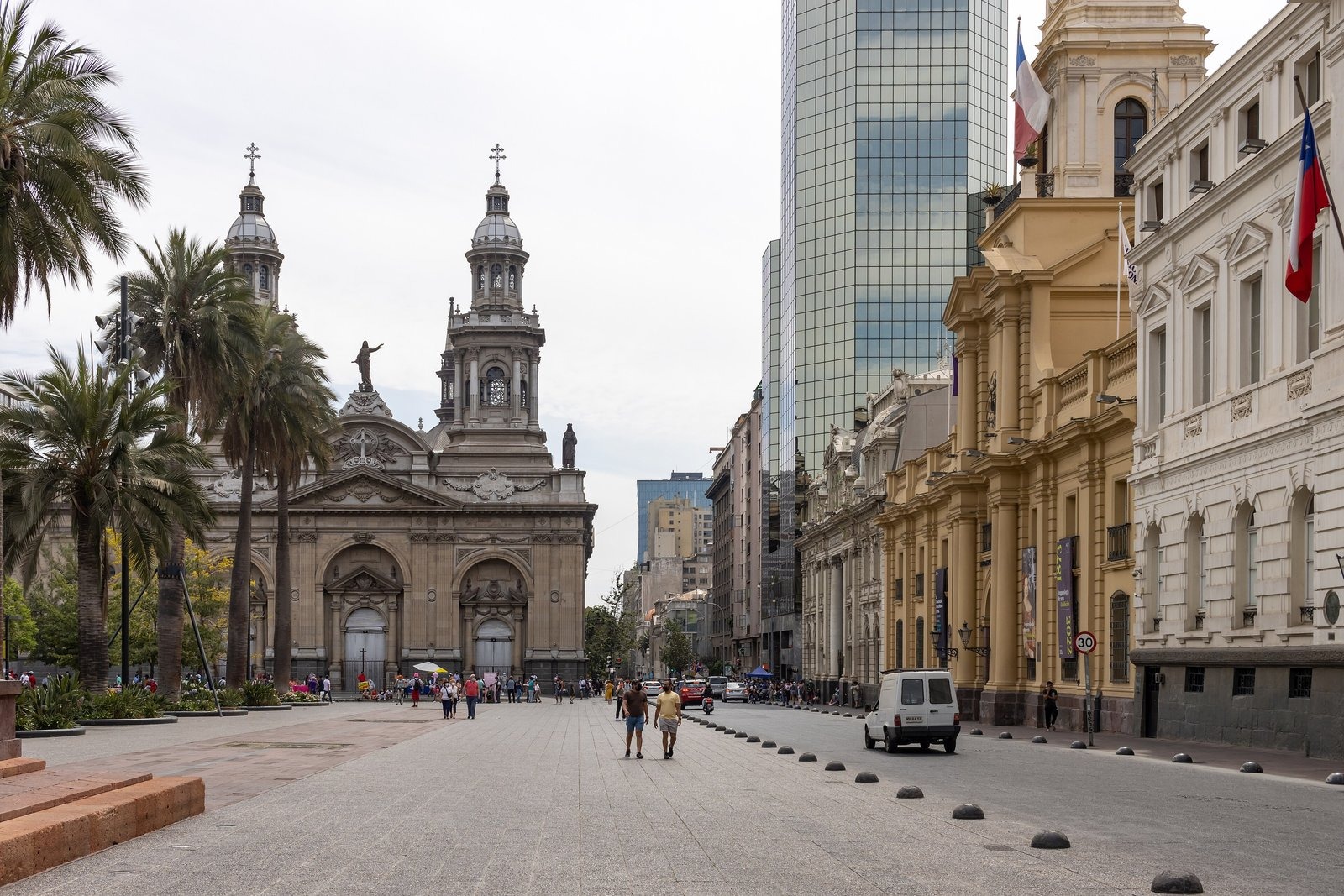
Plaza de Armas de Santiago
The founding square. The stop tells of the 1541 attack led by Michimalonco, when a garrison of 55 under Inés de Suárez held the fort, and of the 1647 earthquake that destroyed most of the city.

Twenty-two stops through colonial churches, civic palaces and places of memory in the old centre.
Listen to one stop before you buy
Photo: Rjcastillo (CC BY-SA 4.0)
Pedro de Valdivia founded Santiago on 12 February 1541, at the foot of the hill called Huelén, and the checkerboard of streets was laid out around the Plaza de Armas. Seven months later Indigenous forces led by Michimalonco attacked and burned the settlement, and the settlers slowly rebuilt. Earthquakes, floods and fires shaped what followed, and many of the buildings on this walk have been rebuilt more than once.
The tour has 22 stops. Several are works of Joaquín Toesca, including La Moneda, built as a royal mint and now the presidency. The tour also includes the cathedral, the churches of San Francisco and La Merced, the Teatro Municipal, the Cerro Santa Lucía and the site of a Jesuit church that burned in 1863. Two stops, La Moneda and Londres 38, deal directly with the 1973 coup and the dictatorship. The guide plays in your browser, starts each stop by GPS and works offline once downloaded.
The founding square. The stop tells of the 1541 attack led by Michimalonco, when a garrison of 55 under Inés de Suárez held the fort, and of the 1647 earthquake that destroyed most of the city.
Designed by Toesca as the royal mint, inaugurated in 1805 and a presidential residence from 1846. The stop covers the bombing of 11 September 1973 and the walled-up door at Morandé 80, reopened in 2003.
Built between 1586 and 1618 in white stone. Its tower is the fourth, designed by Fermín Vivaceta in 1857, and inside you can find the Mudéjar ceiling and the Virgen del Socorro, the image the church was built for.
A house that was a secret detention and torture centre from 1973 to 1975, run by the DINA, and has been open as a site of memory since 2008. Plates in the paving carry the names of people who disappeared here.
Housed in the old Real Aduana, built between 1805 and 1807 to Toesca's plans. A contemporary building added by Smiljan Radic holds the exhibition Chile before Chile.
The rocky hill where Valdivia founded the city, turned into a promenade from 1872. On the Caupolicán terrace, the stop explains why a Mapuche leader wears feathers: the figure was first made for a US competition honouring Native American warriors.
A garden on the site of the Jesuit church destroyed by fire on 8 December 1863. Estimates of the dead run from about 1,500 to 3,000, and the authorities ruled that the church would never be rebuilt.
A neoclassical courts building built in two stages. Look on the façade for a condor on an open book marked LEX, and inside for a stained-glass window made in Munich from more than 3,500 painted pieces.
The palace interior and its patios can be visited only with prior registration, so the stop is told from the Plaza de la Constitución, outside. It covers the building's origin as a royal mint, built by Toesca, and what happened on 11 September 1973.
A house on a short cobbled street that was a secret DINA detention, torture and extermination centre from 1973 to 1975, then hidden by a change of street number. The state recovered it in 2007, and it has been open to the public as a site of memory since 2008.
An Italian architect who worked in Chile. The tour links him to La Moneda, the cathedral's main façade and the Real Aduana, which now holds the pre-Columbian art museum, and notes that historians disagree about his part in La Merced.
Yes. The Plaza de Armas stop covers Michimalonco's attack in 1541, and the Monument to the Indigenous Peoples is described as honouring the Mapuche, with its broken face read both as strength and as insensitive. The pre-Columbian museum covers cultures before Valdivia arrived.
No. You open the guide in your phone's browser, each stop starts by GPS, and once you have downloaded the tour it plays offline.
More in Chile: Punta Arenas — the Strait of Magellan Town