Steingasse and Joseph Mohr's Birthplace
Mohr was born on December 11, 1792, in a damp house at Steingasse 31, not at number 9, where the plaque hangs. The stop explains how the wrong number came about and what the street was once used for.

Twelve stops in two parts: the Old Town of Salzburg, then Oberndorf on the Salzach, where the carol was first performed.
Listen to one stop before you buy
Photo: Andrew Bossi (CC BY-SA 2.5)
Silent Night was first sung on Christmas Eve 1818 in St. Nicholas Church at Oberndorf, with Joseph Mohr singing and playing guitar and Franz Xaver Gruber singing bass. Mohr was born in poverty in Salzburg's Steingasse in 1792 and sang as a boy in the choirs of St Peter's Abbey. This tour follows his story from the city to the river town.
It has 12 stops. In Salzburg you cross Mirabellplatz, Alter Markt, Mozartplatz, Residenzplatz and Domplatz, where the Christkindlmarkt gathers each Advent, and pass the Great Festival Hall. The salt boatmen's river, the Salzach, leads downstream to Oberndorf, where the second half covers the Europasteg bridge, the Silent Night Chapel and the parish church. The guide also separates documented facts from popular stories, such as the one about mice and the organ.
Mohr was born on December 11, 1792, in a damp house at Steingasse 31, not at number 9, where the plaque hangs. The stop explains how the wrong number came about and what the street was once used for.
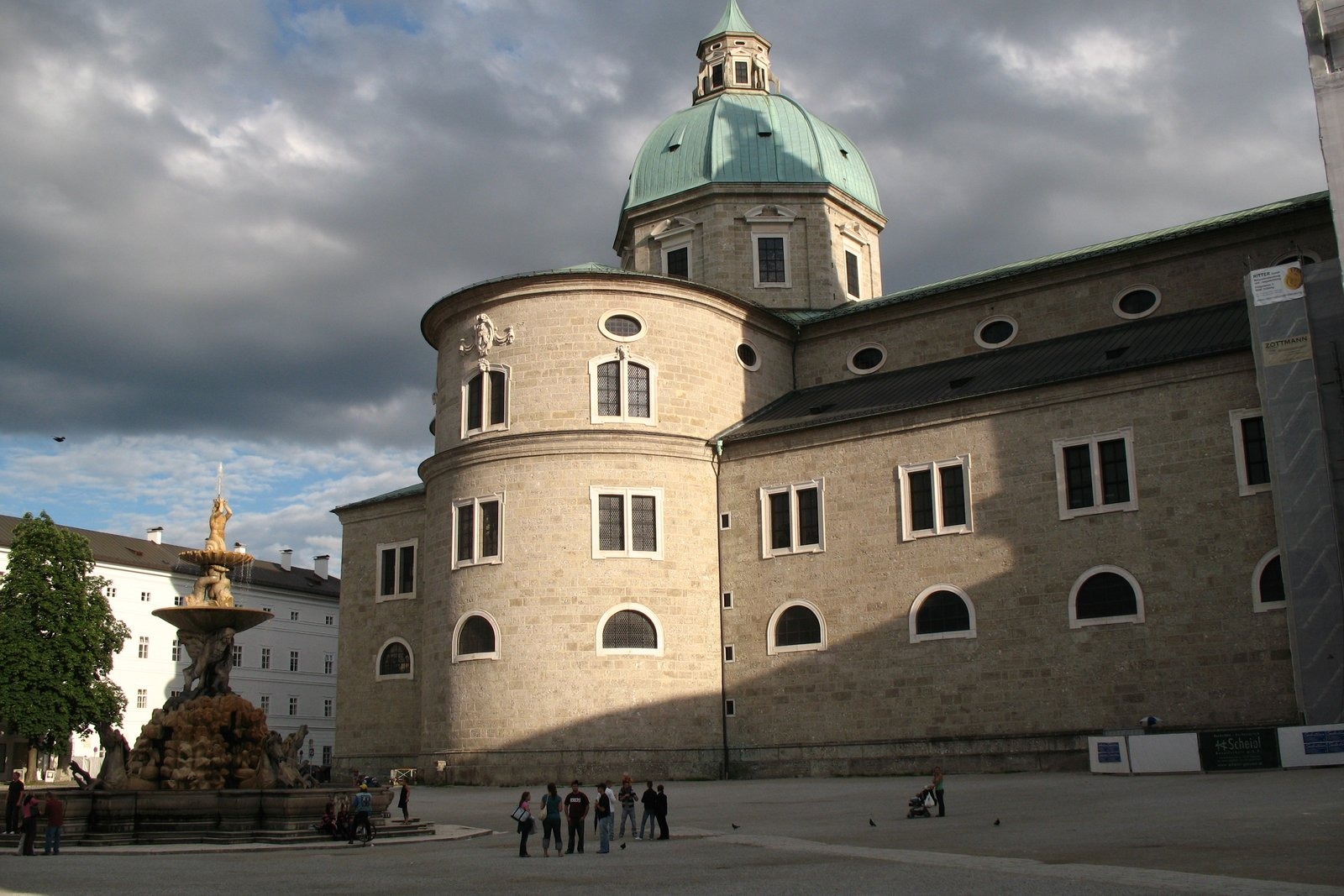
The Untersberg-marble cathedral consecrated in 1628, and the font in which both Mozart and Joseph Mohr were baptised. It also covers the cathedral fire of 1598 and the arches that link Domplatz to Residenzplatz.
Fifty-five medieval buildings were demolished to make this square. The stop gives the history of the Christkindlmarkt, held under that name since 1974, and explains the Krampus and the Perchten as regional customs of Advent.
The museum owns the earliest surviving manuscript of Silent Night in Mohr's own hand, written around 1820 to 1824. The stop also explains the Roman mosaic found while digging the Mozart monument's foundation.
Founded by Saint Rupert, with a church consecrated in 1147 and a Rococo interior from 1760 to 1782. Mohr earned his keep here as a boy soprano and violinist, and stairs lead from the cemetery into rock-cut catacombs.
Built in 1956 to 1960 by blasting 55,000 cubic metres from the Mönchsberg. Each Advent it hosts the Salzburg Advent Singing, founded by Tobi Reiser in 1946, a staged Advent story told in traditional songs and Alpine music.
Built on the rubble mound of the flood-damaged St. Nikola Church and inaugurated on 15 August 1937. The audio looks at its windows, the guitar in Gruber's hand, and why historians reject the story that the organ failed.
A 131-metre pedestrian bridge opened in 2006 that reconnects Laufen and Oberndorf, split in 1816 when the Salzach became a border. It now carries the Silent Night Peace Path, created in 2018.
No. Nine stops are in Salzburg, and three are at Oberndorf, about twenty kilometres north on the Salzach, where Silent Night was first performed. The Oberndorf half is a separate walk.
Joseph Mohr wrote the poem in 1816 while serving at Mariapfarr, and in 1818, as assistant priest at Oberndorf, asked the schoolteacher Franz Xaver Gruber to set it to music. The tour tells the full story across several stops.
Yes. Residenzplatz and Domplatz describe the Christkindlmarkt, which grew from a late-15th-century Tandlmarkt, was the Nikolaimarkt by the 17th century and has had its present name since 1974. Mirabellplatz also hosts an Advent market.
The Silent Night Chapel stop says the popular story that the organ failed that Christmas Eve, in some versions because mice ate the bellows, is not supported by evidence. Historians think the song was written for guitar because a guitar was to hand.
No. The audio plays in the browser on your phone, each stop starts by GPS as you arrive, and once you download the tour it plays offline.
More in Austria: Vienna at Christmas — Advent Markets and Traditions of the Old City