Vienna, Innere Stadt
Austria · Vienna

Where Vienna's Christmas customs really began

Fourteen stops that separate documented market history from the popular legends.

$10.9914 stops · one payment
Already bought it? Open your tour

Listen to one stop before you buy

Photo: Geolina163 (CC BY-SA 4.0)

Vienna's Christmas market is often said to go back to a December fair of 1296. The walk takes that story apart: the city rights granted then allowed fourteen-day fairs, none tied to Christmas, and the first documented Christmas huts appeared in 1626 on the Graben and the Brandstätte. Other claims get the same treatment, including a continuous market at the Freyung since 1772.

The 14 stops include Spittelberg's Biedermeier lanes and the MuseumsQuartier, Rathausplatz, Freyung, Am Hof and Hoher Markt, Stephansplatz, the Graben and Demel on the Kohlmarkt, as well as the Albertina, the Karlskirche and Schönbrunn. Along the way you hear where the first Christmas trees stood in Vienna, which markets are old and which are modern, and what to look for at each square.

What you hear along the way

Hoher Markt

Fanny von Arnstein's salon had a Christmas tree in 1814, during the Congress of Vienna, brought from Protestant northern Germany. The stop explains why the city says only that she is said to have introduced it, and how the Ankeruhr's twelve figures parade at noon.

Albertina

The museum dates its first Christmas tree to Christmas Eve 1823, hung with gingerbread, sugar work, apples, nuts and wax candles. The audio connects it to Princess Henriette's tree of 1816 and to Archduke Johann's surprise at finding no Catholic crib.

Graben

The documented history: a nativity and Christ Child market from 1600, huts in 1626, and a market that lasted until 1761. The stop explains why the story of a Christmas market granted by Duke Albrecht I in 1296 is rejected by the city.

Freyung

A Saint Nicholas and Christmas market was documented here in 1764, with the Nikolo and the Krampus. The audio is exact about the difference between that and the Altwiener Christkindlmarkt, which was established in 1987 and moved here after two years.

Am Hof

The market moved here provisionally in 1842 and permanently in 1843, with 132 crèche stalls. The stop also covers the Roman camp beneath the square and the four small cherubs around the Marian Column, each fighting a different creature.

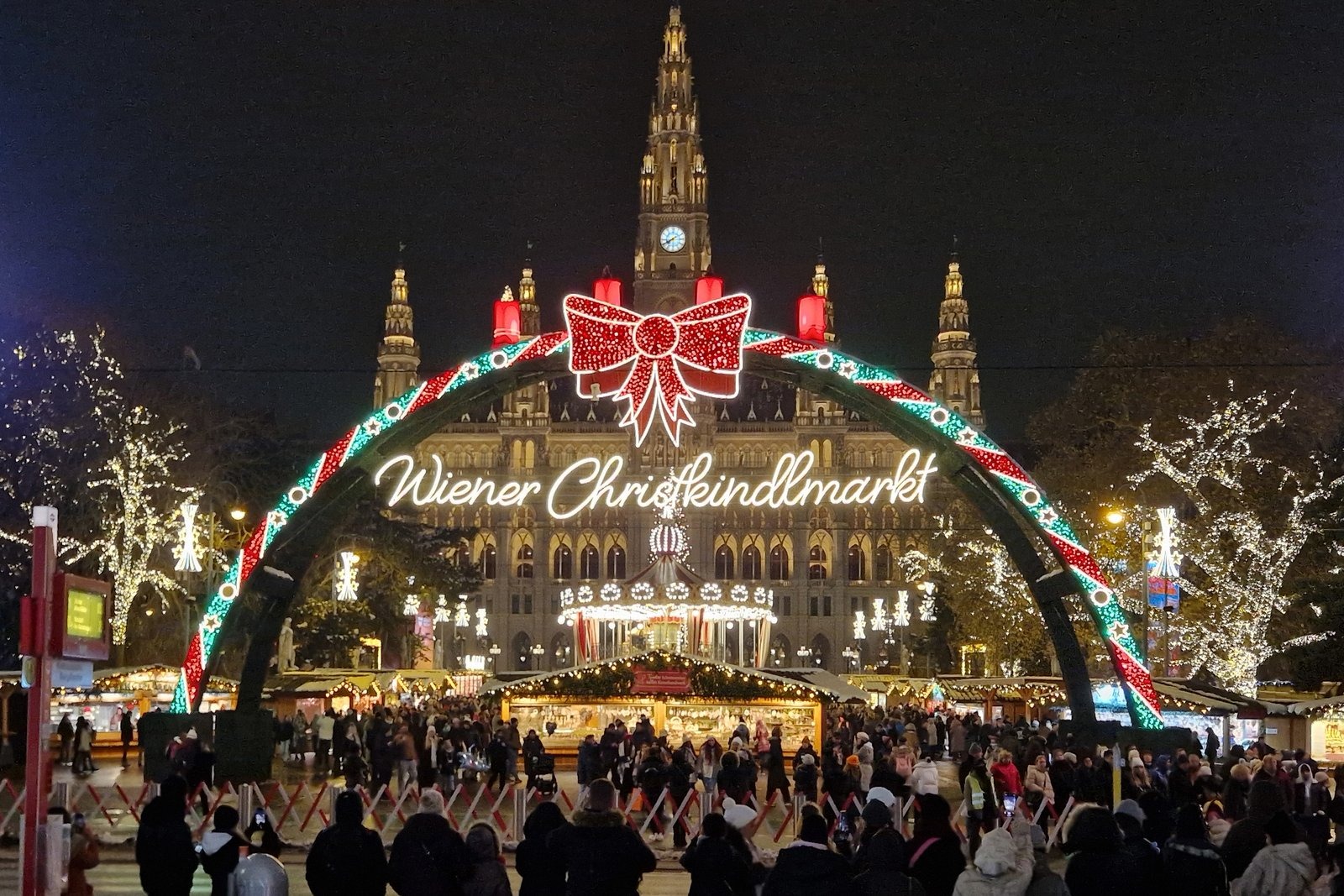
Rathausplatz and the City Hall

The City Hall of 1872 to 1883 stands on the old Josefstädter Glacis. The market moved here in 1975 and became permanent, and a Christmas tree has stood on the square every year since 1959.

Demel and the Kohlmarkt

Demel's Advent windows, its move to number 14 in 1888, and the Vanillekipferl. The popular legend that bakers shaped crescents to mock the Ottomans after 1683 is set against the historians' view that the crescent Kipferl is recorded centuries earlier.

The Schweizerhof and the Hofburg Chapel

The oldest part of the Hofburg, from the second quarter of the 13th century. The chapel's Christmas Day Mass is one of the court choir's fixed dates, and the audio tells how Emperor Franz I came to have a tree in the Hofburg.

The 14 stops

  1. Spittelberg
  2. MuseumsQuartier
  3. Maria-Theresien-Platz
  4. Rathausplatz and the City Hall
  5. Freyung
  6. Am Hof
  7. Hoher Markt
  8. Stephansplatz and St Stephen's Cathedral
  9. Graben
  10. Demel and the Kohlmarkt
  11. The Schweizerhof and the Hofburg Chapel
  12. Albertina
  13. Karlsplatz and the Karlskirche
  14. Schönbrunn Palace

Before you go

Starts at
In Vienna's Innere Stadt, with Schönbrunn Palace as the one stop outside it; each stop plays as you reach it.
The route
A walking route of 14 stops through the Innere Stadt, with Schönbrunn Palace, a few kilometres out, as the one stop outside it.
Good to know
Several stops describe Advent markets that run only in the season. The Schönbrunn stop says its Christmas market is a modern event, not a Habsburg custom. The Roman sewer at Am Hof is in a basement and cannot be seen from the open square.
When to go
The stops describe Advent markets, so the walk suits the weeks before Christmas, though the buildings and squares are covered whenever you go.
How it plays
In your phone's web browser, with no app to install. GPS starts each stop as you reach it, and once downloaded the tour plays without a signal.

Questions

Does the tour only work in Advent?

The stops are about squares, palaces and churches that are there all year, but the guide also describes the Advent markets and decorations, such as the Spittelberg lanes or the Art Advent beside the Karlskirche. Those details make most sense when the markets are open.

Which Christmas market is the oldest?

The audio sets out the documented record. The first documented Christmas huts were in 1626 on the Graben and Brandstätte, and a Saint Nicholas and Christmas market is recorded at the Freyung in 1764. It says some tourist claims of older or continuous markets do not match the city's history.

Who put up Vienna's first Christmas tree?

The guide gives competing accounts: Fanny von Arnstein at Hoher Markt in 1814, Princess Henriette in the Annagasse in 1816, and the Albertina's own date of 1823. Each stop says what the city's history confirms and what is only said.

Is Schönbrunn included?

Yes. It covers the palace's building from 1696, Maria Theresa's rebuilding under Nikolaus Pacassi, and the opening of the park to the public in 1778.

Does it need an app or mobile data?

No app. The audio plays in your phone's browser and each stop starts by GPS as you arrive. After downloading, it also works offline.

Vienna at Christmas — Advent Markets and Traditions of the Old City

$10.99Tax included
Already bought it? Open your tour

More in Austria: Salzburg and Oberndorf at Christmas — the Christkindlmarkt and Silent Night