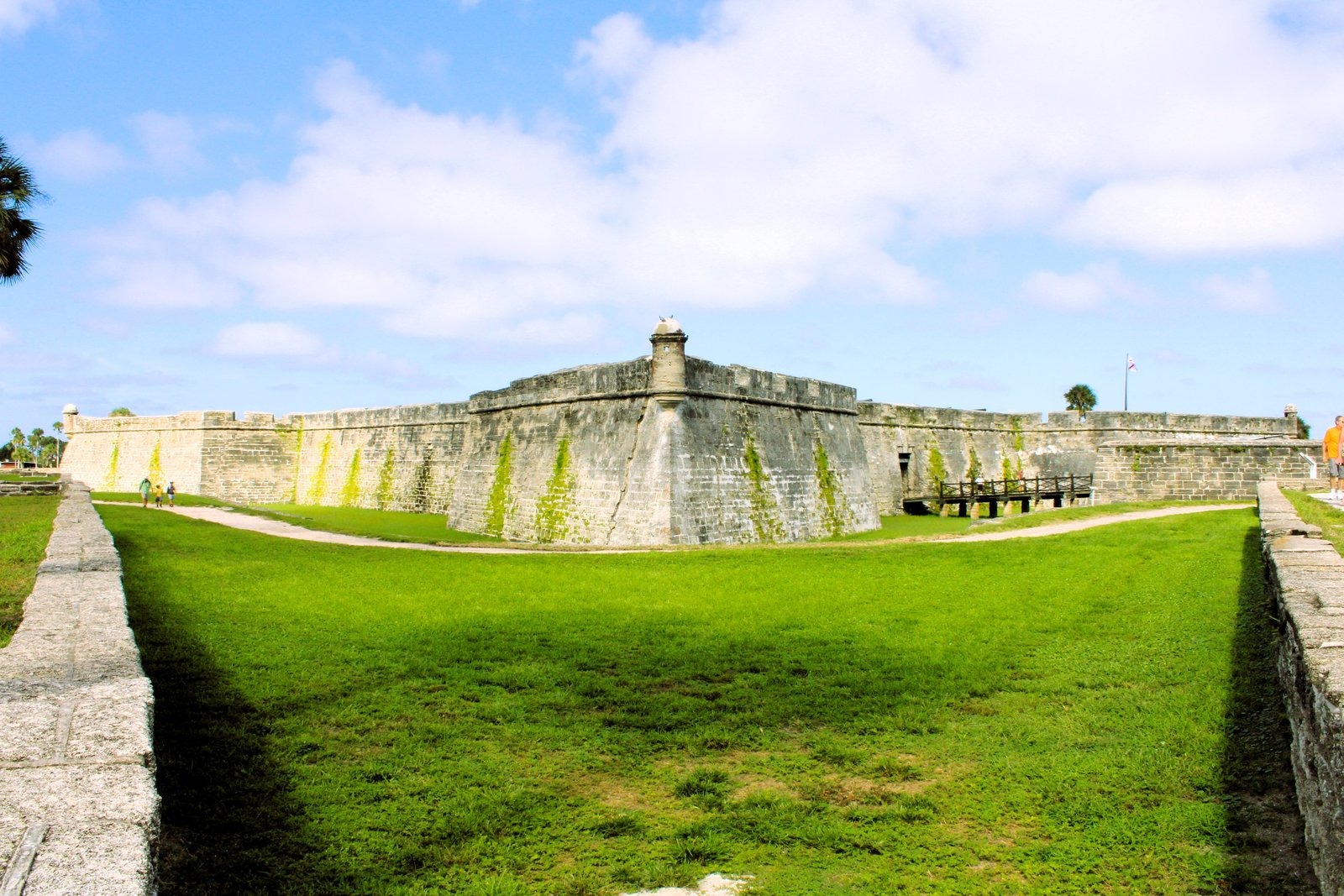
Castillo de San Marcos
The coquina walls, 12 feet thick on average, and the 1702 siege in which almost 1,500 people sheltered inside for about seven weeks. It also covers the fort's use as a prison, including Cheyenne, Kiowa and Apache prisoners in the 1870s and 1886.
Cubo Line
A replica of the defensive wall the Spanish raised in 1704, with its three redoubts. The stop also tells how Fort Mose was settled in 1738 by people who had escaped slavery, and what Kathleen Deagan's excavations found there.
St. Augustine Town Plan Historic District
Why the streets are narrow and meet at right angles, following Spanish ordinances of 1563 and 1573. It explains what was destroyed in 1702, and how much of what looks colonial is later.
Ponce de León Hall
Flagler's hotel of 1888, designed by Carrère and Hastings, was the first large multistory building in the United States built of poured concrete. You hear about the Edison-designed electric system, the Tiffany glass, and the building's later life as Flagler College.
Mission Nombre de Dios
The 208-foot cross marks the 1565 landing site and the first Mass. The audio is clear that Seloy, a Timucua town, was already here, and what excavation did and did not find.
Father Miguel O'Reilly House Museum
A house from before 1763 that became the first schoolhouse of the Sisters of St. Joseph in 1867, for newly freed Black children. In 1916 three of the sisters were arrested under a Florida law against white people teaching in Black schools.
Lincolnville
The neighbourhood settled from 1866 by people freed from slavery, its churches and its 548 historic buildings. It also covers the October 1963 shooting, and the demonstrations of 1964 that were organised from here.
Civil Rights Memorial
The Foot Soldiers Monument, unveiled on 14 May 2011. It tells the story of the 1963 Woolworth's sit-in, the four young people sent to reform school, and the 1964 marches that met Klan violence.