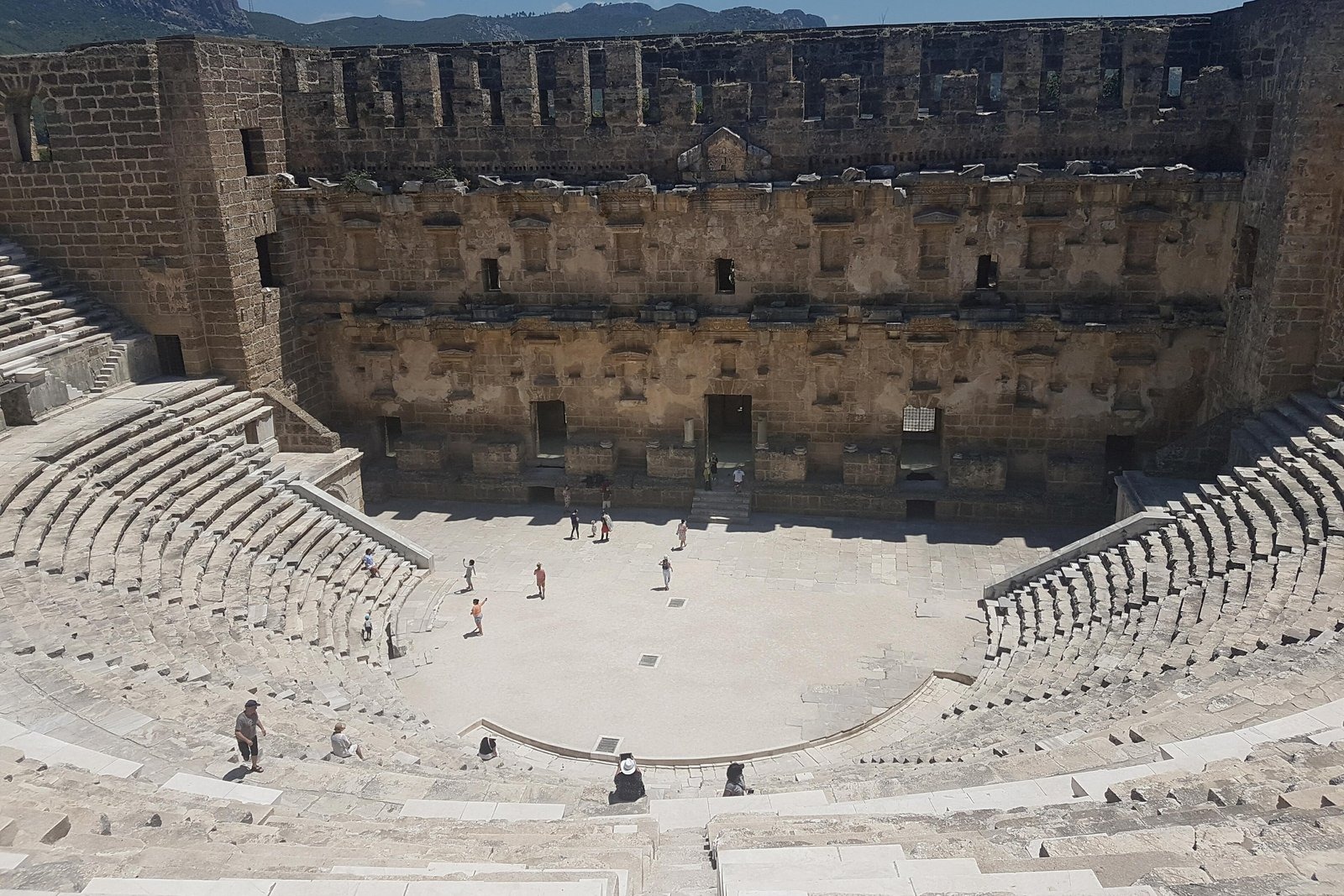
Theatre façade
The stage-building wall is about 100 metres wide and 22 metres high. Two Curtius brothers gave the theatre to the city, and an inscription above the west entrance names its architect, Zenon, son of Theodorus.

Who built the theatre, how it survived, and what stood on the acropolis above it.
Listen to one stop before you buy
Photo: Lee Vilenski (CC BY-SA 4.0)
Aspendos was a river port and market town above the Eurymedon, in Pamphylia. It changed hands often, under Persia, Athens, the Ptolemies, the Seleucids and Rome, and it surrendered to Alexander the Great in 333 BC after first refusing his terms. The theatre is the part most visitors see, and it survives so completely because the Seljuk sultan Alaeddin Keykubad turned it into a palace in the 13th century.
This tour has 11 stops. It starts outside the theatre, then covers the stage building and the seating, and goes on to the agora, basilica, council house, market hall and nymphaeum on the hilltop, the aqueduct, the stadium on the plain, and the Southern Gate. The guide notes where excavators and other accounts disagree on dates and capacities. It plays in your browser, starts by GPS and works offline once downloaded.
The stage-building wall is about 100 metres wide and 22 metres high. Two Curtius brothers gave the theatre to the city, and an inscription above the west entrance names its architect, Zenon, son of Theodorus.
It stands two storeys high, with five doors onto the stage. A relief above the central door shows Dionysos rising from an acanthus. The Seljuk palace phase left brick repairs and faint red zigzag paint.
A covered gallery with columns and arches ran round the top. The excavation team puts the audience at about 7,000 to 8,000, while other accounts claim as many as 18,000. Look for names scratched into seats.
A square roughly 70 metres across. The guide also traces the city's shifting loyalties: Persian rule, Thrasybulos murdered in 389 BC, the Roman levy of 50 talents in 190 BC and the plundering by Verres in 79 BC.
The basilica measured about 105 by 27 metres and was later turned into a church used until the end of the 12th century AD. It was built partly over a three-storey market that the excavators call the earliest of its kind.
A fountain wall about 15 metres high with ten niches over two storeys, fed by the aqueduct. The guide also gives the other reading: that it was a decorative front for the agora and its central niche a doorway.
A sealed siphon of more than 3,000 perforated limestone blocks carried water across a valley about one and a half kilometres wide. Pressure towers stand on the line of arches, and the longest bridge runs for more than 900 metres.
About 215 metres long and 28.50 wide, with vaulted seating and shops beneath it. Much of it lies under soil, and the guide notes that many visitors turn back after the theatre.
In the 13th century the Seljuk sultan Alaeddin Keykubad turned it into a palace, patching the stage walls with brick and decorating them. It was later used as a caravanserai. The guide says those later uses and their repairs largely explain why it stands so complete.
No. Of the 11 stops, three are the theatre. The rest cover the agora, the Roman basilica, the council house, the market hall, the fountain, the aqueduct, the stadium and the Southern Gate.
The guide says it is not agreed. The excavation team puts it at about 7,000 to 8,000 spectators, and other accounts claim as many as 18,000. It gives the same range of views for the stadium, from 5,000 to 15,000.
By a siphon. Water came from springs in the mountains to the north, dropped into the valley and rose again through a sealed pipe of limestone blocks joined with lime and olive oil. The aqueduct stop explains the pressure towers, and the nymphaeum stop shows where the water arrived.
Yes. Excavation began in 2013 under the Antalya Museum and resumed in 2022 under Mustafa Bilgin after work through 2021. The last stop mentions recent finds, including statues of Zeus, Aphrodite and Hermes.
It plays in your phone's browser, so there is no app to install. GPS starts each stop as you arrive, and once the tour is downloaded it works without a data connection.
More in Turkey: Ephesus · Halicarnassus & Bodrum · Hierapolis · Pergamon