Pamukkale travertine terraces
Humann measured the deposit at about 2,700 metres long and 100 metres above the plain. You hear how a channel raises its own walls, what Strabo and Vitruvius said about the stone, and why the water suited dyeing.

How hot water built the white terraces, and what the city made of its springs, its gas cave and its apostle's tomb.
Listen to one stop before you buy
Photo: Pvasiliadis (CC BY-SA 3.0)
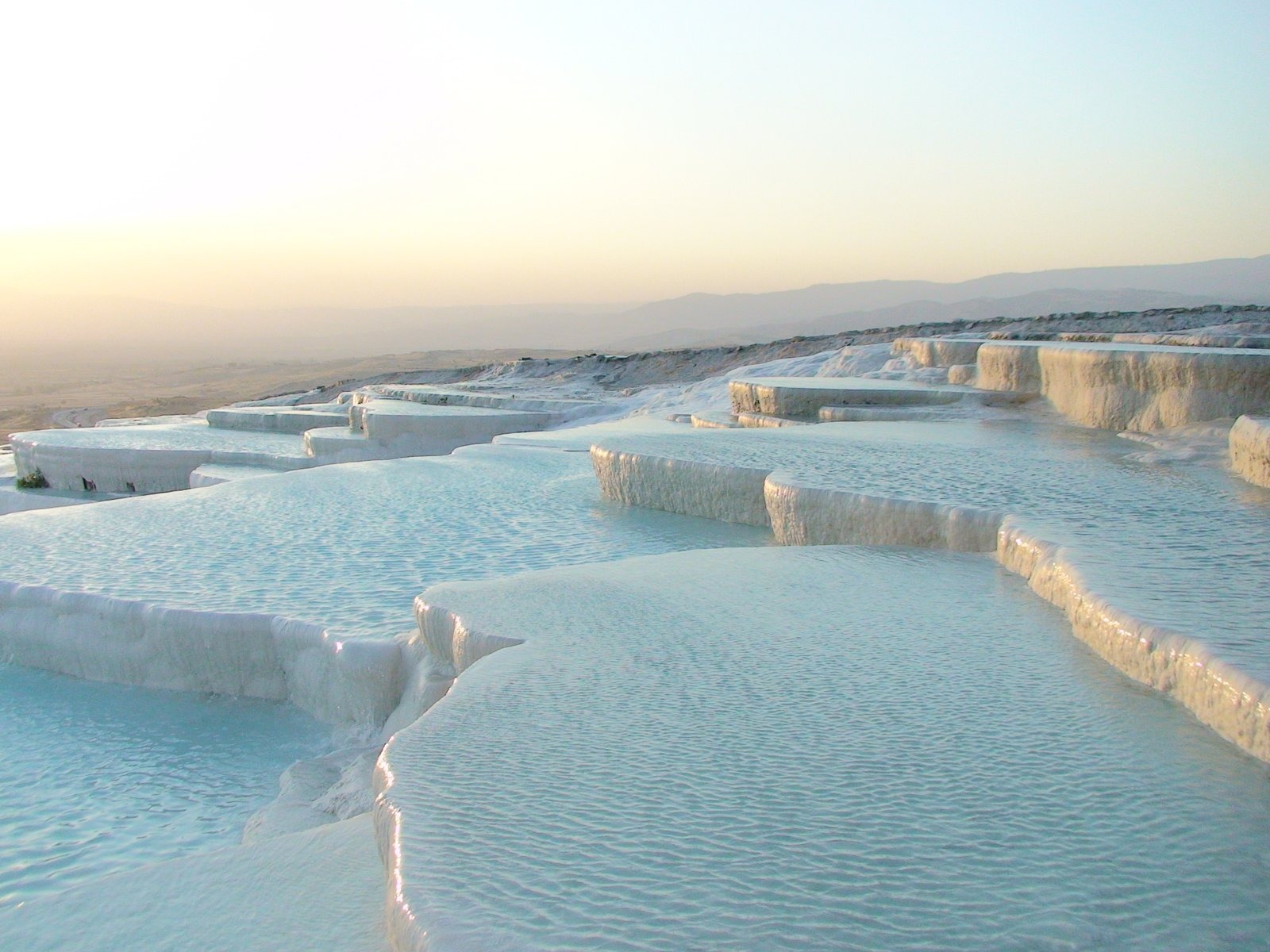
Hierapolis stands on a fault. Water rises from its cracks at about 35 degrees Celsius, laden with lime, and has built the white slope of Pamukkale, the cotton castle. The same fault released the gas that killed animals in the Plutonium, shook the city down in AD 60, and ran along the main street.
This tour has 22 stops. They cover the terraces, the Frontinus Gate and the colonnaded street, the theatre, the Sanctuary of Apollo, the Plutonium, the fountains and baths, and the necropolis. They also take in the Christian city: the cathedral, the baptistery, the octagonal baths and the Martyrion above the tomb traditionally held to be the apostle Philip's. Many stops draw on the 1887 survey by Carl Humann and on the Italian excavations. It plays in your browser, starts by GPS and works offline once downloaded.
Humann measured the deposit at about 2,700 metres long and 100 metres above the plain. You hear how a channel raises its own walls, what Strabo and Vitruvius said about the stone, and why the water suited dyeing.
Strabo's account of bulls and sparrows dying at the cave mouth, the 2012 identification from a dedication to Pluto and Kore, and the 2009 re-reading of the building that earlier excavators had mistaken for the Plutonium.
Between 2009 and 2013 the Italian mission re-erected seven aediculae of the stage front. The guide covers the Severan dedication of 206 or 207, the Apolloneia Pythia frieze and an estimated capacity of ten to twelve and a half thousand.
A gate with two round towers, built by the proconsul Frontinus, who later wrote on Rome's aqueducts. Beyond it runs the main street, about 14 metres wide, which Humann read as proof that the whole city was planned at once.
Villagers told Humann they had no cotton, only a thousand and one tambuks, their word for sarcophagi. The guide also covers a French pilgrim buried with lead badges and a relief showing a water-powered stone saw.
An inscription claims seventy-two trips around Cape Malea to Italy. Walther Judeich did the arithmetic, and the guide follows his doubts about the word translated as merchant.
A ruined octagon on the hill, with the Roman tomb found in 2011 on the slope below. The guide weighs the tradition that Philip is buried at Hierapolis, and mentions Armenian graffiti found in 2015.
It occupies the vaulted halls of the Roman baths, in three galleries: theatre reliefs including Niobe and Persephone, tombs and statues, and small finds from the 4th century BC onwards.
Travertine, which is lime that settles out when the rising warm water meets air and carbon dioxide escapes. The first stop describes it, with Humann's measurements and the notes of Strabo and Vitruvius on how the water turned to stone.
A cave sacred to Pluto and Kore that filled with deadly gas. Strabo describes bulls dragged out dead, and the guide says the gas still kills small birds. It was identified in 2012, south of the Sanctuary of Apollo.
The city lay in a known earthquake zone. The Kleopatra Pool stop lists a quake under Claudius, the one in AD 60 that apparently destroyed the city, and later ones under Antoninus Pius and Alexander Severus. The standing city is essentially the one rebuilt after AD 60.
The guide treats it as the excavators' interpretation. Bishop Polycrates wrote around 190 that Philip sleeps at Hierapolis, and a Roman tomb found in 2011 sits at the centre of a church. The identification rests on tradition and on how the sanctuary was built around it.
Yes. Stops include the 6th-century cathedral and its baptistery, the bishop Papias, the Martyrion, the octagonal baths where patients sought cures, and the pilgrims' graffiti.
In your phone's browser, with no app to install. GPS starts each stop as you reach it, and once downloaded the tour plays without data.
More in Turkey: Ephesus · Aspendos — the Theatre, the Hill City and the Aqueduct · Halicarnassus & Bodrum · Pergamon