Great Altar of Pergamon
Only the platform, about 36 metres by 33, remains; the altar itself is in Berlin. The guide covers the Gigantomachy frieze, longer than any surviving Greek frieze except the Parthenon's, and Humann's finds in a Byzantine wall.
Temple of Athena
The oldest cult centre on the citadel, with unfluted Doric columns. The guide weighs where the royal library stood, Plutarch's 200,000 scrolls and the claim that parchment was invented here, which modern accounts treat as legend.
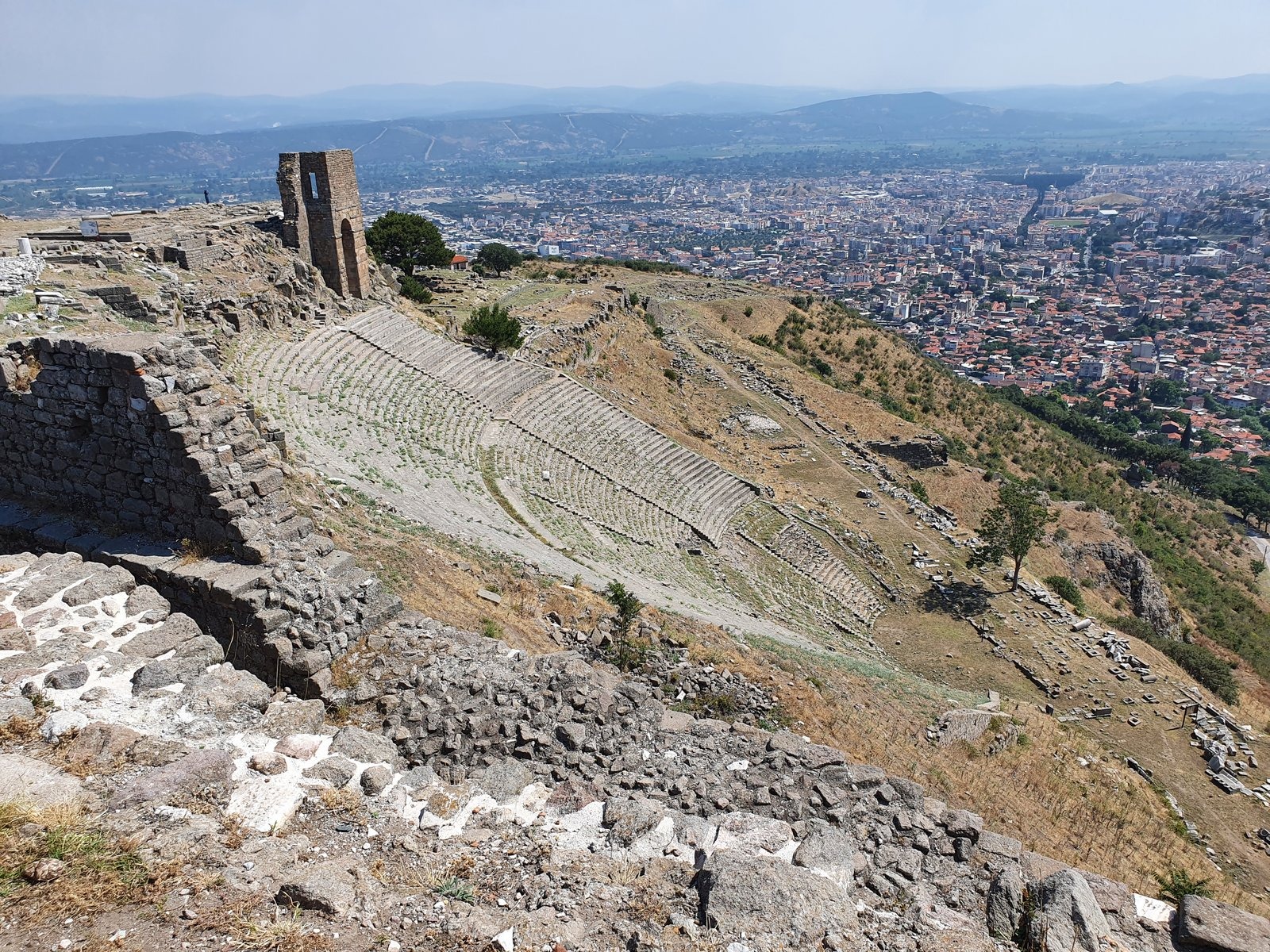
Theatre terrace and Temple of Dionysus
One of the steepest auditoriums of the ancient world, with about 10,000 seats in some 80 rows. A wooden stage was put up and taken down, and a staircase of 25 steps climbs to the god's temple.
Temple of Trajan
Built out over barrel vaults on a terrace 68 by 58 metres, held by a retaining wall 23 metres high. The guide explains how it made Pergamon twice neokoros and how the German Archaeological Institute reassembled its columns.
The Upper Acropolis water supply
The hill had no spring, so water came more than 40 kilometres from the Madradağ mountains and crossed a valley nearly 200 metres deep through a lead pressure pipe. Nine long-distance aqueducts served the city.
Red Basilica
A brick wall about 19 metres high, built as a temple of Egyptian gods over the river Selinus, which still runs beneath it through vaulted tunnels. It later became a church, and its north rotunda is still a mosque.
Asklepieion and its Sacred Road
Galen, born in Pergamon in AD 129, began his career here. The guide follows the covered road of 820 metres, the sacred spring, the round treatment building and the theatre with 29 rows.
Temple of Asclepios Soter
A round temple modelled on the Pantheon, about 24 metres across. The orator Aelius Aristides lived in the sanctuary from 145 to 147, and his Sacred Tales record dreams and the prescriptions he followed.