Roman Theatre of Cartagena
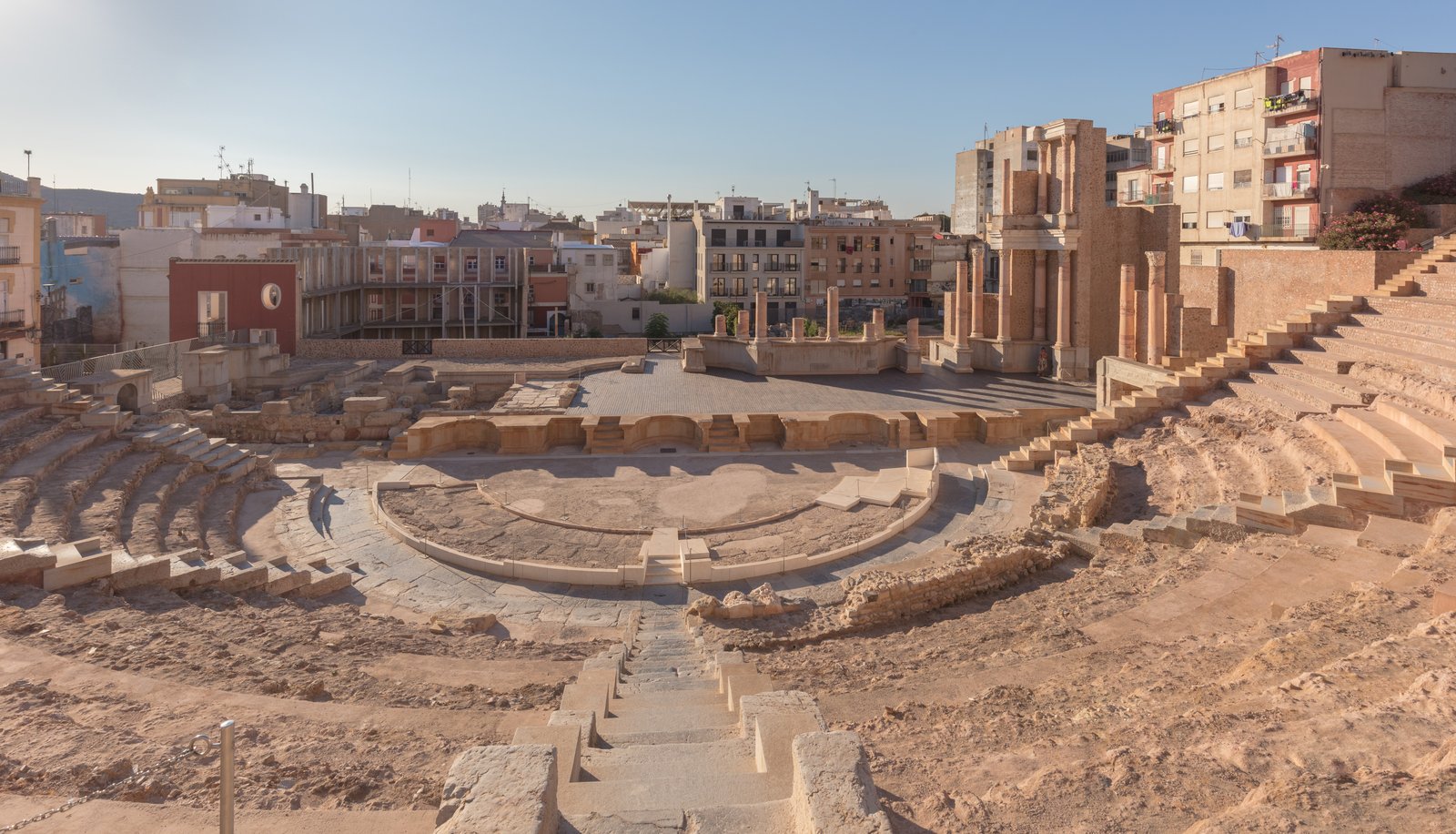
Nobody knew it was there until 1988. Inscriptions to Gaius and Lucius Caesar date it between 5 and 1 BC, and the stop explains how the cathedral and a fishermen's quarter ended up built on its seating.

Twenty-nine stops across the five hills where Hasdrubal founded his Spanish capital.
Listen to one stop before you buy
Photo: Diego Delso (CC BY-SA 4.0)
Cartagena began as Qart Hadasht, the New City that Hasdrubal founded around 229 to 227 BC. Scipio took it in 209 BC, and it became the Roman city of Carthago Nova. Many layers of that history sit on the five hills around the harbour: a stretch of Punic wall behind glass, the Roman theatre found only in 1988, the forum quarter and a sanctuary of Isis and Serapis.
The tour then moves through the Byzantine wall, the castle on the Concepción hill and the eighteenth-century Arsenal built under Philip V and Charles III. It continues to the Cantonal revolution of 1873, the Civil War bombing and the shelter dug in 1937, and the modernist houses that mining money paid for, by architects including Víctor Beltrí.
Nobody knew it was there until 1988. Inscriptions to Gaius and Lucius Caesar date it between 5 and 1 BC, and the stop explains how the cathedral and a fishermen's quarter ended up built on its seating.
A stretch found in 1987 while an underground car park was dug. The tour describes its casemates and Polybius's account of Scipio's attack in 209 BC, which failed at the wall and succeeded across the lagoon.
A small Egyptian temple in a Roman port, with four Ionic columns and four cisterns. Of 335 Roman inscriptions found in the city, only 13 are votive, and three of those name Serapis.
Begun in 1731 and declared complete in January 1782, with convicts first emptying the dry docks by hand. The stop also covers the frigate Almansa raising the red flag in the Cantonal revolution of 1873.
A 7th-century BC Phoenician boat from Mazarrón, loaded with litharge, was lifted in about twenty sections in 2024. The same museum received a 17-tonne treasure from the frigate Nuestra Señora de las Mercedes.
The hull launched on 8 September 1888 by Isaac Peral, the first vessel to combine electric propulsion with underwater torpedo firing. The navy judged it a technical curiosity and Peral left in 1891.
A tunnel cut into the Concepción hill from 1937, with 20 entrances and room for more than 5,000 people. The stop recounts the bombing of 25 November 1936, in which at least 58 civilians died.
Mining fortunes built modernist houses. Beltrí's Casa Cervantes, inaugurated on 26 February 1900, held the Café España, whose suspiros sweets inspired a pasodoble.
Roman remains are a large part: the theatre, the amphitheatre under the bullring, the forum, the Decumanus and the Casa de la Fortuna. But the route also covers Punic and Byzantine walls, the Arsenal, the 1873 canton and the Civil War.
A revolutionary committee occupied the town hall on 12 July 1873 and proclaimed the Canton of Murcia. Government troops besieged the city, and it surrendered in January 1874 as the last canton to fall. The tour tells it at the town hall.
Yes. They include Casa Cervantes, Casa Maestre, the Gran Hotel and the town hall, built between 1900 and 1907. The tour names the architects, including Víctor Beltrí and Tomás Rico Valarino, and the mining money behind them.
It plays in the browser, with no app to install, and GPS starts each stop as you arrive. Download the tour first and it plays offline, so you do not need a mobile signal.
Yes. Every stop triggers only when you get there, so you can leave out any that do not interest you.
More in Spain: Itálica · La Laguna · Cadiz & Seville · Ibiza · Palma · Arrecife — the Port Town of Lanzarote