Plaza del Adelantado
How Lugo broke Guanche resistance after a defeat at Acentejo, why the town was founded beside a lake, and the competing theories about its grid: Leonardo's map of Imola, Plato and Vitruvius, or the sun.

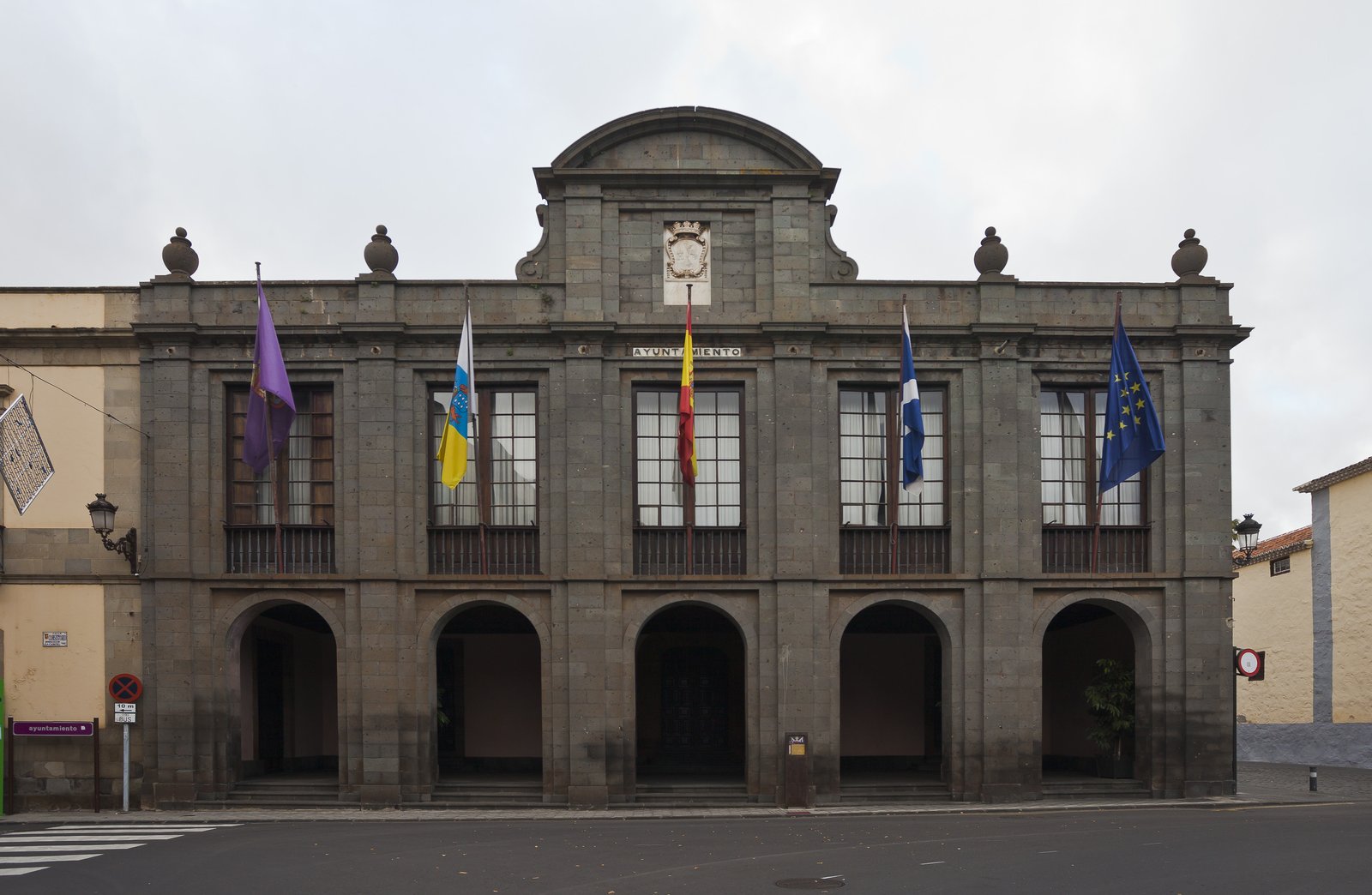
Thirty stops through the streets Alonso Fernández de Lugo laid out on Tenerife's inland plain.
Listen to one stop before you buy
Photo: Diego Delso (CC BY-SA 3.0)
La Laguna was founded inland, beside a shallow lake, after Alonso Fernández de Lugo finished the conquest of Tenerife. It was never walled, and UNESCO inscribed it in 1999 as the first unfortified Spanish colonial town, a model for many in the Americas. The tour keeps that fact in view and asks why the streets look the way they do.
Along the way you meet the Plaza del Adelantado and the older upper town around La Concepción, the convents of Santo Domingo and Santa Clara, merchant and noble houses on Calle San Agustín, and a cathedral rebuilt in reinforced concrete. Each stop is told through its documents, its fires and its disputes, including the scholars who still disagree about the town plan.
How Lugo broke Guanche resistance after a defeat at Acentejo, why the town was founded beside a lake, and the competing theories about its grid: Leonardo's map of Imola, Plato and Vitruvius, or the sun.
Only the Neoclassical façade survived the demolition of 1904. Lieutenant José Rodrigo-Vallabriga rebuilt the rest in concrete moulded to look like Gothic stone, but the steel corroded and the cathedral closed again from 2002 to 2014.
A portal finished between 1540 and 1545, the oldest Plateresque work in the Canaries. The cement used to repair it in the 1970s damaged the soft stone, and the portal was unveiled again in May 2026 after hand restoration.
A Mannerist doorway built in the 1590s for Genoese merchants, now the island's history museum, plus the ghost story of Catalina Lercaro and the street's older names, Calle Real and the street of merchants.
A Dominican convent built on the Adelantado's own house plot. It keeps the body of Sor María de Jesús, found incorrupt about three years after her death in 1731 and shown to the public on two days a year.
A life-size Flemish crucifix of oak, dated 1514 by a hidden inscription, brought to the Franciscan convent in 1520. A fire in 1810 destroyed the church but saved the image and the silver.
The birthplace of José de Anchieta, who sailed for Brazil in 1553, helped found the school around which São Paulo grew, wrote the first Tupi grammar, and was declared a saint in 2014.
The roofless church that burned on 2 June 1964. Two accounts of the cause survive, a short circuit or a blowtorch, and no official cause was ever confirmed.
UNESCO inscribed it in 1999 as the first unfortified Spanish colonial town, and as a model for many colonial towns in the Americas. The tour explains the plan Lugo set out in 1500 around the Plaza del Adelantado and the debate over where that plan came from.
Yes. It tells how the old church was demolished in 1904 except for its façade, rebuilt in reinforced concrete between 1905 and 1913, and closed again in 2002 when the steel corroded. It reopened in 2014.
Many. They include the Guanche kings taken to the Catholic Monarchs, the ghost of Catalina Lercaro, the Enlightenment circle at the Nava house, the incorrupt body of Sor María de Jesús, and Anchieta, the Jesuit missionary born in the town.
It plays in your phone's browser, with no app to install. As you reach each stop, GPS starts its narration. You can download the tour in advance and then play it offline.
Not if you download the tour first. Once the download is complete, the stops play from your phone without a connection.
Yes. Each stop starts when you arrive at it, so you can follow the streets in whatever order suits you rather than a fixed sequence.
More in Spain: Itálica · Cadiz & Seville · Ibiza · Cartagena · Palma · Arrecife — the Port Town of Lanzarote