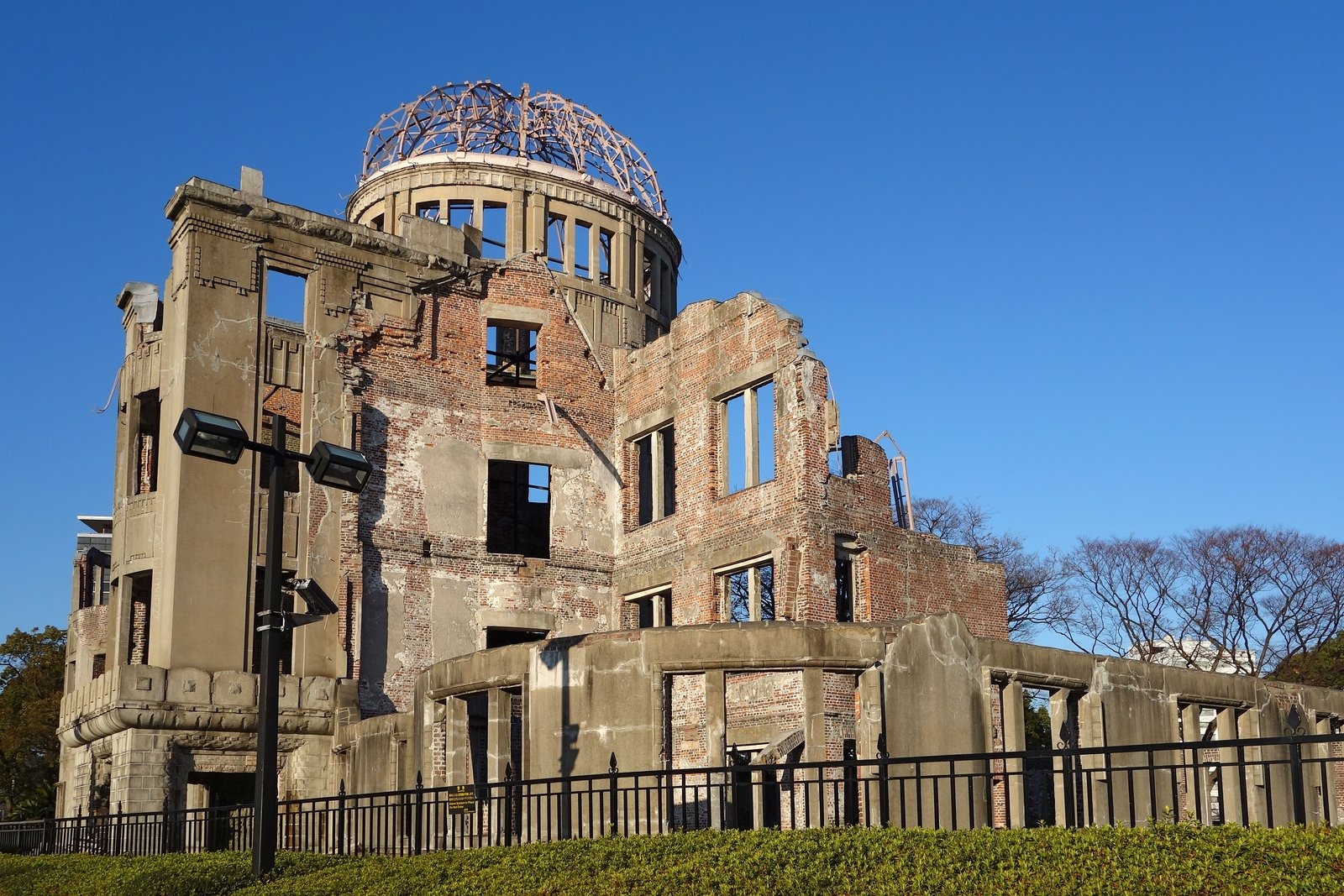
A-Bomb Dome
Opened in 1915 as an exhibition hall for the prefecture's products and later used for government offices. Jan Letzel, a Czech architect, designed it, and it stood roughly 160 meters from the hypocenter. UNESCO listed the ruin in 1996.

Fifteen stops among the bridges, monuments and survivors' places of the park, from the Dome to the museum.
Listen to one stop before you buy
Photo: Oilstreet (CC BY 2.5)
On August 6, 1945, at 8:15 a.m., an atomic bomb exploded over the Nakajima district of Hiroshima. The park that now fills that district was opened in April 1954, after a design competition won by Kenzo Tange's group, and almost everything in it is placed in relation to that moment.
The walk begins at the A-Bomb Dome beside the Genbaku Dome-mae tram stop and ends at the Peace Memorial Museum. Between them you stand on the T-shaped Aioi Bridge, which the guide identifies as the aimpoint, find the small plaque at the hypocenter, and visit memorials to mobilized students, Korean victims and children. You also see a Chinese parasol tree that survived the bomb, a flame meant to burn until nuclear weapons are gone, and the cenotaph whose arch frames the Dome. Each stop plays by GPS as you arrive.
Opened in 1915 as an exhibition hall for the prefecture's products and later used for government offices. Jan Letzel, a Czech architect, designed it, and it stood roughly 160 meters from the hypocenter. UNESCO listed the ruin in 1996.
The bridge's T-shape, made by a leg added in 1934, is identified as the intended aimpoint on August 6, 1945. At the former Shima Hospital, a small plaque on the sidewalk marks the spot beneath the explosion, about 600 meters up.
Built in 1929 as the Taishoya Kimono Shop, 170 meters from the hypocenter. Eizo Nomura survived in its basement while the floor above was destroyed, and the basement, seen when open, shows bomb remnants alongside his account.
A nine-meter bronze monument begun by the classmates of Sadako Sasaki. A gold-colored crane is held above the central girl figure, and visitors leave bundles of folded paper cranes in booths at its foot.
Designed by Kenzo Tange, its arch shelters a stone chamber holding the register of victims, which includes people of every nationality. From the front of it, on the central axis, you look through the arch to the Flame of Peace and the Dome.
A black monolith on a granite turtle, put up in 1970 at the western end of Honkawa Bridge and relocated into the park in July 1999. The guide explains why its first site, and its inscriptions, became a focus of debate about Korean victims.
A circular wall with one opening leads down to an underground Hall of Remembrance. Its panorama is made from roughly 140,000 tiles, the number estimated to have died by the end of 1945, and a fountain aligns with a clock face showing 8:15.
Moved in May 1973 from a courtyard about 1.3 kilometers from the hypocenter. The trunk is burned and hollowed on the side that faced the blast, yet the tree revived, and its seedlings have been given to schools in Japan and elsewhere.
It begins at the A-Bomb Dome, by the Genbaku Dome-mae tram stop across the Motoyasu River, and concludes at the Hiroshima Peace Memorial Museum. The fifteen stops lie in between, in and around the park.
Yes. A stop at the former Shima Hospital explains where the bomb exploded, about 600 meters above the site. The guide notes the marker is a small plaque on the sidewalk beside the present clinic entrance.
The guide focuses on the bombing and its memory, but also covers the buildings before it: the 1915 Exhibition Hall, the 1929 kimono shop, the original wooden Motoyasu Bridge and the postwar design of the park.
That it was designed by Kenzo Tange, that its inscription reads "Let all the souls here rest in peace; For we shall not repeat the evil," and that the Peace Memorial Ceremony is held in front of it on August 6th.
It runs in your phone's browser, with no app. Each stop starts by GPS when you reach it, and a downloaded copy works offline.
Yes: the mobilized students, whose tower honours more than 10,000 young people, the Korean victims, the children represented by Sadako Sasaki, and the unidentified dead whose remains lie in the Atomic Bomb Memorial Mound.
More in Japan: Miyajima — Itsukushima Shrine and the Island Town · Kanazawa — Kenroku-en, the Castle and the Samurai Quarter