Kanazawa
Japan · Ishikawa

Kanazawa: garden, castle and samurai lanes

Eighteen stops through the Maeda lords' garden, the castle grounds and the earthen-walled Nagamachi quarter.

$10.9918 stops · one payment
Already bought it? Open your tour

Listen to one stop before you buy

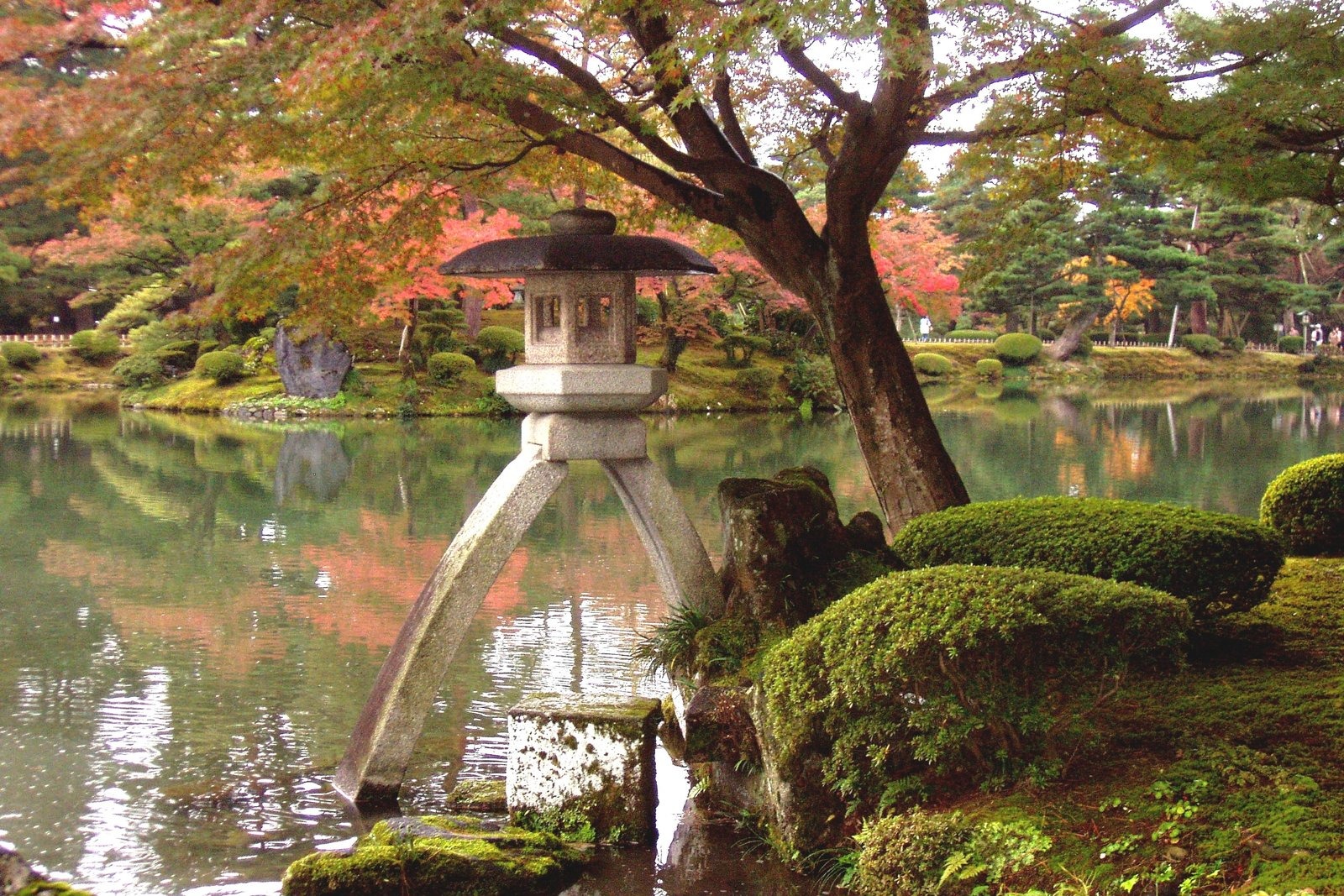
Photo: Daderot at English Wikipedia (CC BY-SA 3.0)

Kanazawa was the seat of the Maeda family, rulers of the Kaga Domain from 1583, and three places still show how they lived and defended themselves. Kenroku-en began in 1676 as a villa and garden and opened to the public in 1874. Kanazawa Castle, whose keep burned in 1602 and was never rebuilt, keeps an original gate and a set of watchtowers rebuilt in 2001. Nagamachi preserves the earthen walls and canal-fed gardens of samurai households.

The walk begins at Kenroku-en, crosses to the castle and concludes in Nagamachi. It points out what to look for at each place: the exposed roots of the Neagari Pine, the rope supports on the Karasaki Pine, stone-dropping openings in castle gates, a stained-glass shrine gate, and a pharmacy and an ashigaru house moved to Nagamachi. Each stop plays by GPS as you reach it.

What you hear along the way

Kenroku-en ponds and pines

Kasumiga-ike, the garden's largest pond, was expanded in 1837. Around it stand the Kotoji Lantern with its two unequal legs and the Karasaki Pine, raised from Lake Biwa seed and held up in winter by five poles and about 800 ropes.

Neagari Pine

A black pine planted in deliberately raised soil, then cleared away once mature. About 40 roots rise as much as two meters above the ground, so the trunk seems to hang in the air.

Hisago-ike, Midori-taki and Yugao-tei

A gourd-shaped pond, a basin-less waterfall of about 6.6 meters modelled on Nachi Falls, and a teahouse added in 1774 after the 1759 Kanazawa fire. Look for the gourd-shaped window between its tea room and waiting room.

Seisonkaku

Commissioned in 1863 as a retirement residence for the mother of Maeda Nariyasu, with formal samurai shoin rooms below and sukiya-style rooms upstairs, one finished in imported French ultramarine blue and one with an interlaced-bamboo ceiling.

Ishikawa-mon and the castle gates

Ishikawa-mon is an original Edo-period gate with a square masugata courtyard where attackers could be trapped. The Kahoku-mon, Hishi Yagura and Gojikken Nagaya were rebuilt in traditional wood, with openings for dropping stones on attackers.

Gyokusen'inmaru Garden

Commissioned in 1634 by Maeda Toshitsune, with landscapers invited from Kyoto. Its stepped design has a 22-meter drop from the highest stonework to the pond bottom, a four-step waterfall and a rear wall of staggered square and oblong stones.

Oyama Shrine and its Shinmon

The shrine enshrines Maeda Toshiie. Its three-story gate, completed on November 25, 1875, mixes Japanese, Chinese and Western styles, with three stone arches, stained-glass windows and a lightning rod.

Nagamachi: canal, houses and museum

The Onosho Canal runs along the earthen walls and feeds samurai garden streams. The Nomura house dates to 1843, and the Ashigaru Museum shows the homes of foot soldiers, with stones laid across the roofs.

The 18 stops

  1. Kenroku-en
  2. Kotoji Lantern and Kasumiga-ike
  3. Karasaki Pine
  4. Neagari Pine
  5. Seisonkaku
  6. Hisago-ike and Midori-taki
  7. Yugao-tei
  8. Ishikawa-mon
  9. Kahoku-mon
  10. Hishi Yagura, Gojikken Nagaya and Hashizume-mon
  11. Sanjikken Nagaya
  12. Gyokusen'inmaru Garden
  13. Oyama Shrine Shinmon
  14. Oyama Shrine
  15. Kanazawa Shinise Memorial Hall
  16. Onosho Canal
  17. Nomura Family Samurai House
  18. Ashigaru Museum

Before you go

Starts at
At Kenroku-en; the walk crosses from the garden to Kanazawa Castle and concludes in the Nagamachi samurai quarter.
The route
Eighteen stops on foot: the garden, the castle grounds and gates, Oyama Shrine, and the streets and canal of Nagamachi.
Good to know
Several buildings, including Seisonkaku, the Nomura house and the Shinise Memorial Hall, are described for when they are open. The castle gates are partly original and partly rebuilt, and the guide says which.
When to go
The guide describes the winter yukitsuri rope supports at Kenroku-en and snow on the Karasaki Pine.
How it plays
In your phone's web browser, with no app to install. GPS starts each stop as you reach it, and once downloaded the tour plays without a signal.

Questions

Where does the Kanazawa tour start and finish?

It begins at Kenroku-en, moves to Kanazawa Castle and finishes in the Nagamachi samurai quarter. Eighteen stops are spread across those three areas, and each plays when you reach it.

Is the castle original?

Only in part. The guide says Ishikawa-mon is an original Edo-period structure, while the Hishi Yagura and Gojikken Nagaya were rebuilt between 1999 and July 2001 using traditional methods, after a fire in 1881 destroyed most of the Ninomaru buildings.

What are the ropes on the pine trees?

Yukitsuri, a winter support. The Karasaki Pine stop describes five poles and about 800 ropes arranged conically to suspend the branches and stop snow breaking them. It also notes snow can settle on the ropes, and they are sometimes lit at night.

Does it include inside views of samurai life?

Yes. The Nomura Family Samurai House has a garden, a tea room, swords and armor, and the Ashigaru Museum shows the houses of foot soldiers. The Shinise Memorial Hall shows a merchant pharmacy.

Do I need an app or data?

No app is needed. The tour plays in your browser, each stop starts by GPS on arrival, and a downloaded copy works offline.

Who were the Maeda?

The lords of the Kaga Domain. Maeda Toshiie led the family from Kanazawa Castle starting in 1583, and later lords such as Tsunanori, Harunaga and Nariyasu built and reshaped Kenroku-en, as the guide explains.

Kanazawa — Kenroku-en, the Castle and the Samurai Quarter

$10.99Tax included
Already bought it? Open your tour

More in Japan: Hiroshima — the Peace Memorial Park and the A-Bomb Dome · Miyajima — Itsukushima Shrine and the Island Town