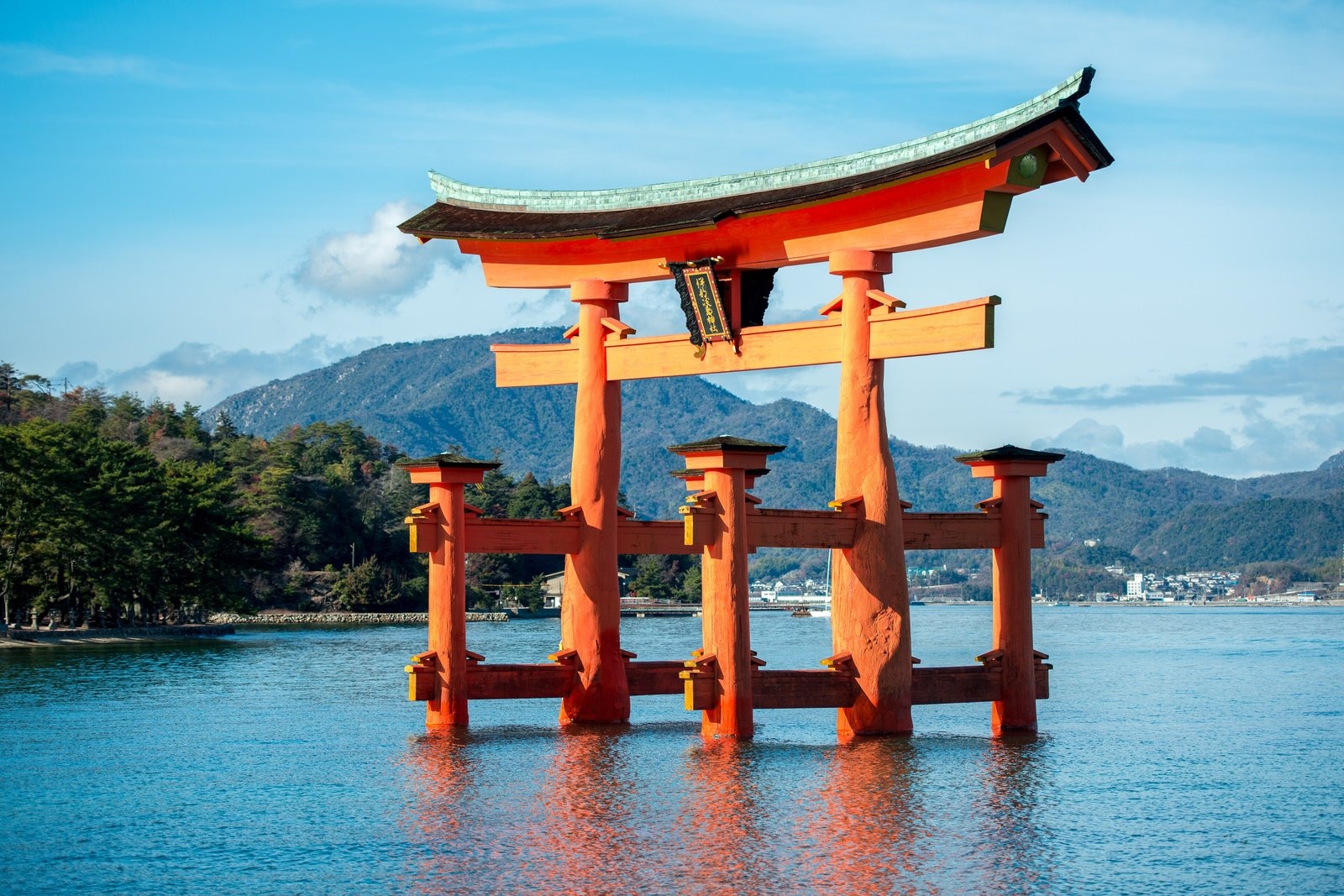
Great Torii
The vermilion gate stands offshore, about 160 meters from the main hall. The current one was completed in 1875, with two camphor pillars and four cedar sleeve pillars. About 7 tons of stones in the upper lintel keep it steady, and you can count six legs at the base.
Itsukushima Shrine Main Hall
Rebuilt in 1571 by Mori Motonari after his victory at the Battle of Itsukushima in 1555, in the Heian style with a cypress-bark roof and white stucco walls. The guide asks you to notice the small deliberate gaps between the floorboards.
Hirabutai and Takabutai
A flat stage on stone foundations, attributed to Mori Motonari's donations in 1571, and an elevated stage built for Bugaku court dance. A Hitasaki projection runs toward the Great Torii, ending in a lone lantern with the clearest alignment.
Noh stage
Erected over the sea in 1680 by Asano Tsunanaga. Because of the water, it could not use resonance jars under the floor. A typhoon nearly destroyed it in 1991, and performances are held during the Toka Festival from April 16 to 18.
Senjokaku and the Five-Storey Pagoda
Toyotomi Hideyoshi commissioned the great sutra hall in 1587, and it became a Shinto shrine in the Meiji separation. Beside it, the red-lacquered pagoda dates to 1407 and has an unusually short central pillar that stops at the second story.
Tahoto Pagoda
A two-story pagoda with a square lower level and a circular upper one. It was renamed Hozan Shrine in 1880 and, from the slope park around it, gives a raised view back over the shrine, the torii and the sea.
Daisho-in
At the foot of Mount Misen, rebuilt largely after an 1887 fire, with rotating sutra wheels in the stair handrails and 500 rakan statues with individually different faces. At the top, the Henjokutsu cave holds statues of the eighty-eight Shikoku temples.
Machiya-dori and the History and Folklore Museum
A curving street of timber townhouses one street inland from Omotesando, still lived in. The museum is built around the early-19th-century house of the Egami family, merchants whose wealth came from soy-sauce brewing.