Acueducto de Segovia
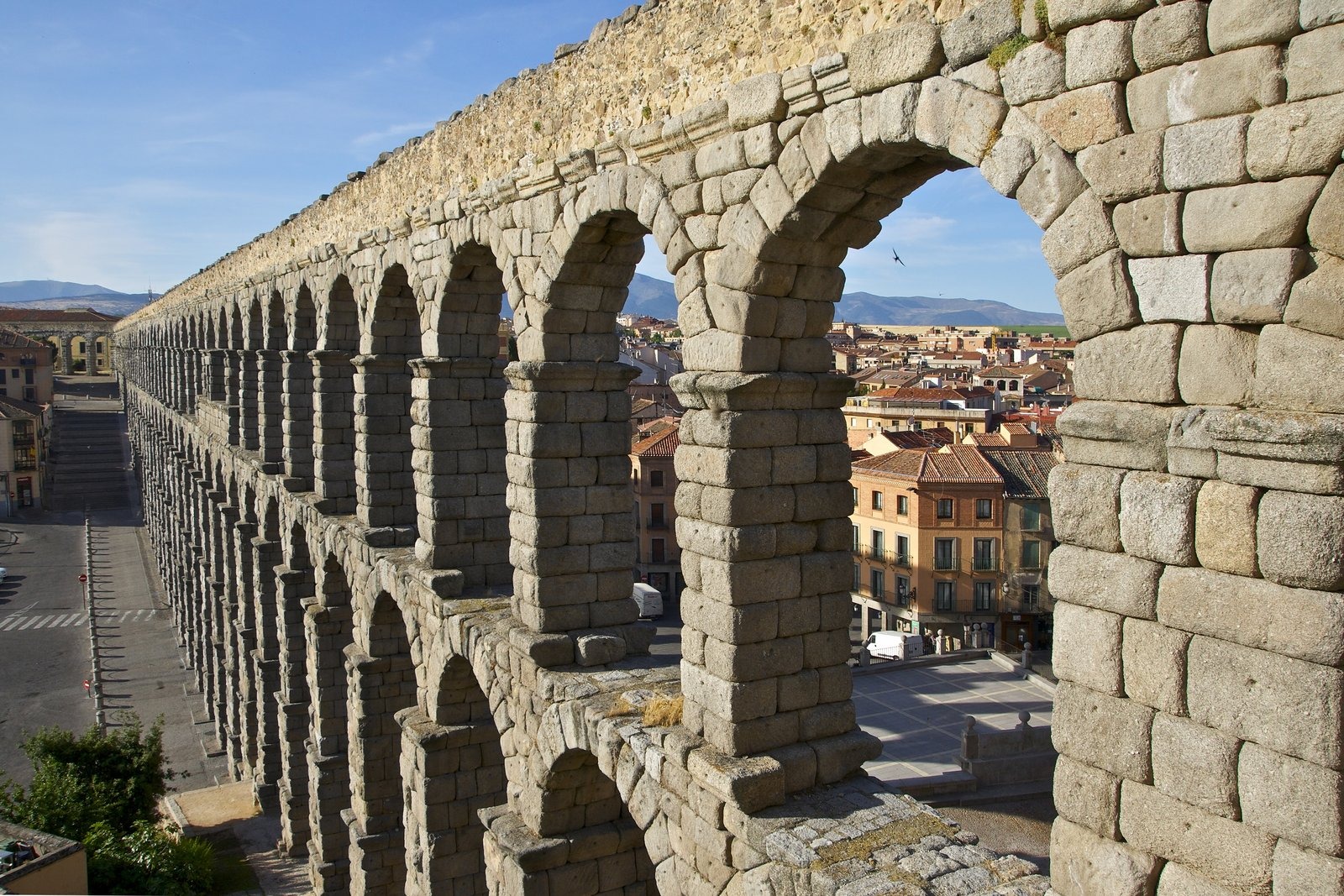
UNESCO gives about AD 50, while Segovia's tourism office puts it in the early second century. The arcade runs roughly 270 metres. Look for the two niches, and the small statue of the devil on Calle San Juan.

Twenty-four stops that climb through the walled town, with the Jewish quarter and the canons' precinct along the way.
Listen to one stop before you buy
Segovia stands on a rock above a sloping valley, and its aqueduct is what let a city sit there. Over 24,000 granite blocks from the Guadarrama, set without mortar, carry the water across the Azoguejo. From there the route climbs west through the old town, ending at the Alcázar on sloping streets.
On the way you pass the Romanesque churches of San Martín, San Millán and San Esteban, the Judería, the canons' precinct and a late-Gothic cathedral built after the revolt of 1520 and 1521 destroyed its predecessor. The stops explain what each building was for and what to notice in its stonework.
UNESCO gives about AD 50, while Segovia's tourism office puts it in the early second century. The arcade runs roughly 270 metres. Look for the two niches, and the small statue of the devil on Calle San Juan.
A fortified residence documented from around the eleventh century and reworked by kings from Alfonso VI onward. It later held a prison for over two centuries and, from 1764, an artillery school.
Juan Gil de Hontañón signed the contract on 7 May 1524, after the War of the Communities wrecked the old cathedral. The tour points out a small white tile marking the cathedral's tiniest stone.
The Jewish community built it around 1300. It became a church in the early fifteenth century and was damaged by fire in 1899. Horseshoe arches and a gallery for women survive.
The home of Castile's last court rabbi, who converted shortly before the expulsion of 1492. Someone has chipped at the Coronel coat of arms, and the chapel inside dates from 1909.
Isabella was proclaimed Queen of Castile on 13 December 1474 at the earlier Romanesque church on the square. The present church took from 1536 to 1587 and helped open up the Plaza Mayor.
A façade of granite blocks cut into diamond points, put up around 1500 for the councillor Juan de la Hoz. Its fortified look answered its position beside the former San Martín Gate.
A gate between the walled city and the Judería, with reused Roman funerary stones in its masonry. Outside, the old Jewish cemetery lies cut into the rock across the Clamores valley.
With over 24,000 blocks of Guadarrama granite, laid dry and balanced by their own weight. Water came from the Frío river and had to hold an even gradient into the city, with sand traps along the way to settle out grit.
Yes. It covers the Judería, which had five synagogues, the Corpus Christi church that was the Sinagoga Mayor, Abraham Seneor's house, and the Puerta de San Andrés with the old cemetery across the valley.
San Martín, San Millán, San Esteban and San Andrés all have stops. They include a skewed apse, a Mozarabic tower, and a portico of ten arches with carved capitals of animals, lions, griffins and harpies.
It plays in your browser, with no app to install. GPS starts each stop as you reach it, and once you have downloaded the tour it works offline.
No. After the download the audio is on your phone, and each stop plays without a signal.
More in Spain: Itálica · La Laguna · Cadiz & Seville · Ibiza · Cartagena · Palma