Palace of King Sancho
How the royal palace was absorbed into the charterhouse in 1399: five halls became cells, the dungeon the refectory, the pantry the sacristy, and the courtyard the cloister and cemetery.

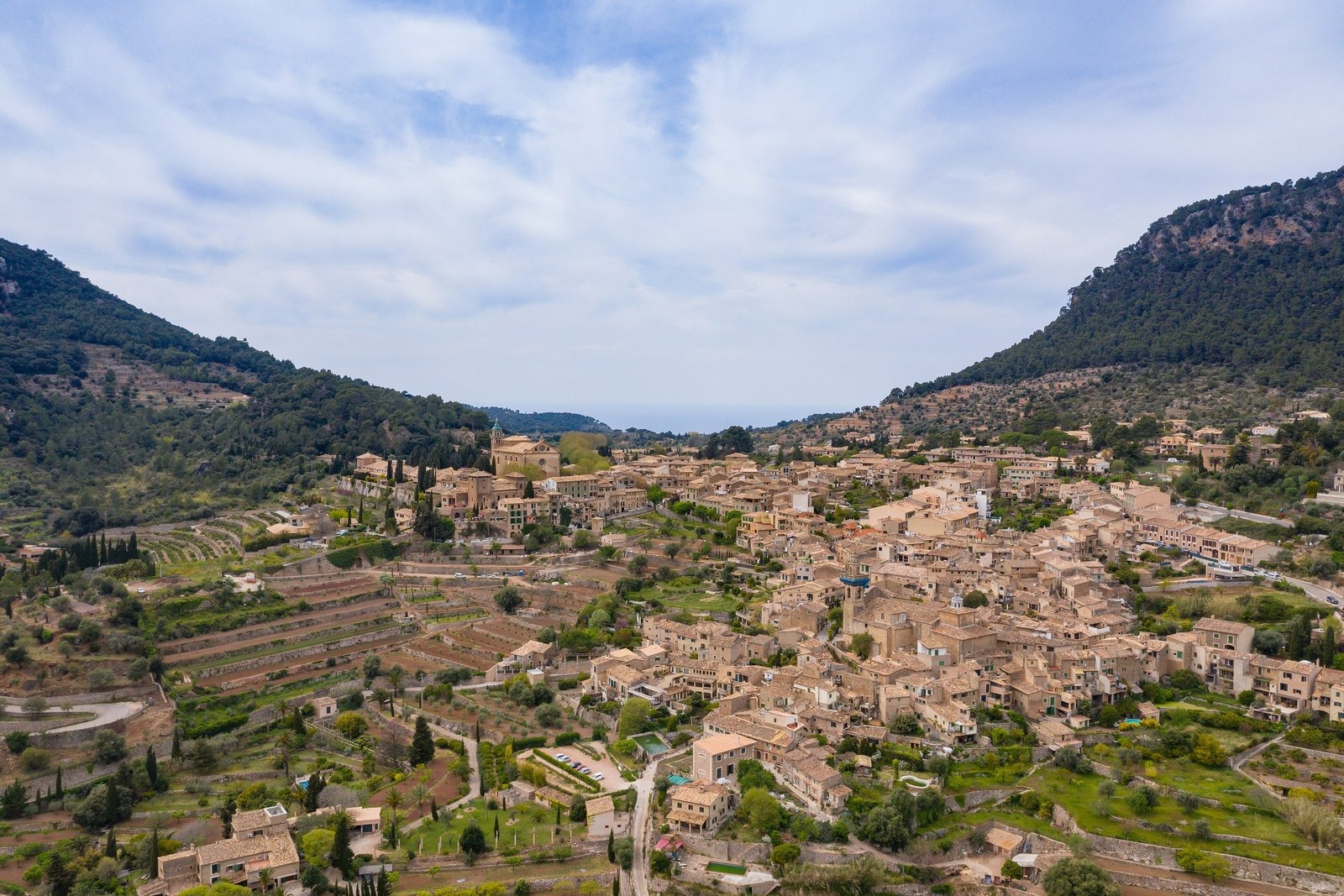
Fifteen stops in a Tramuntana hill village, from a royal palace of 1309 to the birthplace of its saint.
Listen to one stop before you buy
Valldemossa sits more than 400 metres up in the Serra de Tramuntana. Its story begins with a palace that Jaume II of Mallorca had built for his son Sancho, probably from 1309, because mountain air was thought to ease the prince's breathing illness. In 1399 Martin I of Aragon gave it to the Carthusians, and the palace became a charterhouse.
The tour moves through the church, the cloisters and the monks' cells, the prior's rooms and the old pharmacy. It stops in cell number 4, where Chopin and George Sand spent the winter of 1838 to 1839, and ends in the old village at the birthplace of Santa Catalina Thomàs. It also takes in a memorial chapel, a hillside cultural centre and a viewpoint over the valley.
How the royal palace was absorbed into the charterhouse in 1399: five halls became cells, the dungeon the refectory, the pantry the sacristy, and the courtyard the cloister and cemetery.
They lived in cell 4 from 15 December 1838 until 11 February 1839. Chopin worked on the 24 Preludes here, his Pleyel was delayed until January, and Sand later wrote of a hostile village.
The great cloister was built in stages between 1505 and 1626. Each Carthusian lived alone in his own cell, with a private garden terrace at the back.
Founded between 1723 and 1725, with 138 ceramic apothecary jars, 124 glass containers and 49 wooden boxes. It kept serving the village until the 1890s.
Consecrated in 1812, with frescoes by Brother Manuel Bayeu, Goya's brother-in-law, and two choirs, one for lay people and one for monks.
A cell the size of two ordinary ones, with a chapel, library, audience room and garden, serving both the prior's dealings with visitors and a Carthusian's solitude.
Born here on 1 May 1531, beatified in 1792 and canonised in 1930. Painted tiles with her prayer are set into house fronts all over the village.
A memorial built by Archduke Ludwig Salvator in 1911 on Son Gual land. Local tradition holds that Saint Vincent Ferrer preached on this ground in 1413.
Today both cell 2 and cell 4 are museums of their stay. The case for cell 4 rests on Édouard Ganche's research, which uses a drawing by Maurice Sand and George Sand's writings, and a court ruling in 2013 confirmed it.
In the winter of 1838 to 1839 he worked on the 24 Preludes, Op. 28, among them the Raindrop, as well as his Second Ballade, his Third Scherzo and polonaises. The stop also describes the weather and the damp cell.
No. The monastery, the Carthusian way of life, the pharmacy, Jovellanos's stay in 1801 and 1802, and the village's own saint all have stops. Chopin is one stop among fifteen.
It plays in the browser, and no app is needed. GPS starts each stop when you arrive. If you download the tour beforehand, it plays offline.
No. The walk begins at the chapel at the top of the village, but the stops can be taken in any order, and each plays when you reach it.
More in Spain: Itálica · La Laguna · Cadiz & Seville · Ibiza · Cartagena · Palma