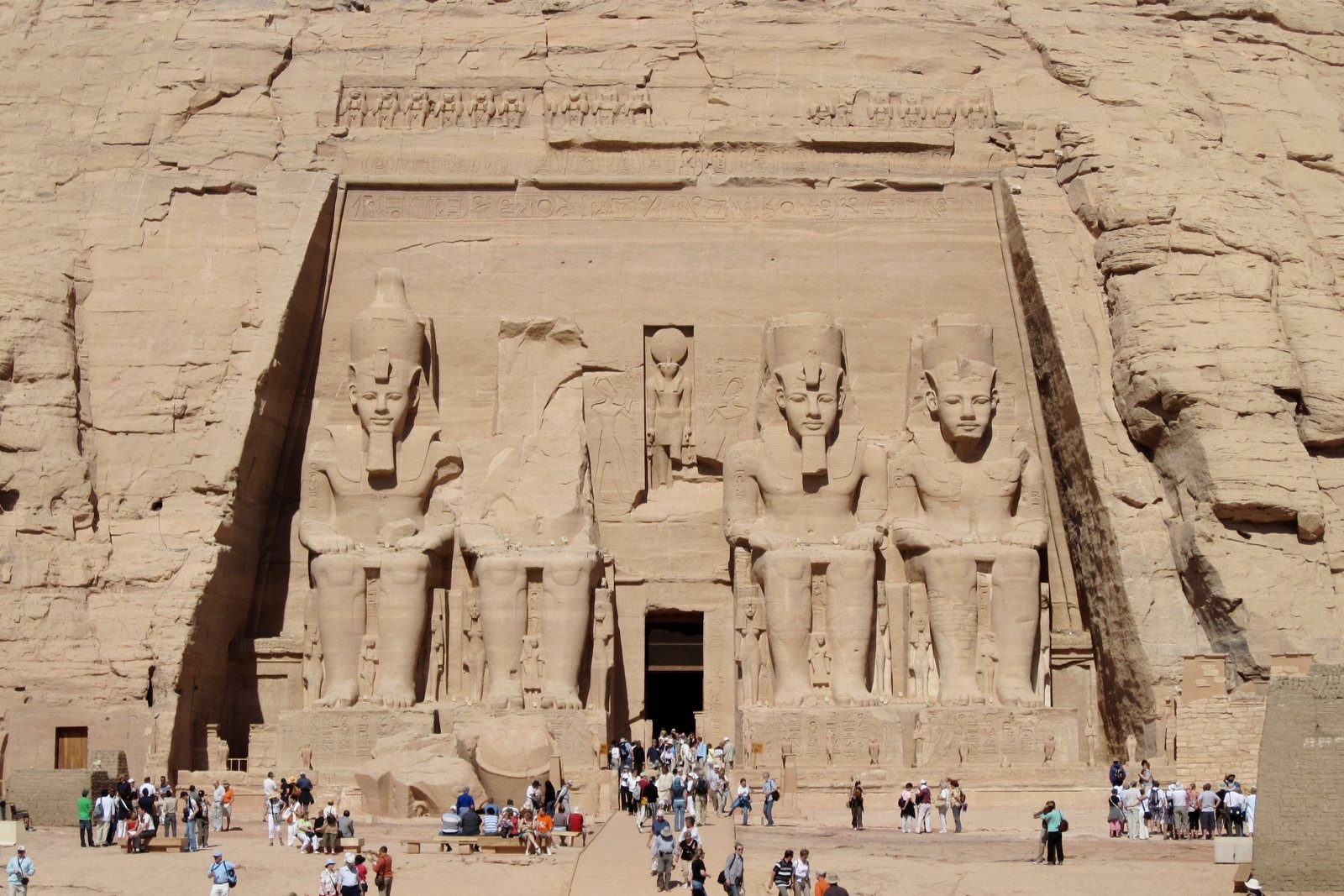
Great Temple facade
Four seated colossi of Ramesses II, each about 20 metres high, around the only entrance. The guide reads the facade as propaganda in stone aimed at Nubia, and the small figures at the colossi's feet show Nefertari and some of their children.
Fallen head of the second colossus
An earthquake, probably in the reign of Ramesses II, broke the upper part of this statue. Paser, Viceroy of Kush, is recorded as restoring it, and the 1960s teams left the fallen head and torso where they were found.
Greek and Carian graffito
Five lines of Greek on the leg of the leftmost colossus record a Nubian expedition under Psammetichus II in the early sixth century BC, left by mercenaries about seven centuries after the temple was carved.
Battle of Kadesh reliefs
Ramesses appears larger than life in his chariot, defeating the Hittites alone. The guide separates that claim from the historical record, which suggests something closer to a draw, and notes the Marriage Stela records a Hittite princess's arrival.
Solar alignment and sanctuary
Around 22 February and 22 October the rising sun travels the 60 to 61 metres of the axis and lights Amun-Re, Ramesses II and Ra-Horakhty. Ptah stays in shadow. The birthday and coronation explanation is called a modern tradition.
Rediscovery by Burckhardt and Belzoni
Burckhardt saw the colossi emerging from sand in March 1813. Belzoni's party removed about 31 feet of sand and entered on 1 August 1817; the guide points out their carved names in the sanctuary.
Artificial hill
More than a thousand numbered blocks were moved, and about 300,000 tons of rubble were placed over reinforced-concrete domes. From behind the facades you can see the hidden structure rather than a natural mountain.
Small Temple of Nefertari and Hathor
Six standing figures, four of Ramesses and two of Nefertari, front a hall of six Hathor-headed pillars. Look for Nefertari crowned by Hathor and Isis, and for Hathor as a cow emerging from the rock in the sanctuary.