Agilkia Island landscaped setting
About 13,000 square metres were added to the coastline to reproduce Philae's shape. After the Aswan Low Dam of 1902, much of the old complex lay under water for about ten months each year.

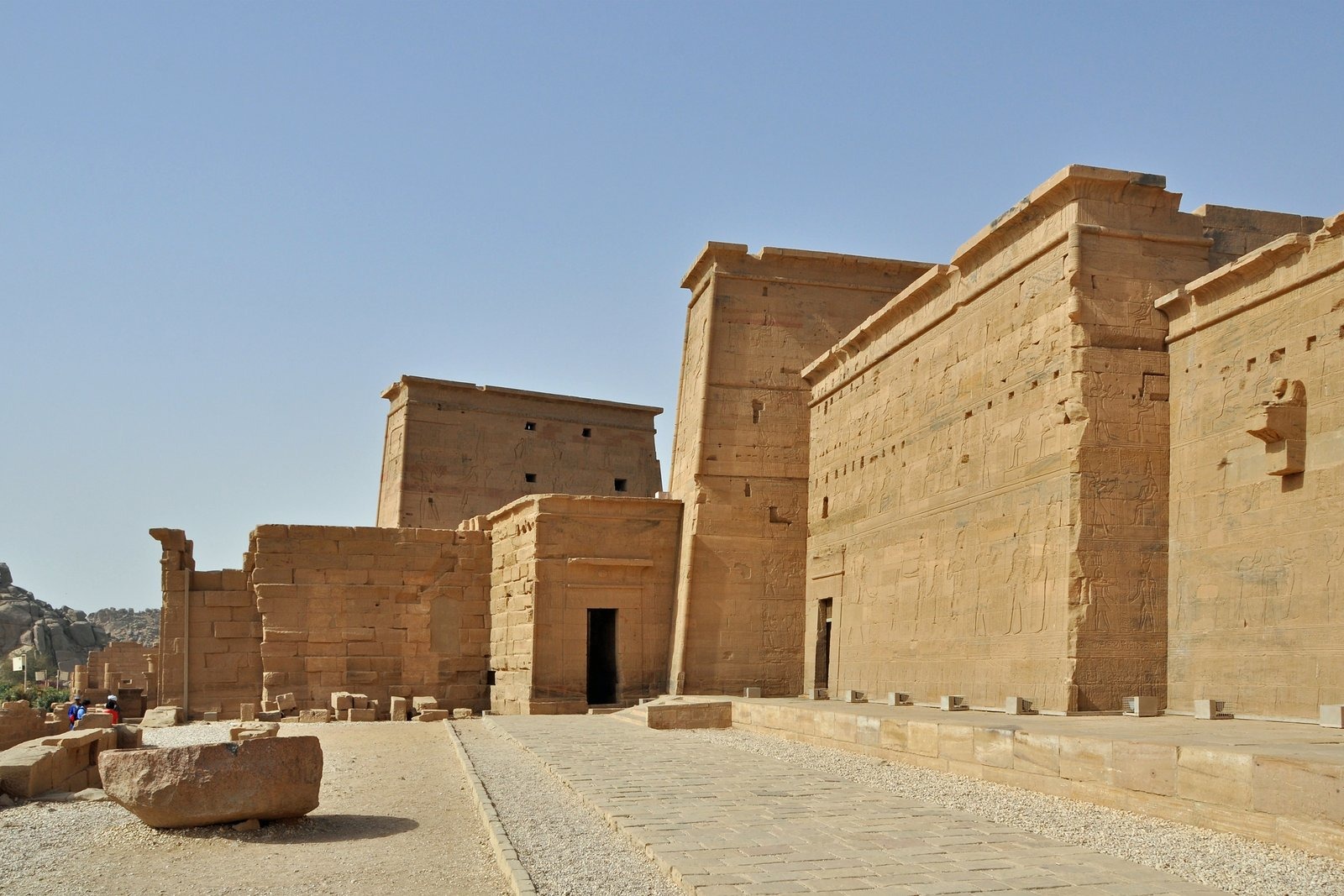
Pylons, colonnades, Osiris chapels and the last dated writing in hieroglyphic and demotic.
Listen to one stop before you buy
Photo: Marc Ryckaert (CC BY 3.0)
The temples of Philae were taken apart and rebuilt on Agilkia Island because the Aswan High Dam threatened to drown them. The guide covers that rescue: Agilkia was blasted, filled and reshaped to copy the original island, and the complex was reassembled from roughly 40,000 blocks between 1972 and 1980.
The tour has 24 stops. It follows the approach from the landing through the colonnades and pylons of the Temple of Isis to the hypostyle hall and sanctuary, then covers Hadrian's gateway, the Osiris chapels, the Nilometer and the outlying temples of Hathor, Augustus and Harendotes. Coptic crosses, Greek and Latin graffiti and two last-dated inscriptions show how long the site stayed in use. The guide plays in your phone's browser, starts each stop by GPS and works offline once downloaded.
About 13,000 square metres were added to the coastline to reproduce Philae's shape. After the Aswan Low Dam of 1902, much of the old complex lay under water for about ten months each year.
Blocks of 2 to 25 tons were moved here. In the sanctuary only the pedestal naming Ptolemy III and Berenice is still in place; the two granite shrines went to Europe, one now in the Louvre and one in Florence.
The ten columns carry papyrus, lotus and palm capitals. Coptic crosses are carved over the older reliefs, a mark of the conversion to a church in the sixth century under Justinian I.
The corridor where Isis's barque set out for Osiris's tomb on Biga. A small Mandulis figure beside the graffito of Esmet-Akhom, dated AD 394, is the last dated hieroglyphic inscription known.
Four open chambers sunk about eight feet into the roof platform showed Osiris's death, burial, mourning and resurrection. The roof is closed to visitors, but the guide describes Isis weeping beside the bier.
A mammisi for the child Horus, about 24 by 10.8 metres, begun under Ptolemy II and III. Its reliefs show Isis suckling Horus, a scene often compared with the Madonna and Child.
Reliefs celebrate Hathor's return from Nubia as the Sun's Eye. Look for Bes playing the harp and tambourine, and apes dancing or playing instruments.
The Augustus temple was commissioned by the prefect Publius Rubrius Barbarus in 13/12 BCE. Nearby, the three-arched Gate of Diocletian may be a triumphal arch or a late fortification; the guide says its function is not secure.
The original island was flooded repeatedly after the Aswan Low Dam of 1902, and the High Dam threatened permanent flooding. UNESCO and the Egyptian authorities moved the monuments to a reshaped Agilkia, rebuilt from roughly 40,000 blocks between 1972 and 1980.
Isis above all, with Osiris, Horus and Hathor. Nubian gods such as Mandulis and Arensnuphis had chapels too, and the Temple of Imhotep was linked with Asklepios. The guide shows a border sanctuary that drew pilgrims from Nubia as well as Egypt.
In the sixth century Justinian I closed the temple of Isis and it became a church. You can still see Coptic crosses carved over older reliefs in the hypostyle hall and around the Second Pylon's central doorway.
It measured the Nile flood. Water entered through an opening at the base and rose against marked steps, and the readings guided taxation, irrigation and grain decisions. The tour points out the stairway beside the Temple of Isis.
Two things. The Esmet-Akhom graffito of AD 394 in Hadrian's gateway is the last dated hieroglyphic inscription known, and a demotic graffito of AD 452 in the Temple of Isis is the last dated demotic text.
No, once you have downloaded the tour. It plays in the phone's browser with no app to install, and GPS starts each stop as you arrive.
More in Egypt: Abu Simbel — Ramesses II's Great Temple and Nefertari's Temple · Edfu — the Temple of Horus · Cairo Citadel — Saladin's Fortress, Muhammad Ali and Sultan Hassan · Coptic Cairo — Babylon Fortress, the Churches and Ben Ezra · Dahshur — Sneferu's Bent and Red Pyramids