Citadel Walls and Towers
Walls about three metres thick, with projecting towers over twenty metres high. The Ramla and Haddad towers controlled the pass to the hills, and the Al-Mattar tower sent pigeon-post messages across Egypt and the Levant.

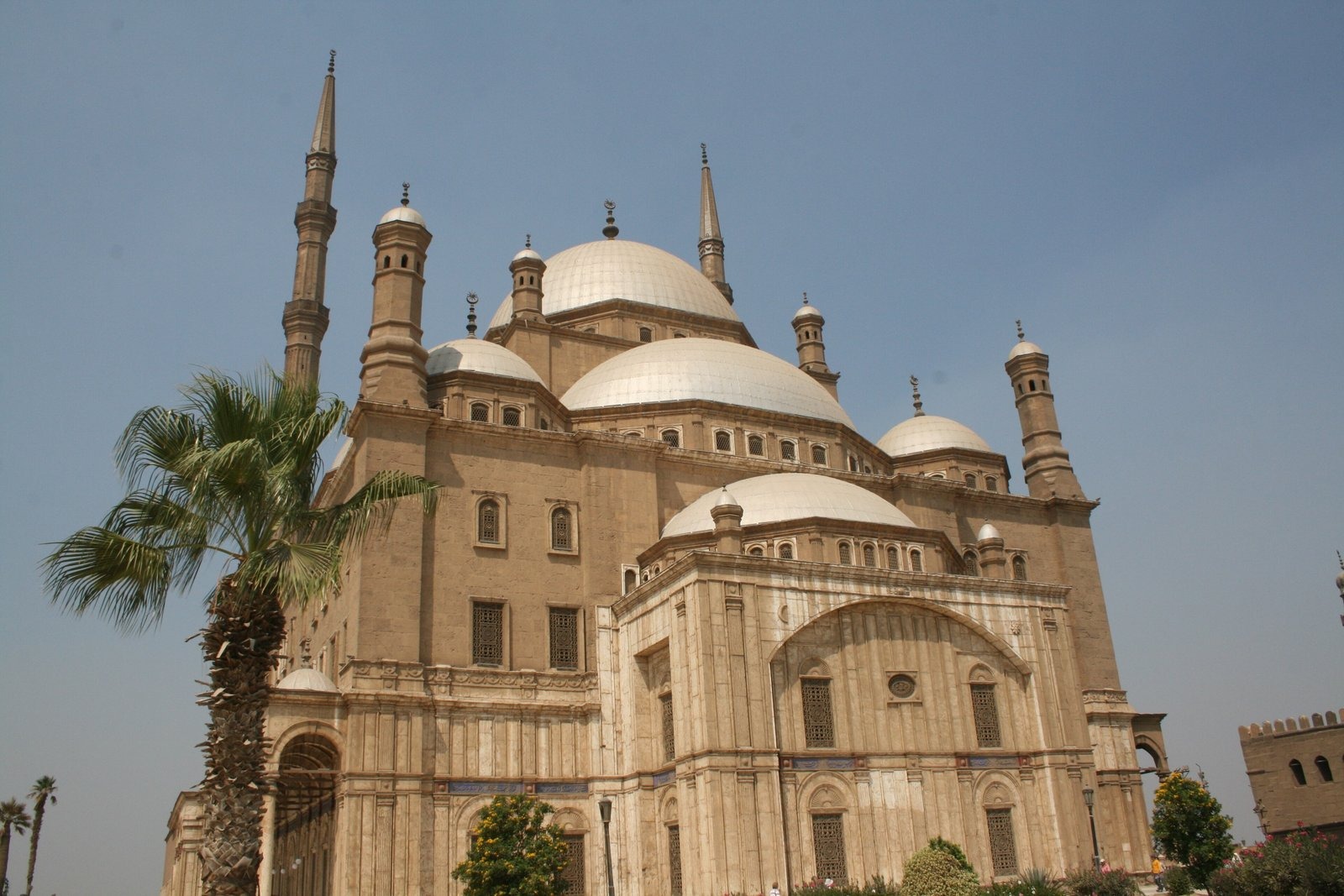
Saladin's fortress, the Mamluk sultan's mosque, Muhammad Ali's palaces and the two great mosques facing each other below.
Listen to one stop before you buy
Photo: Diego Delso (CC BY-SA 3.0)
The Citadel of Cairo was commissioned by Saladin in 1176 on a spur of the Muqattam Hills between Cairo and Fustat, partly to guard against Crusader attacks. For some seven centuries it was the seat of Egyptian government, passing from the Ayyubids to the Mamluks, the Ottomans and Muhammad Ali, who rebuilt much of it after 1805. It opened to the public in 1983.
The tour has 18 stops. It covers the walls and towers, the 85 to 90 metre Joseph's Well, the Mosque of al-Nasir Muhammad, Gawhara Palace and the Alabaster Mosque of Muhammad Ali, three museums, Bab al-Azab where Mamluk leaders were shot in 1811, and, in Salah al-Din Square, the Sultan Hassan Mosque-Madrasa and the al-Rifa'i Mosque. The guide plays in your phone's browser, starts each stop by GPS and works offline once downloaded.
Walls about three metres thick, with projecting towers over twenty metres high. The Ramla and Haddad towers controlled the pass to the hills, and the Al-Mattar tower sent pigeon-post messages across Egypt and the Levant.
A shaft cut through rock to a depth of about 85 to 90 metres, with a double spiral stair so people and oxen never met. The name refers to Saladin, whose birth name was Yusuf, not the biblical Joseph.
The Mamluk royal mosque, begun in 1318 and rebuilt in 1335. Its arcade columns are all different, reused from earlier buildings, and its minarets have unusual garlic-shaped finials.
Begun in 1830 and completed under Said Pasha in 1857, clad in alabaster and modelled on the royal mosques of Istanbul. Muhammad Ali's tomb is inside, and the courtyard clock, a gift from Louis-Philippe in exchange for the Luxor obelisk, is well known for not working.
Built or rebuilt in 1754. On 1 March 1811 Muhammad Ali's guests were shot from above as they left through the narrow passage; the usual count is some 470 Mamluk leaders killed.
The striped palace of 1313 to 1314, named for its black and ochre courses of stone. Only a platform and two damaged vaulted halls remain, so the guide reconstructs it from texts and excavation.
Built between 1356 and 1363 with four madrasas for the four Sunni legal schools around a courtyard of four iwans. The mausoleum chamber behind the qibla wall contains the tombs of the sultan's sons.
Opened in 1912 as a deliberate match for its Mamluk neighbour across the square. It is described as the first use of cement in an Islamic monument in Egypt, and it holds royal burials and the tomb of the last Shah of Iran.
Saladin commissioned it in 1176, with the amir Qaraqush starting the work. His own works ran to about 1183, al-Adil added towers by 1207 and in 1218 Sultan al-Kamil made it the royal residence. Later rulers kept rebuilding it.
Muhammad Ali Pasha invited Mamluk leaders to a celebration in the Citadel. As they left through the narrow passage the gates were closed and Albanian troops fired from above, ending Mamluk political power. The Police Museum terrace looks down over the lane.
Its limestone body is clad in alabaster inside and out. It was designed in the style of royal Ottoman mosques in Istanbul, by Yusuf Bushnaq, and construction ran from 1830 to 1848, with Said Pasha completing it in 1857.
Yes. The guide describes the National Military Museum in the former Harem Palace, the Police Museum with its six halls, and the Carriage Museum with eight official carriages, so you can decide which to enter.
Both. Sultan Hassan is a Mamluk complex of 1356 to 1363, and al-Rifa'i, finished in 1912, was built to match it in scale and height. The guide describes the interiors of each.
Yes, once downloaded. It plays in the phone's browser with no app to install, and GPS starts each stop as you arrive.
More in Egypt: Abu Simbel — Ramesses II's Great Temple and Nefertari's Temple · Philae — the Temple of Isis on Agilkia Island · Edfu — the Temple of Horus · Coptic Cairo — Babylon Fortress, the Churches and Ben Ezra · Dahshur — Sneferu's Bent and Red Pyramids