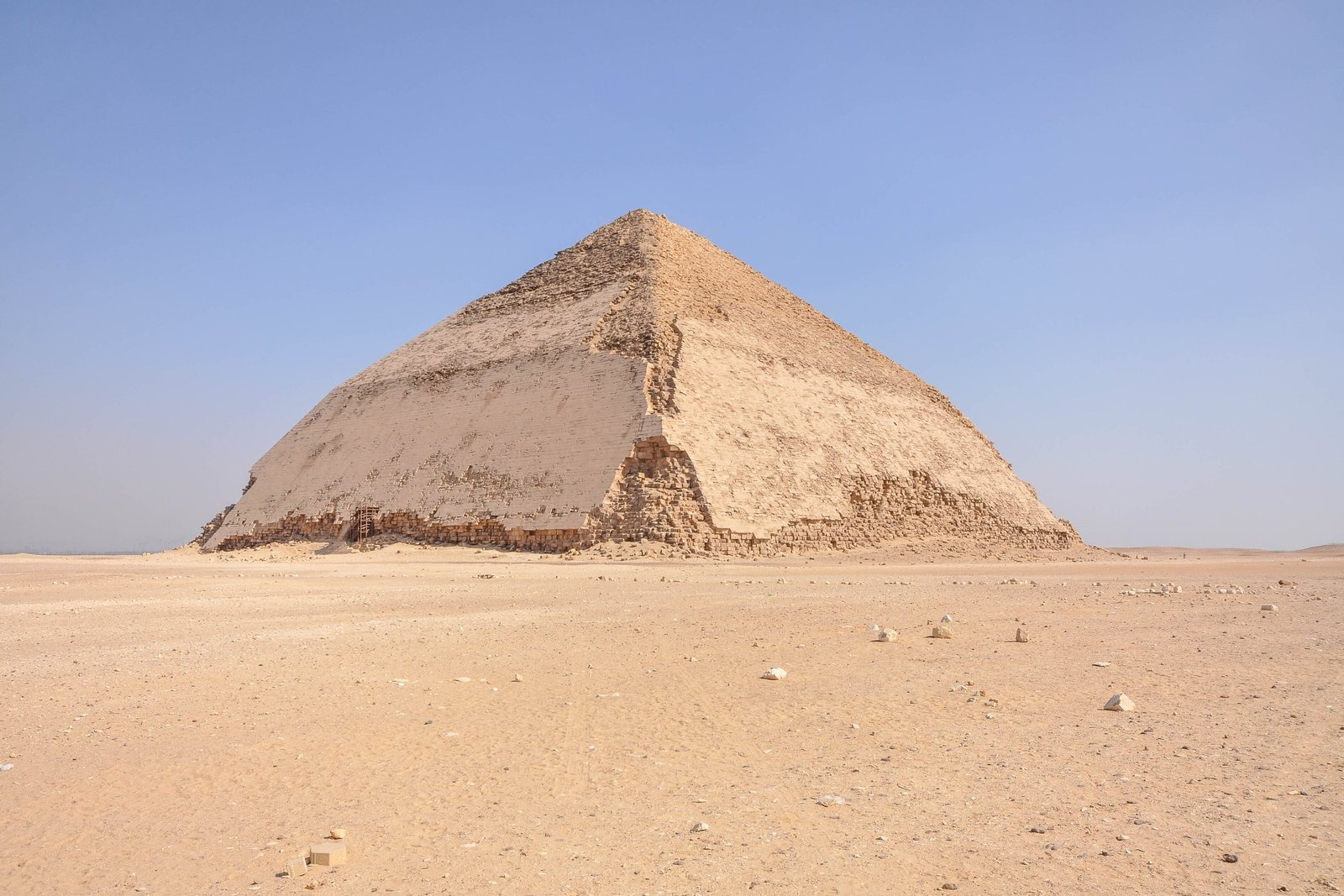
Bent Pyramid
The slope changes from about 54 degrees to 43 to 45 degrees at around 47 to 49 metres up. The bend is usually linked to instability during construction, but the guide says the reasons are still debated. Much of the Tura limestone casing survives.
Inside the Bent Pyramid
Two entrances, corbelled ceilings and original cedar beams in the chambers. It reopened in 2019 for the first time since 1965, with lighting and wooden ramps along the 79-metre northern passage.
Red Pyramid
Built with a lower, consistent slope. Work-gang marks on casing blocks suggest building began around the thirtieth year of Sneferu's reign and took ten to seventeen years. Some scholars see one program rather than a repair of a failure.
Inside the Red Pyramid
A passage of about 62 metres leads to three chambers. You can count eleven corbelled layers in the first, and the third chamber rises about 15 metres and runs east to west, unlike the first two.
Bent Pyramid valley temple
Excavated by Ahmed Fakhry between 1951 and 1955, and described as the oldest decorated pyramid temple known. Relief fragments show Sneferu's estates and villages as female figures carrying offerings.
Bent Pyramid causeway and satellite pyramid
A limestone causeway about 700 metres long ran to the valley temple. The small satellite pyramid, 55 metres south of the main one, was probably meant for a statue housing the king's ka.
Pyramid of Senusret III
A ruined mud-brick mound with a west-side entrance. Jacques de Morgan found a gallery for princesses with eight burial chambers in 1894 to 1895, and Queen Weret's jewelry cache was found in 1994.
Black Pyramid
Built for Amenemhat III around 1860 BC on unstable clay ground, with a mudbrick core, and now a dark, eroded ruin closed to visitors. Its basalt capstone, found in 1900, is in the Egyptian Museum.