Great Pylon
About 36 metres high, finished in 57 BCE, with four storeys of rooms in its towers and four slots for flagpoles. The guide points out Ptolemy XII gripping enemies by the hair before Horus.

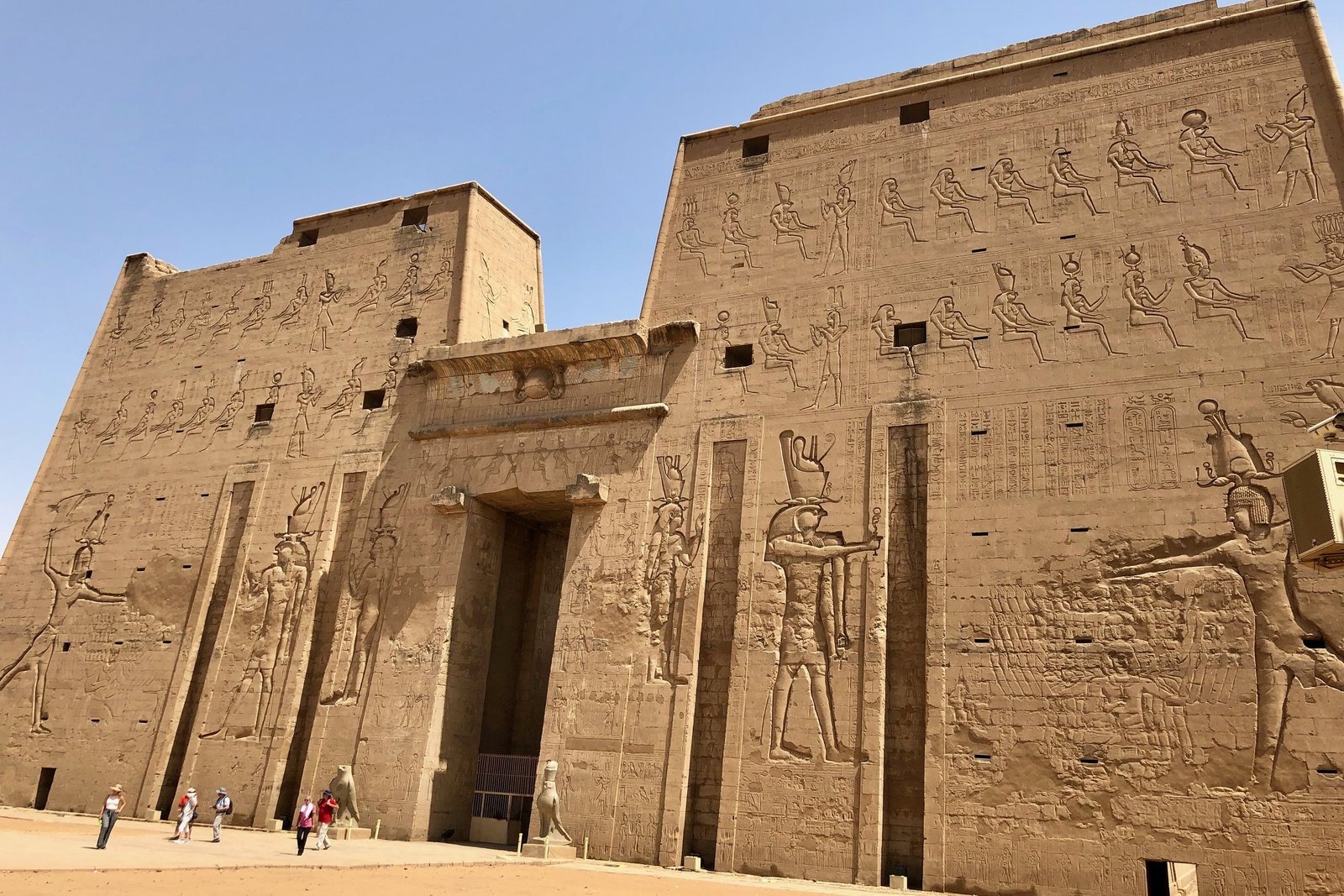
A Ptolemaic temple on the Nile's west bank, read room by room from pylon to enclosure wall.
Listen to one stop before you buy
The Temple of Horus at Edfu was begun under Ptolemy III Euergetes in 237 BCE and stood largely complete when it was excavated by Auguste Mariette in the 1860s. It replaced an earlier Horus temple that faced east toward the river; the new one was turned to a north-south axis. The guide draws on the building's own inscriptions, which record dates, room names and what each space was for.
The tour has 21 stops. They run from the mammisi and the 36-metre Great Pylon through the court and the columned halls to the library, the perfume laboratory and the sanctuary, then up the roof stairs, around the ambulatory and out to the Nilometer and the mound of the ancient town. The guide plays in your phone's browser, starts each stop by GPS and works offline once downloaded.
About 36 metres high, finished in 57 BCE, with four storeys of rooms in its towers and four slots for flagpoles. The guide points out Ptolemy XII gripping enemies by the hair before Horus.
Thirty-two columns surround the court where the Feast of the Joyous Union played out: a fifteen-day festival for the marriage of Horus of Edfu and Hathor of Dendera, whose statue arrived by boat.
The House of Books has its catalogue of scrolls carved in the wall. The Laboratory's walls hold recipes for incense, oils and unguents rather than prayers.
At the New Year festival the image of Horus received offerings here, went up one stair to the roof for the sun's renewing light and came down the other. The stairways are now closed.
A single block of dark granite kept from an earlier temple, with the king's name in its cartouches. In front stands a modern gilded replica of Horus's sacred barque with falcon heads at both ends.
The passage around the temple carries Isis hiding the infant Horus in the Delta marshes and Horus spearing Seth as a hippopotamus. Thirteen side chapels ring the sanctuary.
A circular well outside the east wall, reached by a sloping stair carved with scales. It supplied purification water and let priests track the annual flood.
A tell rising 10 to 15 metres west of the temple, with occupation from about 2450 BCE. The Tell Edfu Project, begun in 2001, has found silos, an elite cemetery and an Old Kingdom quarter.
Ptolemy III Euergetes began the present temple in 237 BCE, and the Great Pylon was finished in 57 BCE under Ptolemy XII. The Edfu building inscription records the pronaos finished in 124 BCE and the sanctuary and inner rooms in 142 BCE.
A fifteen-day festival marking the sacred marriage of Horus of Edfu and Hathor of Dendera. Hathor's statue came by boat from Dendera, and her arrival started the celebrations in the Peristyle Court, whose walls show festival scenes.
It was buried for centuries, with only the tops of the pylons showing. A French expedition identified the site in 1798, and Auguste Mariette's excavations in the 1860s exposed the temple largely intact.
Texts and scenes on the ambulatory walls about the conflict between Horus and Seth. One relief shows Horus spearing Seth in the form of a hippopotamus. The ambulatory stop explains how they served as a guide to the temple's myths.
Partly. The granite naos was kept from an earlier building and carries Nectanebo II's name. The barque in front of it is a modern replica. The original wooden doors of the naos are gone.
No, once you have downloaded the tour. It plays in the phone's browser with no app to install, and GPS starts each stop as you arrive.
More in Egypt: Abu Simbel — Ramesses II's Great Temple and Nefertari's Temple · Philae — the Temple of Isis on Agilkia Island · Cairo Citadel — Saladin's Fortress, Muhammad Ali and Sultan Hassan · Coptic Cairo — Babylon Fortress, the Churches and Ben Ezra · Dahshur — Sneferu's Bent and Red Pyramids