Babylon Fortress
Round Roman towers in red brick and stone, with reused stones from Pharaonic temples. The guide traces the Trajanic harbour and canal, the Diocletian fortress and the Arab siege that ended Byzantine control.

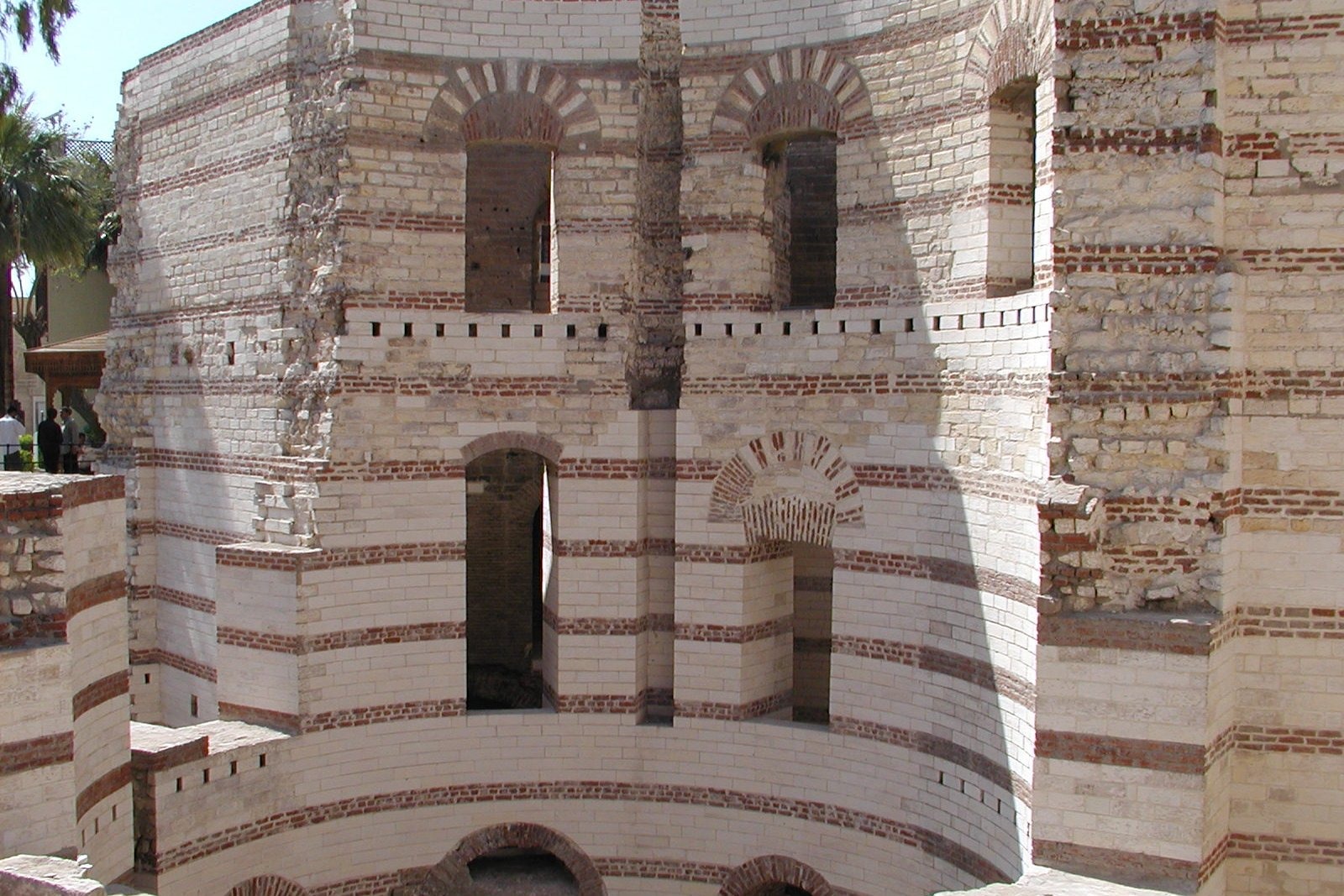
Churches, a synagogue and the first Islamic capital of Egypt, built over and around the walls of Babylon.
Listen to one stop before you buy
Photo: Néfermaât (CC BY-SA 2.5)
Coptic Cairo grew inside and on top of the Roman fortress of Babylon, which stood at the mouth of the Amnis Traianus canal and is attributed to Diocletian, around 300 CE. The Hanging Church sits over the southern gate, the Greek Orthodox church of St George stands on a round tower, and the Arab army besieged the garrison for about seven months before Egypt changed hands.
The tour has 14 stops. They include the fortress remains, the Coptic Museum, the Church of Saints Sergius and Bacchus with the Abu Serga crypt, the churches of St Barbara, St Mercurius and the Virgin al-Damshiriya, and the Convent of St George. Ben Ezra Synagogue and the Cairo Geniza are covered, then Fustat, founded in 641 CE, and the Mosque of Amr ibn al-As. The guide plays in your phone's browser, starts each stop by GPS and works offline once downloaded.
Round Roman towers in red brick and stone, with reused stones from Pharaonic temples. The guide traces the Trajanic harbour and canal, the Diocletian fortress and the Arab siege that ended Byzantine control.
Built directly over the fortress's southern gatehouse, with foundations of palm logs. Rebuilt between 975 and 978, it was a patriarchal residence for roughly six centuries, and a cut-out in the floor shows the Roman Water Gate below.
A small vaulted chamber about ten metres below the church floor, linked by tradition to the Holy Family. The guide says plainly that this is a devotional tradition, and that groundwater means access varies.
Rebuilt between 1889 and 1892, with an upper room that held discarded manuscripts. Fragments from the tenth to twelfth centuries now sit in sixty or seventy collections worldwide, including major holdings at Cambridge.
One of very few round churches in Egypt, built on the northern Roman tower after a fire in 1904 and finished in 1909. A barred staircase descends into the tower beneath.
Set about one and a half metres below the lane, originally dedicated to the physician-martyrs Cyrus and John. It holds relics venerated as Saint Barbara's and a medieval ten-column ambo rebuilt in 1911.
Rebuilt in the 970s after being used as a sugar-cane store. Forty-seven bishops met here in 1080 to establish Coptic canons, and its twelfth-century ebony iconostasis is inlaid with ivory.
The first capital founded after the conquest, laid out in 641 CE. You see low reconstructed walls of houses, baths and streets, and the mosque, rebuilt in 1796 by Murad Bey, that began as palm columns and mud brick.
A Roman military fortress at the mouth of the Amnis Traianus canal, controlling the river and the eastern desert road. Archaeological work attributes the large surviving fortress to Diocletian, around 300 CE, on earlier works of Trajan.
It was built directly over the southern gatehouse of the fortress, above two large towers, so it seems to hang over the passage. A cut-out in the floor lets you look down at the Roman Water Gate.
A room above Ben Ezra Synagogue where worn-out manuscripts were stored instead of discarded. The fragments date mainly from the tenth to twelfth centuries and include legal records, letters and literary works. They reached scholars in the 1890s and were mostly taken to Cambridge.
No. The crypt and the nearby well are described as traditions, and the guide says the crypt's identification as a shelter is a devotional tradition rather than a documented original function.
Yes. Ben Ezra Synagogue, the Cairo Geniza, Fustat and the Mosque of Amr ibn al-As are stops, so you hear how Roman, Coptic, Jewish and early Islamic Cairo overlap.
No, once the tour is downloaded. It plays in the phone's browser with no app to install, and GPS starts each stop as you arrive.
More in Egypt: Abu Simbel — Ramesses II's Great Temple and Nefertari's Temple · Philae — the Temple of Isis on Agilkia Island · Edfu — the Temple of Horus · Cairo Citadel — Saladin's Fortress, Muhammad Ali and Sultan Hassan · Dahshur — Sneferu's Bent and Red Pyramids